
Judge, 1937-11 · page 9 of 36
Judge — November 1937 — page 9: what you’re looking at
What you’re looking at
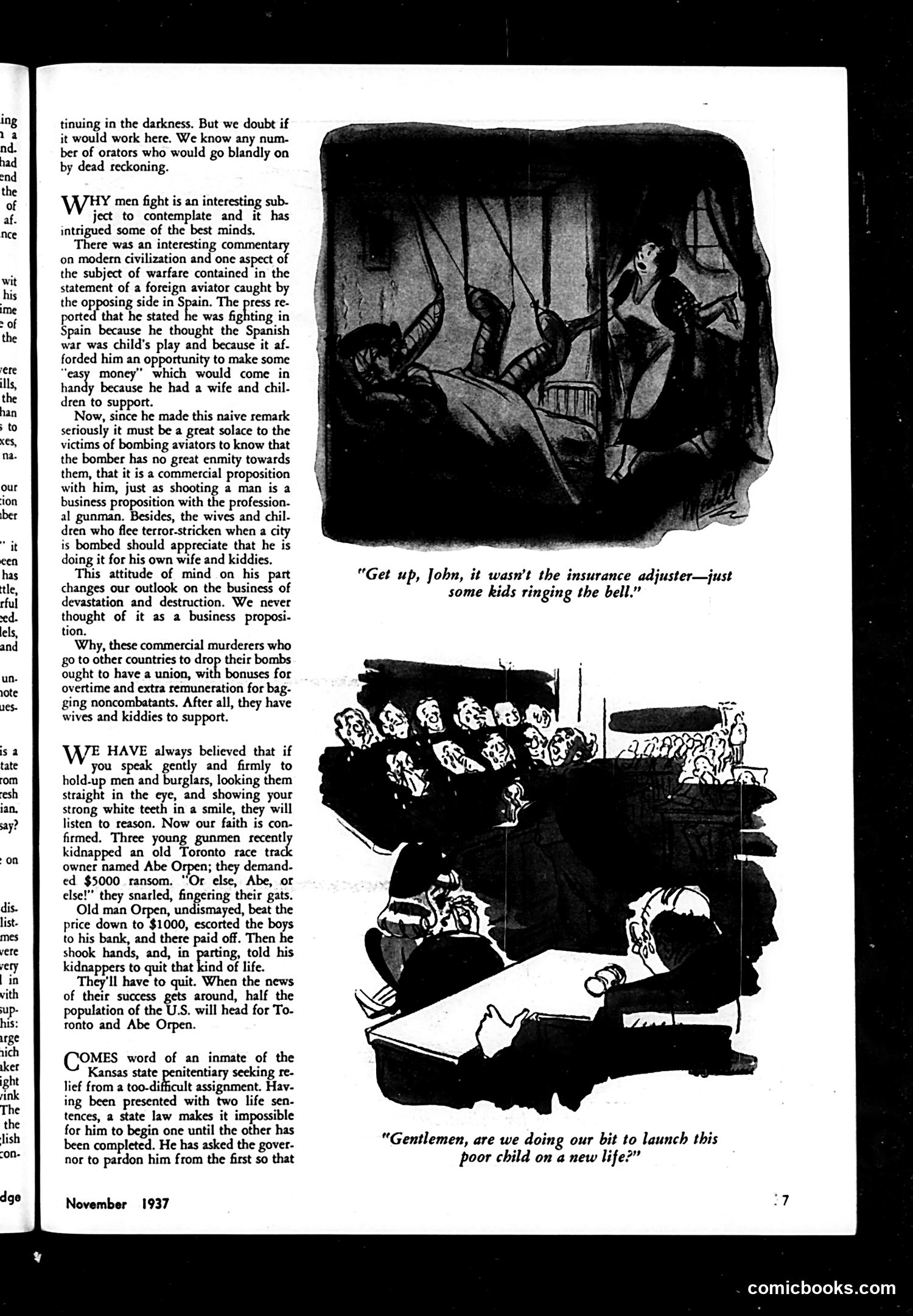
# Analysis of Judge Magazine Page, November 1937 This page contains two satirical cartoons critiquing wartime profiteering and callousness toward human suffering. The **upper cartoon** mocks an insurance adjuster's indifference to bombing casualties—he dismisses children ringing a doorbell as mere "insurance adjuster" business rather than victims needing help. The **lower cartoon** depicts wealthy businessmen discussing launching "this poor child on a new life," suggesting cynical exploitation of orphans or war refugees for profit rather than genuine charity. The accompanying text criticizes "commercial murderers"—arms dealers and bombers who treat warfare as business. It argues they should unionize for hazard pay, sarcastically suggesting bombing civilians is morally equivalent to any other profession. The overall message: war profiteers show no humanity toward victims, viewing devastation purely as financial opportunity.
📄 Transcribed text from this page (OCR, searchable)
Machine-transcribed from the original scan — historical spelling and the odd misread are preserved.
tinuing in the darkness. But we doubt if it would work here. We know any num- ber of orators who would go blandly on by dead reckoning. WHY men fight is an interesting sub- ject to contemplate and it has intrigued some of the best minds. There was an interesting commentary on modern civilization and one aspect of the subject of warfare contained in the statement of a foreign aviator caught by the opposing side in Spain. The press re- ported that he stated he was fighting in Spain because he thought the Spanish war was child's play and because it af- forded him an opportunity to make some “easy money” which would come in handy because he had a wife and chil- dren to support. Now, since he made this naive remark seriously it must be a great solace to the victims of bombing aviators to know that the bomber has no great enmity towards them, that it is a commercial proposition with him, just as shooting a man is a business proposition with the profession- al gunman. Besides, the wives and chil- dren who flee terror-stricken when a city is bombed should appreciate that he is doing it for his own wife and kiddies. This attitude of mind on his part changes our outlook on the business of devastation and destruction. We never thought of it as a business proposi- tion. Why, these commercial murderers who go to other countries to drop their bombs ought to have a union, with bonuses for overtime and extra remuneration for bag- ging noncombatants. After all, they have wives and kiddies to support. WE HAVE always believed that if you speak gently and firmly to hold-up men and burglars, looking them straight in the eye, and showing your strong white teeth in a smile, they will listen to reason. Now our faith is con- firmed. Three young gunmen recently kidnapped an old Toronto race tra owner named Abe Orpen; they demand- ed $5000 ransom. “Or else, Abe, or else!" they snarled, fingering their gats. Old man Orpen, undismayed, beat the price down to $1000, escorted the boys to his bank, and there paid off. Then he shook hands, and, in parting, told his kidnappers to quit that kind of life. They'll have to quit. When the news of their success gets around, half the population of the U.S. will head for To- ronto and Abe Orpen. (COMES word of an inmate of the Kansas state penitentiary seeking re- lief from a too-difficult assignment. Hav- ing been presented with two life sen- tences, a state law makes it impossible for him to begin one until the other has been completed. He has asked the gover- nor to pardon him from the first so that November 1937 “Get up, John, it wasn't the insurance adjuster—just some kids ringing the bell.” “Gentlemen, are we doing our bit to launch this poor child on a new life?” comicbooks.com