
Judge, 1937-11 · page 19 of 36
Judge — November 1937 — page 19: what you’re looking at
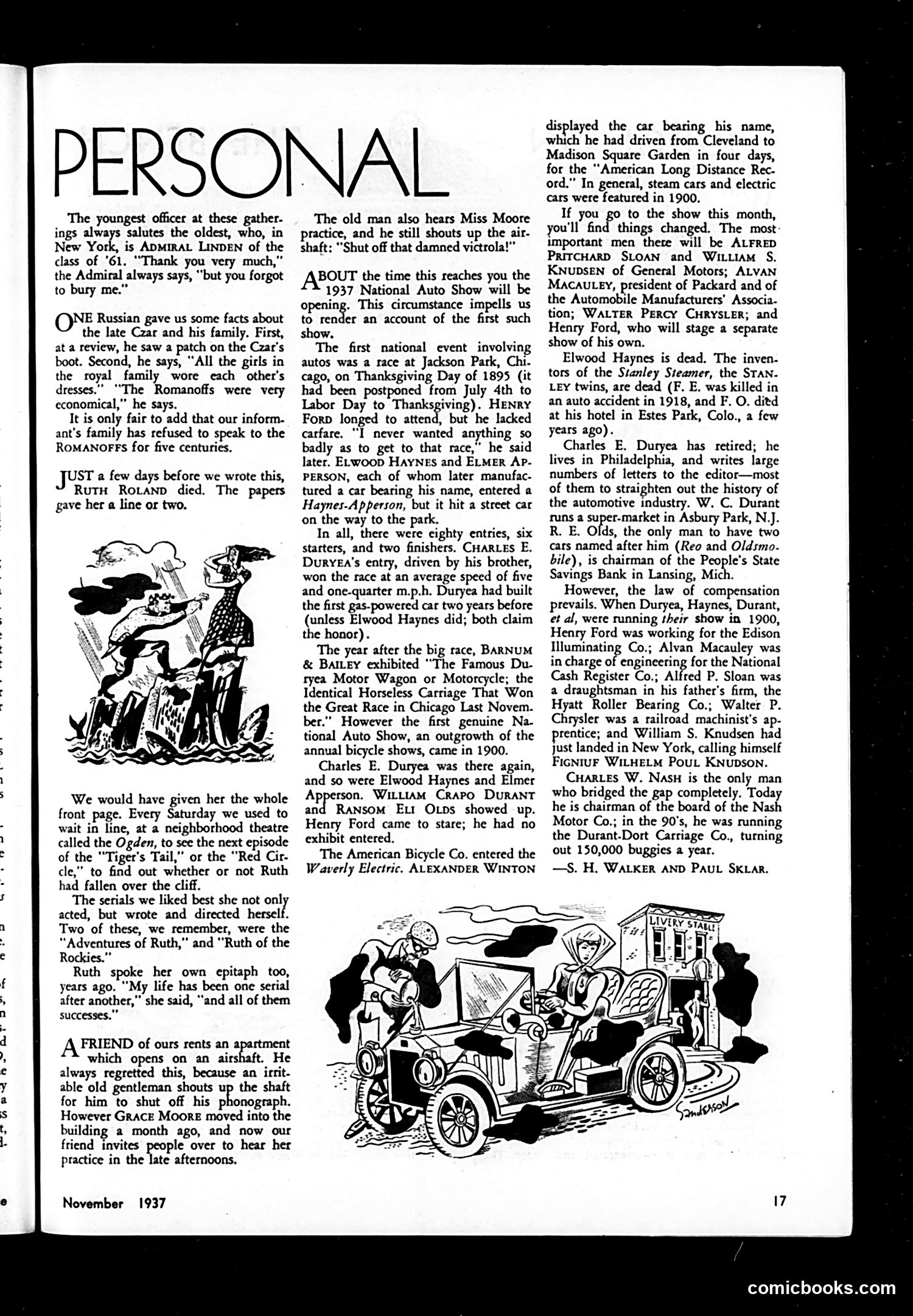
A restored page from Judge, 1937-11. Page through the whole issue in the reader above.
📄 Transcribed text from this page (OCR, searchable)
Machine-transcribed from the original scan — historical spelling and the odd misread are preserved.
PERSONAL The youngest officer at these gather- ings aie Slates the oldest, who, in New York, is ADMIRAL LINDEN of the class of 61, “Thank you very much,” the Admiral always says, “but you forgot to bury me.” ONE Russian gave us some facts about the late Czar and his family. First, at a review, he saw a patch on the Czar's boot. Second, he says, “All the girls in the royal family wore each other's dresses.” “The Romanoffs were very economical,” he says. It is only fair to add that our inform. ant’s family has refused to speak to the RomanorfFs for five centuries. Just a few days before we wrote this, RutH Rotanp died. The papers gave her a line or two. We would have given her the whole front page. Every Saturday we used to wait in line, at a neighborhood theatre called the Ogden, to see the next episode of the “Tiger's Tail,” or the “Red Cir- cle,” to find out whether or not Ruth had fallen over the cliff. The serials we liked best she not onl) acted, but wrote and directed herself. Two of these, we remember, were the “Adventures of Ruth,” and “Ruth of the Rockies.” Ruth spoke her own epitaph too, years ago. “My life has been one serial after another,” she said, “and all of them AFRIEND of ours rents an apartment which opens on an airs He always regretted this, because an irrit- able old gentleman shouts up the shaft for him to shut off his phonograph. However GRACE Moore moved into the building a month ago, and now our friend invites people over to hear her practice in the late afternoons. November 1937 The old man also hears Miss Moore practice, and he still shouts up the air- shaft: “Shut off that damned victrola!”’ BOUT the time this reaches you the 1937 National Auto Show will be opening. This circumstance impells us to render an account of the first such show. The first national event involving autos was a race at Jackson Park, Chi. cago, on Thanksgiving Day of 1895 (it had been postponed from July 4th to Labor Day to Thanksgiving). HENRY Forp longed to attend, but he lacked carfare. “I never wanted anything so badly as to get to that race,” he said later. E.woop HayNes and ELMER AP- PERSON, each of whom later manufac- tured a car bearing his name, entered a Haynes-Apperson, but it hit a street car on the way to the park. In all, there were eighty entries, six starters, and two finishers. CHARLES E. DuryeEa’s entry, driven by his brother, won the race at an average speed of five and one-quarter m.p.h. Duryea had built the first gas-powered car two years before (unless Elwood Haynes did; both claim the honor). The year after the big race, BARNUM & BAILEY exhibited “The Famous Du- ryea Motor Wagon or Motorcycle; the Identical Horseless Carriage That Won the Great Race in Chicago Last Novem. ber.” However the first genuine Na- tional Auto Show, an outgrowth of the annual bicycle shows, came in 1900. Charles E, Duryea was there again, and so were Elwood Haynes and Elmer Appenots Wittiam Crapo Durant and Ransom Ext Oxps showed up. Henry Ford came to stare; he had no exhibit entered. The American Bicycle Co. entered the Waverly Electric. ALEXANDER WINTON displayed the car bearing his name, which he had driven from Cleveland to Madison Square Garden in four days, for the “American Long Distance Rec- ord.” In general, steam cars and electric cars were featured in 1900. If you to the show this month, you'll find things changed. The most- important men there will be ALFRED PRITCHARD SLOAN and WituaM S. KNupsen of General Motors; ALVAN MACAULEY, president of Packard and of the Automobile Manufacturers’ Associa- tion; WALTER Percy CHRYSLER; and Henry Ford, who will stage a separate show of his own. Elwood Haynes is dead. The inven- tors of the Stanley Steamer, the STAN. LEY twins, are dead (F. E, was killed in an auto accident in 1918, and F. O. ditd at his hotel in Estes Park, Colo., a few years ago). Charles E. Duryea has retired; he lives in Philadelphia, and writes large numbers of letters to the editor—most of them to straighten out the history of the automotive industry. W. C. Durant runs a sures market in Asbury Park, N.J. R. E. Olds, the only man to have two cars named after him (Reo and Oldsmo- bile), is chairman of the People’s State Savings Bank in Lansing, Mich. However, the law of compensation prevails. When Duryea, Haynes, Durant, et al, were running their show in 1900, Henry Ford was working for the Edison Illuminating Co.; Alvan Macauley was in charge of, engineering for the National Cash Register Co.; Alfred P. Sloan was a draughtsman in his father’s firm, the Hyatt Roller Bearing Co.; Walter P. Chrysler was a railroad machinist's ap- prentice; and William S. Knudsen had just landed in New York, calling himself FicNtuF WILHELM Pout KNupson. Cxares W. Nasu is the only man who bridged the gap completely. Today he is chairman of the board of the Nash Motor Co.; in the 90's, he was running the Durant-Dort Carriage Co., turning out 150,000 buggies a year. —S. H. WALKER AND PAUL SKLAR. comicbooks.com