
Judge, 1937-10 · page 20 of 36
Judge — October 1937 — page 20: what you’re looking at
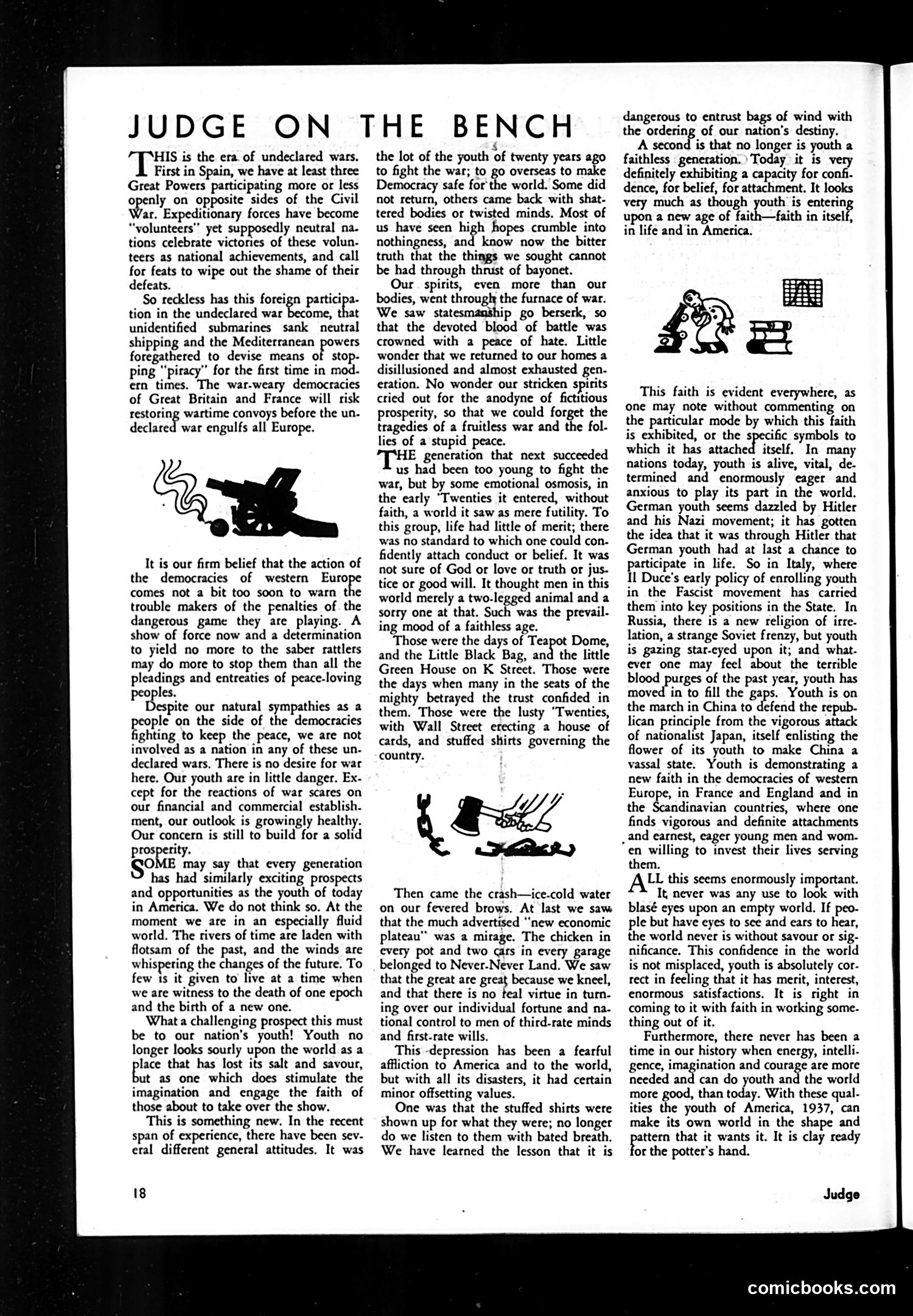
A restored page from Judge, 1937-10. Page through the whole issue in the reader above.
📄 Transcribed text from this page (OCR, searchable)
Machine-transcribed from the original scan — historical spelling and the odd misread are preserved.
JUDGE ON THE BENCH TES is the era of undeclared wars. First in Spain, we have at least three Great Powers participating more or less openly on opposite sides of the Civil ‘ar. Expeditionary forces have become “volunteers” yet sup lly neutral na- tions celebrate victories of these volun- teers as national achievements, and call for feats to wipe out the shame of their cna , So reckless has this foreign participa- tion in the undeclared war fee hat unidentified submarines sank neutral shipping and the Mediterranean powers foregathered to devise means of stop- ping “piracy” for the first time in mod- ern times. The war-weary democracies of Great Britain and France will risk restoring wartime convoys before the un. declared war engulfs all Europe. It is our firm belief that the action of the democracies of western Euro comes not a bit too soon to warn the trouble makers of the penalties of the dangerous game they are playing. A show of force now and a determination to yield no more to the saber rattlers may do more to stop them than all the pleadings and entreaties of peace-loving peoples. espite our natural sympathies as a people on the side of the democracies fighting to keep the peace, we are not involved as a nation in any of these un- declared wars. There is no desire for war here, Our youth are in little danger. Ex- cept for the reactions of war scares on our financial and commercial establish. ment, our outlook is growingly healthy. Our concern is still to build for a solid rosperity. F OME may say that every generation has had simularly exciting prospects and opportunities as the youth of today in America. We do not think so. At the moment we are in an especially fluid world. The rivers of time are laden with flotsam of the past, and the winds are whispering the changes of the future. To few ts it given to live at a time when we are witness to the death of one epoch and the birth of a new one. What a challenging prospect this must be to our nation’s youth! Youth no longer looks sourly upon the world as a lace that has lost its salt and savour, ut as one which does stimulate the imagination and engage the faith of those about to take over the show. This is something new. In the recent span of experience, there have been sev- eral different general attitudes. It was 18 $ the lot of the youth of twenty years a, to fight the war; to go overseas to m: Democracy safe for'the world. Some did not return, others came back with shat- tered bodies or twisted minds. Most of us have seen high hopes crumble into nothingness, and know now the bitter truth that the things we sought cannot be had through thrust of bayonet. Our spirits, even more than our bodies, went through the furnace of war. We saw statesmanthip go berserk, so that the devoted blood of battle was crowned with a peace of hate. Little wonder that we returned to our homes a disillusioned and almost exhausted gen- eration. No wonder our stricken spirits cried out for the anodyne of fictitious prosperity, so that we could forget the tragedies of a fruitless war and the fol- lies of a stupid peace. ‘THE generation that next succeeded us had been too young to fight the war, but by some emotional osmosis, in the early "Twenties it entered, without faith, a world it saw as mere futility. To this group, life had little of merit; there was no standard to which one could con- fidently attach conduct or belief. It was not sure of God or love or truth or jus- tice or good will. It thought men in this world merely a two-legged animal and a sorry one at that. Such was the prevail- ing mood of a faithless age. Those were the days of Tea) Dome, and the Little Black Bag, and the little Green House on K Street. Those were the days when many in the seats of the mighty betrayed the trust confided in them. Those were the lusty ‘Twenties, with Wall Street erecting a house of cards, and stuffed shirts governing the country. Then came the crash—ice-cold water on our fevered brows. At last we saw that the much advertised “new economic plateau” was a mirage. The chicken in every pot and two cars in every garage belonged to Never-Never Land. We saw that the great are great because we kneel, and that there is no teal virtue in turn. ing over our individual fortune and na- tional control to men of third-rate minds and first-rate wills. This -depression has been a fearful affliction to America and to the world, but with all its disasters, it had certain minor offsetting values. One was that the stuffed shirts were shown up for what they were; no longer do we listen to them with bated breath. We have learned the lesson that it is dangerous to entrust bags of wind with the ordering of our nation’s destiny. A second is that no longer is youth a faithless generation. Today it is very definitely exhibiting a capacity for confi- dence, for belief, for attachment. It looks very much as though youth is enterin, upon a new age of faith faith in itself, in life and in America. This faith is evident everywhere, as one may note without commenting on the particular mode by which this faith is exhibited, or the specific symbols to which it has attached itself. In many nations today, youth is alive, vital, de. termined and enormously eager and anxious to play its part in the world. German youth seems dazzled by Hitler and his Nazi movement; it has gotten the idea that it was through Hitler that German youth had at last a chance to participate in life. So in Italy, where Il Duce’s early policy of enrolling youth in the Fascist movement has carried them into key positions in the State. In Russia, there is a new religion of irre. lation, a strange Soviet frenzy, but youth is gazing star-eyed upon it; and what- cree. one ee feel about the terrible irges of the past year, youth has moved 18 1 fill ihe Ba a Youth is on the march in China to defend the repub- lican principle from the vigorous attack of nationalist Japan, itself enlisting the flower of its youth to make China a vassal state. Youth is demonstrating a new faith in the democracies of western Europe, in France and England and in the Scandinavian countries, where one finds vigorous and definite attachments _ and earnest, eager young men and wom. en willing to invest their lives serving them. LL this seems enormously important. It, never was any use to look with blasé eyes upon an empty world. If peo- ple but have eyes to see and ears to hear, the world never is without savour or sig- nificance. This confidence in the world is not misplaced, youth is absolutely cor- rect in feeling that it has merit, interest, enormous satisfactions. It is right in coming to it with faith in working some- thing out of it. Furthermore, there never has been a time in our history when energy, intelli- gence, imagination and courage are more needed and can do youth and the world more good, than today. With these qual- ities the youth of America, 1937, can make its own world in the shape and ttern that it wants it. It is clay ready for the potter’s hand. Judge comicbooks.com