
Judge, 1937-04 · page 4 of 36
Judge — April 1937 — page 4: what you’re looking at
What you’re looking at
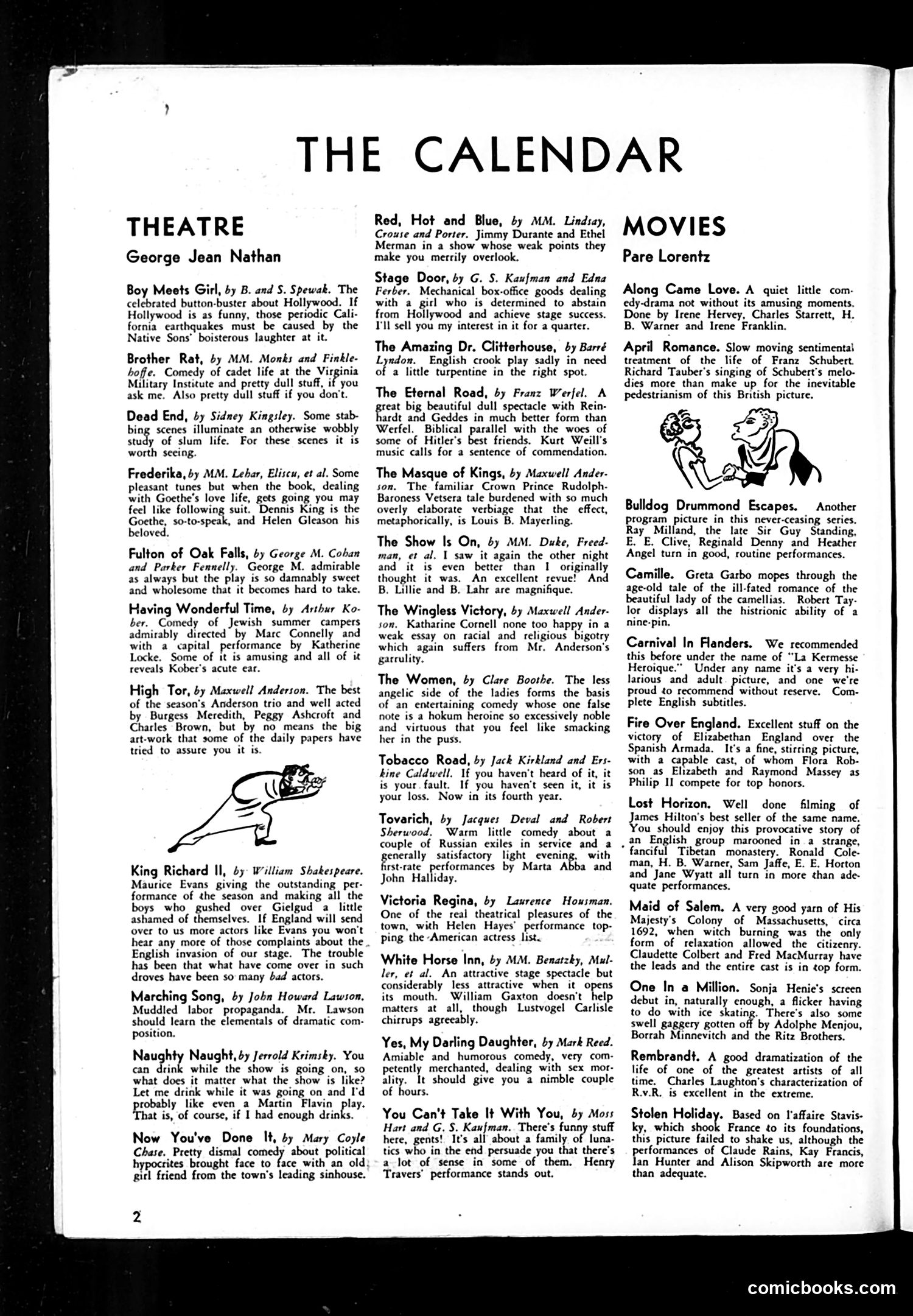
# Analysis of "The Calendar" Page This page is primarily **theater and movie reviews** rather than political satire. It contains critical assessments of Broadway plays (left column) and films (right column), with brief plot summaries and performance evaluations. The only illustration shows **two cartoon figures in casual conversation**—likely representing typical theatergoers or critics discussing a show. This appears decorative rather than satirical. The reviews discuss contemporary productions with performers' names (George Jean Nathan reviewing theater, Pare Lorentz reviewing movies). The tone is lighthearted, evaluating entertainment quality rather than making political points. **No clear political satire or social commentary is evident** on this particular page. It functions as entertainment criticism and promotion typical of Judge magazine's cultural coverage.
📄 Transcribed text from this page (OCR, searchable)
Machine-transcribed from the original scan — historical spelling and the odd misread are preserved.
THE CALENDAR THEATRE George Jean Nathan Boy Meets Girl, by B. and S. Spewak. The celebrated button-buster about Hollywood. If Hollywood is as funny, those periodic Cali- fornia earthquakes must be caused by the Native Sons’ boisterous laughter at it. Brother Rat, by MM. Monks and Finkle- hoffe. Comedy of cadet life at the Virginia Military Institute and pretty dull stuff, if you ask me. Also pretty dull stuff if you don't. Dead End, by Sidney Kingsley. Some stab- bing scenes illuminate an otherwise wobbly study of slum life. For these scenes it is worth seeing. Frederika, by MM. Lebar, Eliscu, et al. Some pleasant tunes but when the book, dealing with Goethe's love life, gets going you may feel like following suit. Dennis King is the Goethe, so-to-speak, and Helen Gleason his beloved. Fulton of Oak Falls, 6y George M. Cohan and Parker Fennelly. George M. admirable as always but the play is so damnably sweet and wholesome that it becomes hard to take. Having Wonderful Time, by Arthur Ko- ber. Comedy of Jewish summer campers admirably directed by Marc Connelly and with a capital performance by Katherine Locke. Some of it is amusing and all of it reveals Kober's acute ear. High Tor, 6y Maxwell Anderson. The best of the season's Anderson trio and well acted by Burgess Meredith, Peggy Ashcroft and Charles Brown, but by no means the big art-work that some of the daily papers have tried to assure you it is. King Richard Il, 67° William Shakespeare. Maurice Evans giving the outstanding per- formance of the season and making all the boys who gushed over Gielgud alittle ashamed of themselves. If England will send over to us more actors like Evans you won't hear any more of those complaints about the English invasion of our stage. The trouble has been that what have come over in such droves have been so many bad actors. Marching Song, y John Howard Lawson, Muddled labor propaganda. Mr. Lawson should learn the elementals of dramatic com- position. Naughty Naught, by Jerrold Krimsky. You can Sin while the show is going on, so what does it matter what the show is like? Let me drink while it was going on and I'd robably like even a Martin Flavin play. at is, of course, if I had enough deinks. Now You've Done It, by Mary Coyle Chase. Pretty dismal comedy about political hypocrites brought face to face with an old; gitl friend from the town’s leading sinhouse. 2 Red, Hot and Blue, by MM. Lindsay, Crouse and Porter. Jimmy Durante and Ethel Merman in a show whose weak points they make you merrily overlook. Stage Door, by G. $. Kaufman and Edna Ferber. Mechanical box-office goods dealing with a girl who is determined to abstain from Hollywood and achieve stage success. F'lll sell you my interest in it for a quarter. The Amazing Dr. Clitterhouse, by Barré Lyndon. English crook play sadly in need of a little turpentine in the right spot. The Eternal Road, 6y Franz Werfel. A reat big beautiful dull spectacle with Rein- farde and Geddes in much better form than Werfel. Biblical parallel with the woes of some of Hitler's best friends. Kurt Weill’s music calls for a sentence of commendation. The Masque of Kings, by Maxwell Ander- son. The familiar Crown Prince Rudolph- Baroness Vetsera tale burdened with so much overly elaborate verbiage that the effect, metaphorically, is Louis B. Mayerling. The Show Is On, 6y MM. Duke, Freed- man, et al. I saw it again the other night and it is even better than I originally thought it was. An excellent revue! And B. Lillie and B. Lahr are magnifique. The Wingless Victory, by Maxwell Ander. son. Katharine Cornell none too happy in a weak essay on racial and religious bigotry which again suffers from Mr. Anderson's garrulity. The Women, by Clare Boothe. The less angelic side of the ladies forms the basis of an entertaining comedy whose one false note is a hokum heroine so excessively noble and virtuous that you feel like smacking her in the puss. Tobacco Road, by Jack Kirkland and Ers- kine Caldwell. If you haven't heard of i is your. fault. If you haven't seen your loss. Now in its fourth year. Tovarich, by Jacques Deval and Robert Sherwood. Warm little comedy about a couple of Russian exiles in service and a generally satisfactory light evening, with first-rate performances by Marta Abba and John Halliday. Victoria Regina, by Laurence Housman. One of the real theatrical pleasures of the town, with Helen Hayes’ performance top- ping the American actress list. White Horse Inn, by MM. Benatzky, Mul- ler, et al. An attractive stage spectacle but considerably les: tractive when it oJ its mouth. William Gaxton doesn’t help matters at all, though Lustvogel Carlisle chirrups agreeably. Yes, My Darling Daughter, by Mark Reed. Amiable and humorous comedy, very com- petently merchanted, dealing with sex mor- Dlity. It should give you a nimble couple of hours. You Can't Take It With You, by Moss Hart and G. S. Kaufman. There's funny stuff here, gents! It’s all about a family of luna- tics who in the end persuade you that there's a lot of sense in some of them. Henry Travers’ performance stands out. MOVIES Pare Lorentz Along Came Love. A quict little com- edy-drama not without its amusing moments. Done by Irene Hervey, Charles Starrett, H. B, Warner and Irene Franklin. April Romance. Slow moving sentimental treatment of the life of Franz Schubert. Richard Tauber's singing of Schubert's melo- dies more than make up for the inevitable pedestrianism of this British picture. Bulldog Drummond Escapes. Another program picture in this never-ceasing series. Ray Milland, the late Sie Guy Standing, E. E. Clive, Reginald Denny and Heather Angel turn in good, routine performances. Camille. Greta Garbo mopes through the age-old tale of the ill-fated romance of the beautiful lady of the camellias. Robert Tay- lor displays all the histrionic ability of a nine-pin, Carnival In Flanders. We recommended this before under the name of “La Kermesse Heroique.” Under any name it's a very hi- larious and adult. picture, and one we're proud to recommend without reserve. Com- plete English subtitles. Fire Over England. Excellent stuff on the victory of Elizabethan England over the Spanish Armada. It’s a fine, stirring picture, with a capable cast, of whom Flora Rob- son as Elizabeth and Raymond Massey as Philip II compete for top honors. Lost Horizon. Well done filming of dunes Hilton's best seller of the same name. ‘ou_should enjoy this provocative story of an English group marooned in a strange, * fanciful Tibetan monastery. Ronald Cole- man, H. B. Warner, Sam Jaffe, E. E. Horton and Jane Wyatt all turn in more than ade- quate performances. Maid of Salem. A very good yarn of His Majesty's Colony of Massachusetts, circa 1692, when witch burning was the only form of relaxation allowed the citizenry. Claudette Colbert and Fred MacMurray have the leads and the entire cast is in top form. One In a Million. Sonja Henie’s screen debut in, naturally enough, a flicker having to do with ice skating. There's also some swell gaggery gotten off by Adolphe Menjou, Borrah Minnevitch and the Ritz Brothers. Rembrandt. A good dramatization of the life of one of the greatest artists of all time. Charles Laughton’s characterization of Rv.R. is excellent in the extreme. Stolen Holiday. Based on I'affaire Stavis- ky, which shook France to its foundations, this picture failed to shake us, although the rformances of Claude Rains, Kay Francis, ian Hunter and Alison Skipworth are more than adequate. comicbooks.com