
Judge, 1937-04 · page 30 of 36
Judge — April 1937 — page 30: what you’re looking at
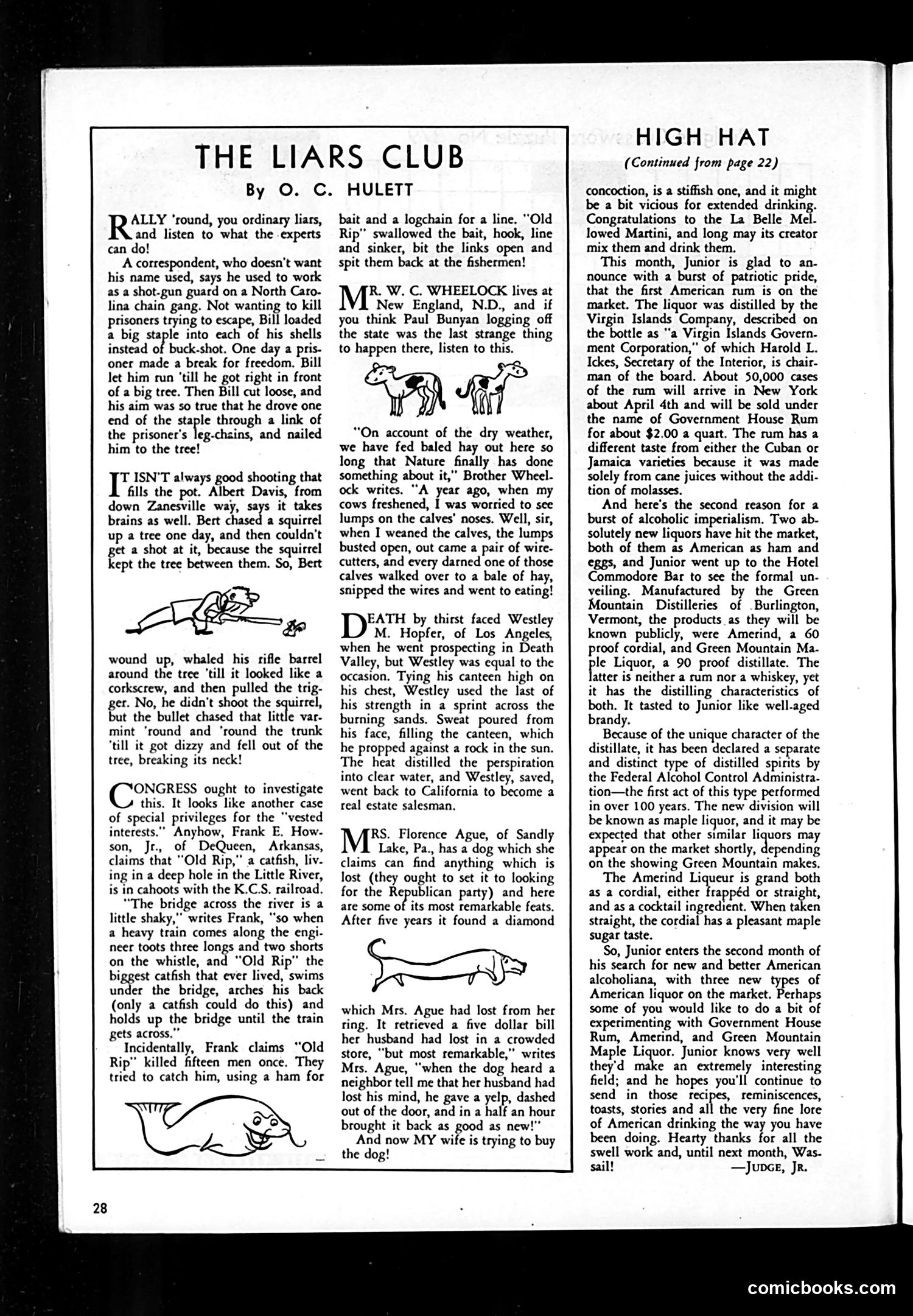
A restored page from Judge, 1937-04. Page through the whole issue in the reader above.
📄 Transcribed text from this page (OCR, searchable)
Machine-transcribed from the original scan — historical spelling and the odd misread are preserved.
THE LIARS CLUB By O. C. HULETT ALLY ‘round, you ordinary liars, and listen to what the experts can do! A correspondent, who doesn’t want his name used, says he used to work as a shot-gun guard on a North Caro- lina chain gang. Not wanting to kill prisoners trying to escape, Bill loaded a big saple into each of his shells instead of buck-shot. One day a pris- oner made a break for freedom. Bill Jet him run ‘till he got right in front of a big tree. Then Bill cut loose, and his aim was so true that he drove one end of the staple through a link of the prisoner's leg-chsins, and nailed him to the tree! [; ISN'T always good shooting that fills the pot. Albert Davis, from down Zanesville way, says it takes brains as well. Bert chased a squirrel up a tree one day, and then couldn't get a shot at it, because the squirrel kept the tree between them. So, Bert ce... wound up, whaled his rifle barrel around the tree ‘till it looked like a corkscrew, and then pulled the trig- get. No, he didn’t shoot the squirrel, but the bullet chased that little var- mint ‘round and ‘round the trunk ‘till it got dizzy and fell out of the tree, breaking its neck! ONGRESS ought to investigate this. It looks like another case of special privileges for the “vested interests." Anyhow, Frank E. How- son, Jr., of DeQueen, Arkansas, claims that “Old Rip,” a catfish, liv. ing in a deep hole in the Little River, is in cahoots with the K.C.S. railroad. “The bridge across the river is a little shaky,”” writes Frank, “so when a heavy train comes along the engi- neer toots three longs and two shorts on the whistle, and “Old Rip” the biggest catfish that ever lived, swims under the bridge, arches his back (only a catfish could do this) and holds up the bridge until the train gets across.” Incidentally, Frank claims “Old Rip” killed fifteen men once. They tried to catch him, using a ham for oo bait and a logchain for a line. “Old Rip” swallowed the bait, hook, line and sinker, bit the links open and spit them back at the fishermen! R. W. C. WHEELOCK lives at New England, N.D., and if you think Paul Bunyan logging off the state was the last strange thing to happen there, listen to this. AAA “On account of the dry weather, we have fed baled hay out here so long that Nature finally has done something about it,” Brother Wheel. ock writes. “A year ago, when my cows freshened, I was worried to sce lumps on the calves’ noses. Well, sir, when I weaned the calves, the lumps busted open, out came a pair of wire- cutters, and every darned one of those calves walked over to a bale of hay, snipped the wires and went to eating! Di" by thirst faced Westley M. Hopfer, of Los Angeles, when he went prospecting in Death Valley, but Westley was equal to the occasion. Tying his canteen high on his chest, Westley used the last of his strength in a sprint across the burning sands. Sweat poured from his face, filling the canteen, which he propped against a rock in the sun. The heat distilled the perspiration into clear water, and Westley, saved, went back to California to become a real estate salesman, Me: Florence Ague, of Sandly Lake, Pa., has a dog which she claims can find anything which is lost (they ought to set it to looking for the Republics party) and here are some of its most remarkable feats. After five years it found a diamond which Mrs. Ague had lost from her ting. It retrieved a five dollar bill her husband had lost in a crowded store, “but most remarkable,” writes Mrs. Ague, “when the dog heard a neighbor tell me that her husband had lost his mind, he gave a yelp, dashed out of the door, and in a half an hour brought it back as good as new!” And now MY wife is trying to buy the dog! HIGH HAT (Continued from page 22) concoction, is a stiffish one, and it might be a bit vicious for extended drinking. Congratulations to the La Belle MeL lowed Martini, and long may its creator mix them and drink them. This month, Junior is glad to an. nounce with a burst of patriotic pride, that the first American rum is on the market. The liquor was distilled by the Virgin Islands Company, described on the bottle as ‘a Virgin Islands Govern- ment Corporation,” of which Harold L. Ickes, Secretary of the Interior, is chair- man of the board. About 50,000 cases of the rum will arrive in New York about April 4th and will be sold under the name of Government House Rum for about $2.00 a quart. The rum has a different taste from either the Cuban or Jamaica varieties because it was made solely from cane juices without the addi- tion of molasses. And here's the second reason for a burst of alcoholic imperialism. Two ab- solutely new liquors have hit the market, both of them as American as ham and eggs, and Junior went up to the Hotel Commodore Bar to see the formal un- veiling. Manufactured by the Green Mountain Distilleries of Burlington, Vermont, the products as they will be known publicly, were Amerind, a 60 proof cordial, and Green Mountain Ma- le Liquor, a 90 proof distillate. The latter is neither a rum nor a whiskey, yet it has the distilling characteristics of both. It tasted to Junior like well-aged brandy. Because of the unique character of the distillate, it has been declared a separate and distinct type of distilled spirits by the Federal Alcohol Control Administra- tion—the first act of this type performed in over 100 years. The new division will be known as maple liquor, and it may be expected that other similar Hiquors may appear on the market shortly, depending on the showing Green Mountain makes. The Amerind Liqueur is grand both as a cordial, either tappéd or straight, and as a cocktail ingredient. When taken straight, the cordial has a pleasant maple sugar taste. So, Junior enters the second month of his search for new and better American alcoholiana, with three new ty of American liquor on the market. Perhaps some of you would like to do a bit of experimenting with Government House Rum, Amerind, and Green Mountain Maple Liquor. Junior knows very well they'd ¢ an extremely interesting field; and he hopes you'll continue to send in those recipes, reminiscences, toasts, stories and all the very fine lore of American drinking the way you have been doing. Hearty thanks for all the swell work and, until next month, Was- sail! —JuncE, Jr. comicbooks.com