
Judge, 1937-04 · page 23 of 36
Judge — April 1937 — page 23: what you’re looking at
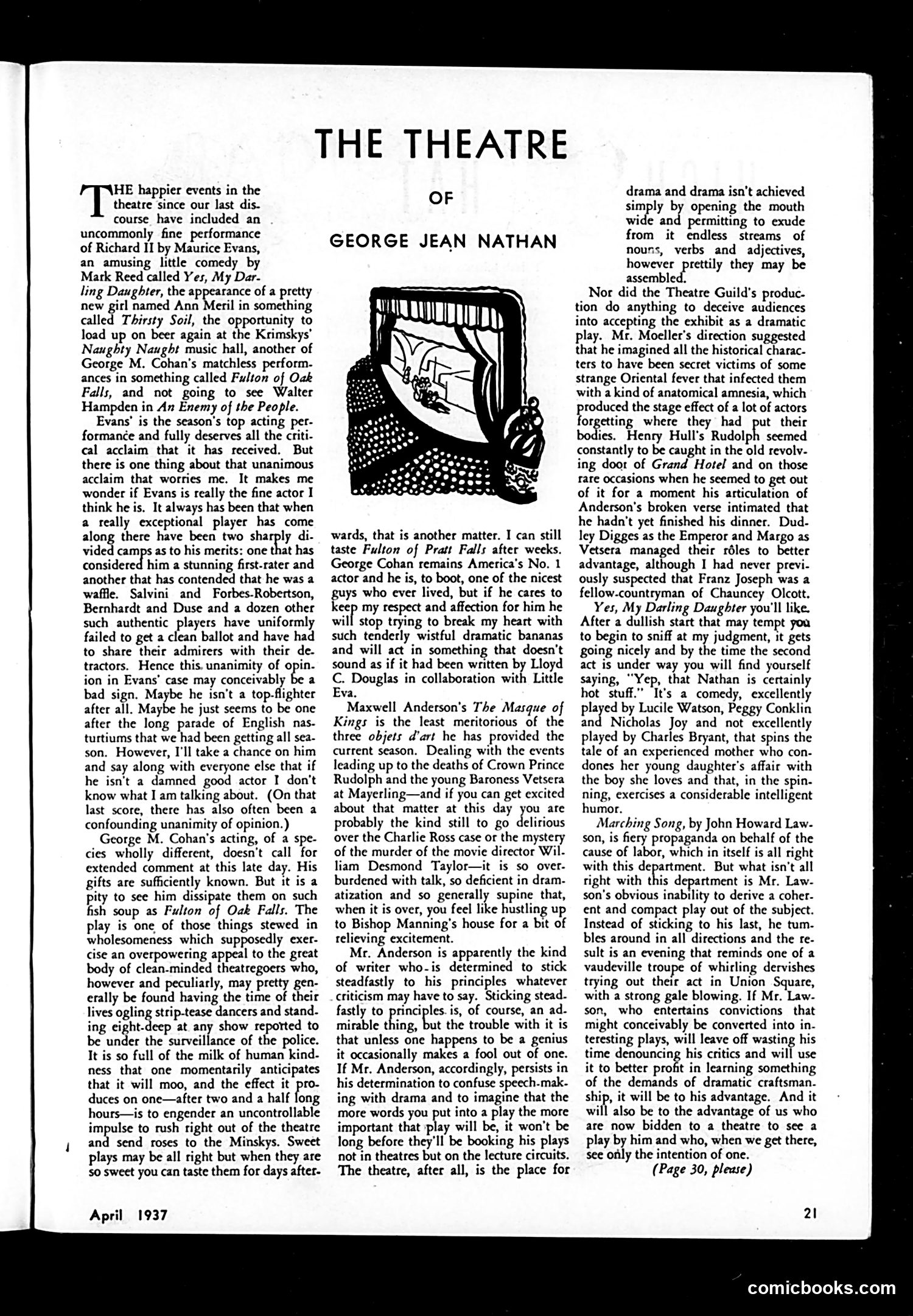
A restored page from Judge, 1937-04. Page through the whole issue in the reader above.
📄 Transcribed text from this page (OCR, searchable)
Machine-transcribed from the original scan — historical spelling and the odd misread are preserved.
"Tite happier events in the theatre since our last dis. course have included an uncommonly fine performance of Richard II by Maurice Evans, an amusing little comedy by Mark Reed called Yes, My Dar. ling Daughter, the sppesrance of a pretty new girl named Ann Meril in something called Thirsty Soil, the opportunity to load up on beer again at the Krimskys’ Naughty Naught music hall, another of George M. Cohan’s matchless perform- ances in something called Fulton of Oak Falls, and not going to see Walter Hampden in An Enemy of the People. Evans’ is the season's top acting per- formance and fully deserves all the criti- cal acclaim that it has received. But there is one thing about that unanimous acclaim that worries me. It makes me wonder if Evans is really the fine actor I think he is. It always has been that when a really exceptional player has come along there have been two sharply di- vided camps as to his merits: one that has considered him a stunning first-rater and another that has contended that he was a waffle. Salvini and Forbes-Robertson, Bernhardt and Duse and a dozen other such authentic players have uniformly failed to get a clean ballot and have had to share their admirers with their de. tractors. Hence this. unanimity of opin. ion in Evans’ case may conceivably be a bad sign. Maybe he isn’t a top-flighter after all. Maybe he just seems to be one after the long parade of English nas- turtiums that we had been getting all sea- son. However, I'll take a chance on him and say along with everyone else that if he isn’t a damned good actor I don't know what I am talking about. (On that last score, there has also often been a confounding unanimity of opinion.) George M. Cohan's acting, of a spe- cies wholly different, doesn’t call for extended comment at this late day. His gifts are sufficiently known. But it is a pity to see him dissipate them on such fish soup as Fulton of Oak Falls. The play is one of those things stewed in wholesomeness which supposedly exer- cise an overpowering appeal to the great body of clean-minded theatregoers who, however and peculiarly, may pretty gen- erally be found having the time of their lives ogling strip-tease dancers and stand. ing eight-deep at ay show reported to be under the surveillance of the police. It is so full of the milk of human kind. ness that one momentarily anticipates that it will moo, and the effect it pre: duces on one—after two and a half long hours—is to engender an uncontrollable impulse to rush right out of the theatre and send roses to the Minskys. Sweet plays may be all right but when they are 0 sweet you can taste them for days after- April 1937 THE THEATRE OF GEORGE JEAN NATHAN wards, that is another matter. I can still taste Fulton of Pratt Falls after weeks. George Cohan remains America’s No. 1 actor and he is, to boot, one of the nicest suys who ever lived, but if he cares to cep my respect and affection for him he will stop trying to break my heart with such tenderly wistful dramatic bananas and will act in something that doesn’t sound as if it had been written by Lloyd < Douglas in collaboration with Little ‘Va. Maxwell Anderson's The Masque of Kings is the least meritorious of the three objets d'art he has provided the current season. Dealing with the events leading up to the deaths of Crown Prince Rudolph and the young Baroness Vetsera at Mayerling—and if you can get excited about that matter at this day you are probably the kind still to go delirious over the Charlie Ross case or the mystery of the murder of the movie director Wil- liam Desmond Taylor—it is so over- burdened with talk, so deficient in dram. atization and so generally supine that, when it is over, you feel like hustling up to Bishop Manning's house for a bit of relieving excitement. Mr. Anderson is apparently the kind of writer who-is determined to stick steadfastly to his principles whatever criticism may have to say. Sticking stead- fastly to nog ples is, of course, an ad. mirable thing, but the trouble with it is that unless one happens to be a genius it occasionally makes a fool out of one. If Mr. Anderson, accordingly, persists in his determination to confuse speech-mak- ing with drama and to imagine that the more words you put into a play the more important that play will be, it won't be long before they'll be booking his plays not in theatres but on the lecture circuits. The theatre, after all, is the place for drama and drama isn’t achieved simply by opening the mouth wide and permitting to exude from it endless streams of nouns, verbs and adjectives, however prettily they may be assembled. Nor did the Theatre Guild's produc- tion do anything to deceive audiences into accepting the exhibit as a dramatic play. Mr. Moeller's direction suggested that he imagined all the historical charac- ters to have been secret victims of some strange Oriental fever that infected them with a kind of anatomical amnesia, which produced the stage effect of a lot of actors forgetting where they had put their ies. Henry Hull's Rudolph seemed constantly to be caught in the old revolv- ing door of Grand Hotel and on those rare occasions when he seemed to get out of it for a moment his articulation of Anderson's broken verse intimated that he hadn't yet finished his dinner. Dud- ley Digges as the Emperor and Margo as Vetsera managed their rdles to better advantage, although I had never previ- ously suspected that Franz Joseph was a fellow-countryman of Chauncey Olcott. Yes, My Darling Daughter you'll like. After a dullish start that may tempt you to begin to sniff at my judgment, it gets going nicely and by the time the second act is under way you will find yourself saying, “Yep, that Nathan is certainly hot stuff.” It’s a comedy, excellently Played by Lucile Watson, Peggy Conklin and Nicholas Joy and not excellently played by Charles Bryant, that spins the tale of an experienced mother who con- dones her young daughter's affair with the boy she loves and that, in the spin. ning, exercises a considerable intelligent humor. Marching Song, by John Howard Law- son, is fiery propaganda on behalf of the cause of labor, which in itself is all right with this department. But what isn’t all right with this department is Mr. Law- son's obvious inability to derive a coher- ent and compact play out of the subject. Instead of sticking to his last, he tum- bles around in all directions and the re- sult is an evening that reminds one of a vaudeville troupe of whirling dervishes trying out their act in Union Square, with a strong gale blowing. If Mr. Law- son, who entertains convictions that might conceivably be converted into in- teresting plays, will leave off wasting his time denouncing his critics and will use it to better profit in learning something of the demands of dramatic craftsman. ship, it will be to his advantage. And it will also be to the advantage of us who are now bidden to a theatre to see a play by him and who, when we get there, see ofily the intention of one. (Page 30, please) comicbooks.com