
Judge, 1937-04 · page 21 of 36
Judge — April 1937 — page 21: what you’re looking at
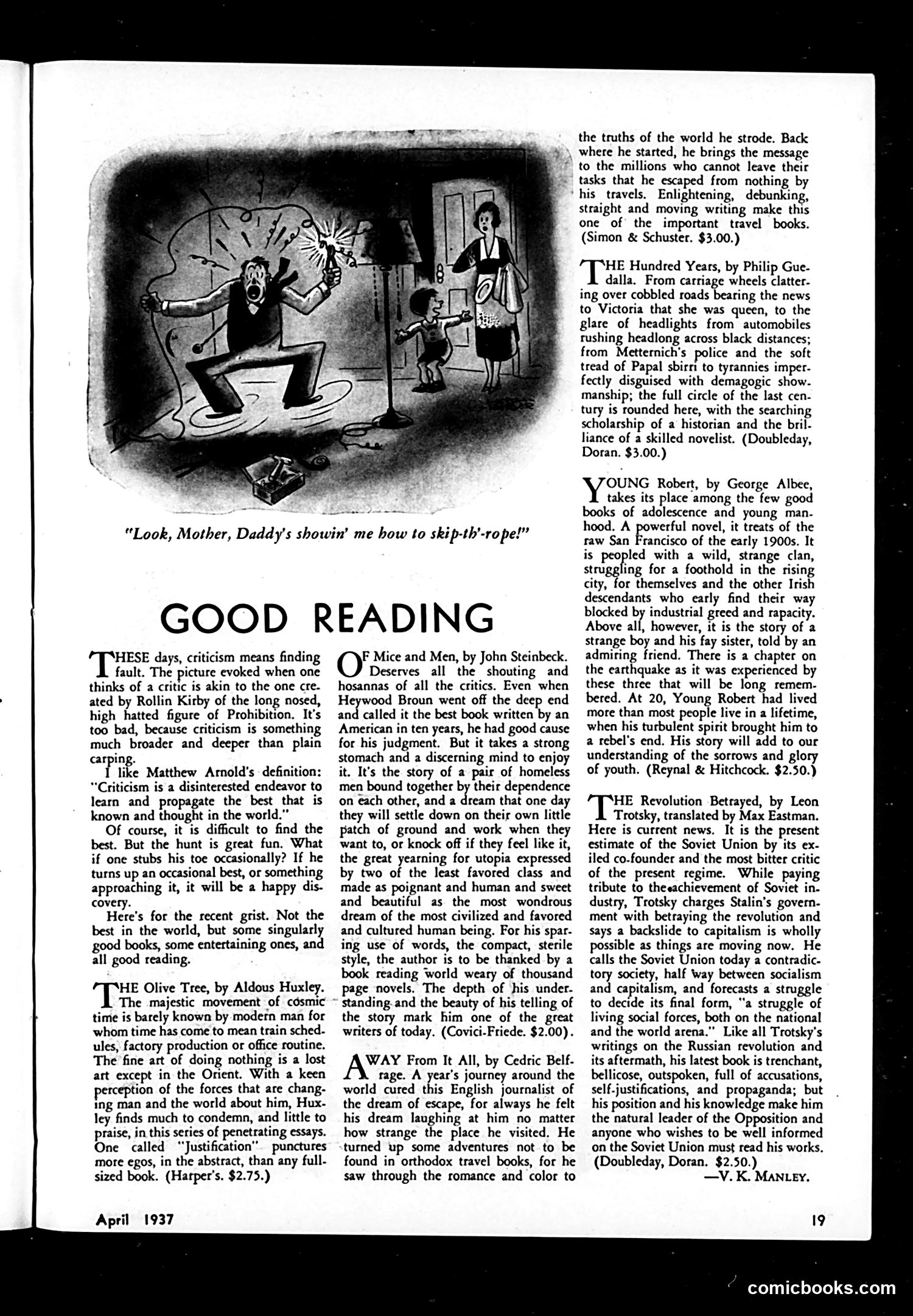
A restored page from Judge, 1937-04. Page through the whole issue in the reader above.
📄 Transcribed text from this page (OCR, searchable)
Machine-transcribed from the original scan — historical spelling and the odd misread are preserved.
“Look, Mother, Daddy's showin’ me how to skip-th’-rope!” GOOD READING HESE days, criticism means finding fault. The picture evoked when one thinks of a critic is akin to the one cre. ated by Rollin Kirby of the long nosed, high hatted figure of Prohibition. It's too bad, because criticism is something much broader and deeper than plain carping. Tike Matthew Arnold's definition: “Criticism is a disinterested endeavor to learn and propagate the best that is known and thought in the world.” Of course, it is difficult to find the best. But the hunt is great fun. What if one stubs his toe occasionally? If he turns up an occasional best, or something approaching it, it will be a happy dis- covery. Here's for the recent grist. Not the best in the world, but some singularly good books, some entertaining ones, and all good reading. "EE Olive Tree, by Aldous Huxley. The majestic movement of cosmic time is barely known by modern man for whom time has come to mean train sched- ules, factory production or office routine. The fine art of doing nothing is a lost art except in the Orient. With a keen ception of the forces that are chang- ing man and the world about him, Hux. ley finds much to condemn, and little to praise, in this series of penetrating essays. One called ‘“‘Justification”. punctures more egos, in the abstract, than any full- sized book. (Harper's. $2.75.) April 1937 OO Mice and Men, by John Steinbeck. Deserves all the shouting and hosannas of all the critics. Even when Heywood Broun went off the deep end and called it the best book written by an American in ten years, he had good cause for his judgment. But it takes a strong stomach and a discerning mind to enjoy it. It's the story of a pair of homeless men bound together by their dependence on each other, and a dream that one day they will settle down on their own little patch of ground and work when they want to, or knock off if they feel like it, the great yearning for utopia expressed by two of the least favored class and made as poignant and human and sweet and beautiful as the most wondrous dream of the most civilized and favored and cultured human being. For his spar- ing use of words, the compact, sterile style, the author is to be thanked by a book reading World weary of thousand page novels. The depth of his under. standing. and the beauty of his telling of the story mark him one of the great writers of today. (Covici-Friede. $2.00). A™4Y From It All, by Cedric Belf- rage. A years journey around the world cured this English journalist of the dream of escape, for always he felt his dream laughing at him no matter how strange the place he visited. He turned up some adventures not to be found in orthodox travel books, for he saw through the romance and color to the truths of the world he strode. Back , where he started, he brings the message * to the millions who cannot leave their = tasks that he escaped from nothing by ‘his travels. Enlightening, debunking, straight and moving writing make this one of the important travel books. (Simon & Schuster. $3.00.) ‘HE Hundred Years, by Philip Gue- dalla. From carriage wheels clatter- ing over cobbled roads bearing the news to Victoria that she was queen, to the glare of headlights from automobiles rushing headlong across black distances; from Metternich’s police and the soft tread of Papal sbirn to tyrannies imper- fectly disguised with demagogic show. manship; the full circle of the last cen- tury is rounded here, with the searching scholarship of a historian and the bril- liance of a skilled novelist. (Doubleday, Doran. $3.00.) VY SuNG Robert, by George Albee, takes its place among the few good books of adolescence and young man. hood. A powerful novel, it treats of the raw San Francisco of the early 1900s. It is peopled with a wild, strange clan, struggling for a foothold in the rising city, for themselves and the other Irish descendants who early find their way blocked by industrial greed and rapacity. Above all, however, it is the story of a strange boy and his fay sister, told by an admiring friend. There is a chapter on the earthquake as it was experienced by these three that will be long remem. bered. At 20, Young Robert had lived more than most people live in a lifetime, when his turbulent spirit brought him to a rebel’s end. His story will add to our understanding of the sorrows and glory of youth. (Reynal & Hitchcock. $2.50.) ‘Te Revolution Betrayed, by Leon Trotsky, translated by Max Eastman. Here is current news. It is the present estimate of the Soviet Union by its ex- iled co-founder and the most bitter critic of the present regime. While paying tribute to theeachievement of Soviet in- dustry, Trotsky charges Stalin’s govern. ment with betraying the revolution and says a backslide to capitalism is wholly possible as things are moving now. He calls the Soviet Union today a contradic. tory society, half way between socialism and capitalism, and forecasts a struggle to decide its final form, “a struggle of living social forces, both on the national and the world arena.” Like all Trotsky’s writings on the Russian revolution and its aftermath, his latest book is trenchant, bellicose, outspoken, full of accusations, self-justifications, and propaganda; but his position and his knowledge make him the natural leader of the Opposition and anyone who wishes to be well informed on the Soviet Union must read his works. (Doubleday, Doran. $2.50.) —V. K. MANLEy. 19 comicbooks.com