
Judge, 1937-02 · page 21 of 45
Judge — February 1937 — page 21: what you’re looking at
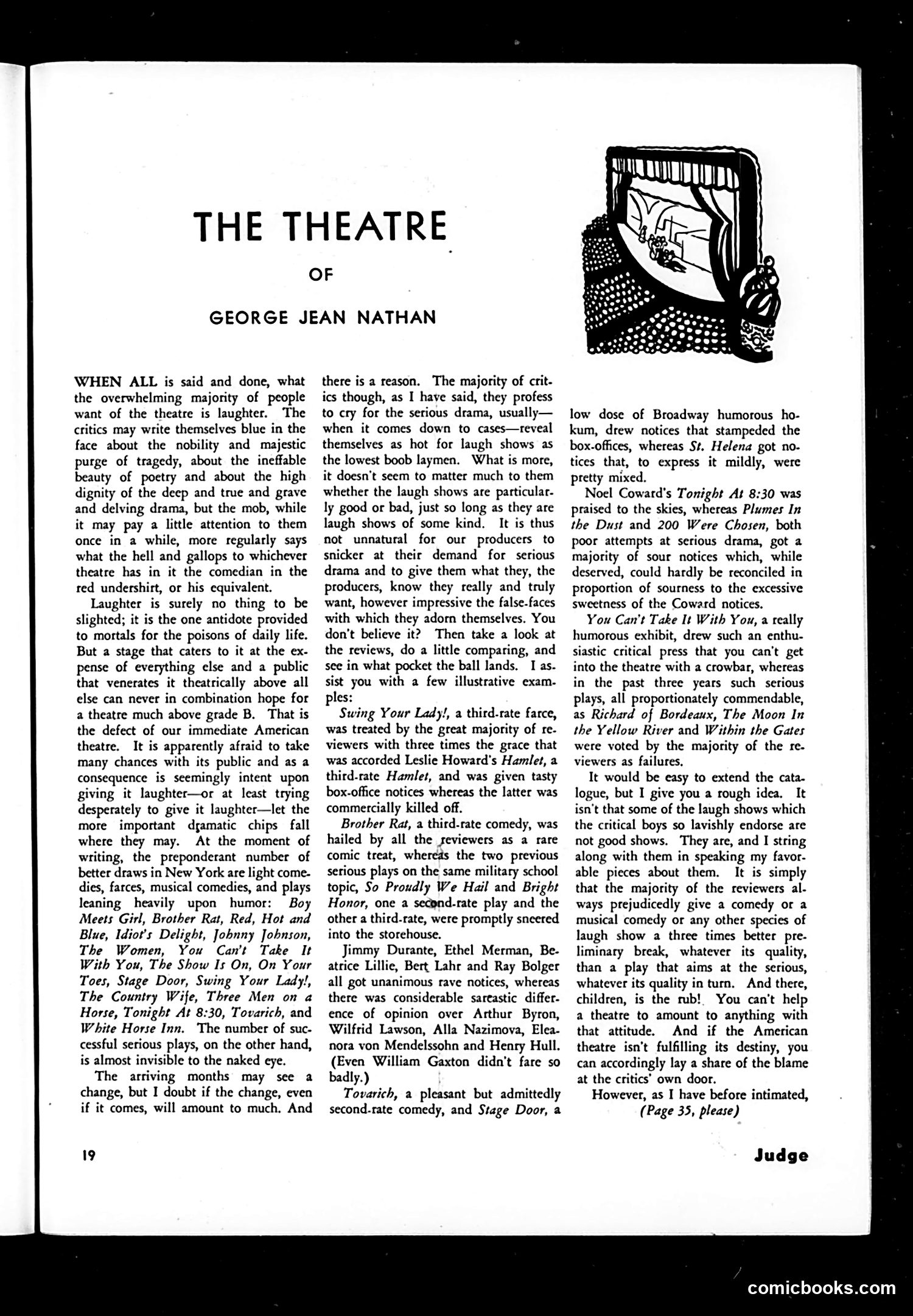
A restored page from Judge, 1937-02. Page through the whole issue in the reader above.
📄 Transcribed text from this page (OCR, searchable)
Machine-transcribed from the original scan — historical spelling and the odd misread are preserved.
THE THEATRE OF GEORGE JEAN NATHAN WHEN ALL is said and done, what the overwhelming majority of people want of the theatre is laughter. The critics may write themselves blue in the face about the nobility and majestic purge of tragedy, about the ineffable beauty of poetry and about the high dignity of the deep and true and grave and delving drama, but the mob, while it may pay a little attention to them once in a while, more regularly says what the hell and gallops to whichever theatre has in it the comedian in the red undershirt, or his equivalent. Laughter is surely no thing to be slighted; it is the one antidote provided to mortals for the poisons of daily life. But a stage that caters to it at the ex- pense of everything else and a public that venerates it theatrically above all else can never in combination hope for a theatre much above grade B. That is the defect of our immediate American theatre. It is apparently afraid to take many chances with its public and as a consequence is seemingly intent upon giving it laughter—or at least trying desperately to give it laughter—let the more important dsamatic chips fall where they may. At the moment of writing, the preponderant number of better draws in New York are light come- dies, farces, musical comedies, and plays leaning heavily upon humor: Boy Meets Girl, Brother Rat, Red, Hot and Blue, Idiot's Delight, Johnny Jobnson, The Women, You Can't Take It With You, The Show Is On, On Your Toes, Stage Door, Swing Your Lady!, The Country Wife, Three Men on a Horse, Tonight At 8:30, Tovarich, and White Horse Inn. The number of suc- cessful serious plays, on the other hand, is almost invisible to the naked eye. The arriving months may see a change, but I doubt if the change, even if it comes, will amount to much. And 19 there is a reason. The majority of crit- ics though, as I have said, they profess to cry for the serious drama, usually— when it comes down to cases—reveal themselves as hot for laugh shows as the lowest boob laymen. What is more, it doesn’t seem to matter much to them whether the laugh shows are particular. ly good or bad, just so long as they are laugh shows of some kind. It is thus not unnatural for our producers to snicker at their demand for serious drama and to give them what they, the producers, know they really and truly want, however impressive the false-faces with which they adorn themselves. You don’t believe it? Then take a look at the reviews, do a little comparing, and see in what pocket the ball lands. I as. sist you with a few illustrative exam- ples: Swing Your Lady!, a third-rate farce, was treated by the great majority of re- viewers with three times the grace that was accorded Leslie Howard's Hamlet, a third-rate Hamlet, and was given tasty box-office notices whereas the latter was commercially killed off. Brother Rat, a third-rate comedy, was hailed by all the seviewers as a rare comic treat, whereds the two previous serious plays on the same military school topic, So Proudly We Hail and Bright Honor, one a secpnd.rate play and the other a third-rate, were promptly sneered into the storehouse. Jimmy Durante, Ethel Merman, Be- atrice Lillie, Bert Lahr and Ray Bolger all got unanimous rave notices, whereas there was considerable sareastic differ- ence of opinion over Arthur Byron, Wilfrid Lawson, Alla Nazimova, Elea- nora von Mendelssohn and Henry Hull. (Even William Gaxton didn’t fare so badly.) Tovarich, a pleasant but admittedly second-rate comedy, and Stage Door, a yaw W mn a low dose of Broadway humorous ho- kum, drew notices that stampeded the box-offices, whereas St. Helena got no- tices that, to express it mildly, were pretty mixed. Noel Coward's Tonight At 8:30 was praised to the skies, whereas Plumes In the Dust and 200 Were Chosen, both poor attempts at serious drama, got a majority of sour notices which, while deserved, could hardly be reconciled in proportion of sourness to the excessive sweetness of the Coward notices. You Can't Take It With You, a really humorous exhibit, drew such an enthu- siastic critical press that you can’t get into the theatre with a crowbar, whereas in the past three years such serious plays, all proportionately commendable, as Richard of Bordeaux, The Moon In the Yellow River and Within the Gates were voted by the majority of the re. viewers as failures, It would be easy to extend the cata- logue, but I give you a rough idea. It isn’t that some of the laugh shows which the critical boys so lavishly endorse are not good shows. They are, and I string along with them in speaking my favor- able pieces about them. It is simply that the majority of the reviewers al- ways ptejudicedly give a comedy or a musical comedy or any other species of laugh show a three times better pre- liminary break, whatever its quality, than a play that aims at the serious, whatever its quality in turn. And there, children, is the rub!. You can’t help a theatre to amount to anything with that attitude. And if the American theatre isn’t fulfilling its destiny, you can accordingly lay a share of the blame at the critics’ own door. However, as I have before intimated, (Page 35, please) Judge comicbooks.com