
Judge, 1937-01 · page 34 of 52
Judge — January 1937 — page 34: what you’re looking at
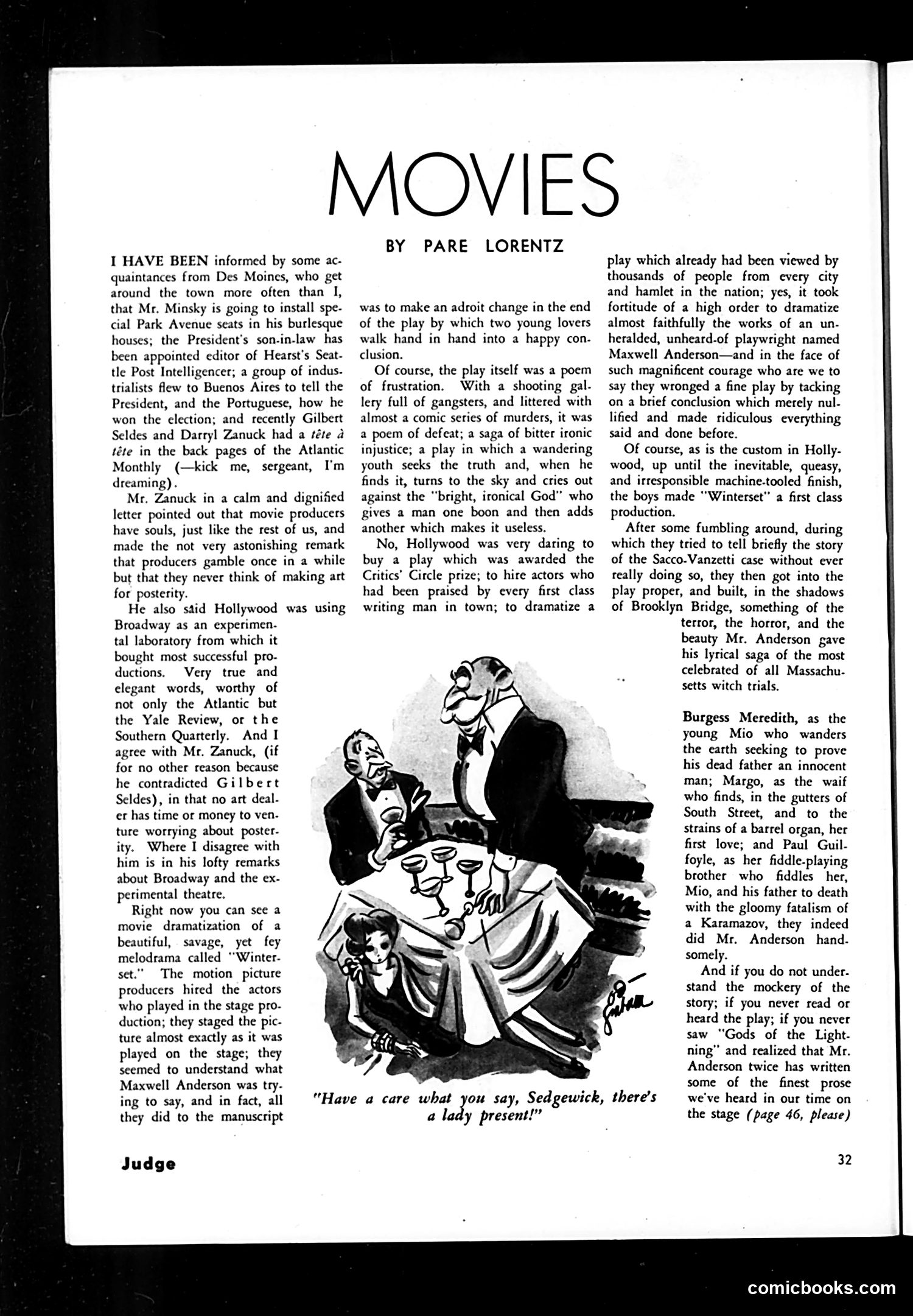
A restored page from Judge, 1937-01. Page through the whole issue in the reader above.
📄 Transcribed text from this page (OCR, searchable)
Machine-transcribed from the original scan — historical spelling and the odd misread are preserved.
MOVIES I HAVE BEEN informed by some ac- quaintances from Des Moines, who get around the town more often than I, that Mr. Minsky is going to install spe- cial Park Avenue seats in his burlesque houses; the President's son-in-law has been appointed editor of Hearst's Seat- tle Post Intelligencer; a group of indus. trialists flew to Buenos Aires to tell the President, and the Portuguese, how he won the election; and recently Gilbert Seldes and Darryl Zanuck had a téte 4 téte in the back pages of the Atlantic Monthly (—kick me, sergeant, I'm dreaming). Mr. Zanuck in a calm and dignified letter pointed out that movie producers have souls, just like the rest of us, and made the not very astonishing remark that producers gamble once in a while but that they never think of making art for posterity. He also said Hollywood was using Broadway as an experimen. tal laboratory from which it bought most successful pro- ductions. Very true and elegant words, worthy of not only the Atlantic but the Yale Review, or the Southern Quarterly. And I agree with Mr. Zanuck, (if for no other reason because he contradicted Gilbert Seldes), in that no art deal- er has time or money to ven- ture worrying about poster- ity. Where I disagree with him is in his lofty remarks about Broadway and the ex- perimental theatre. Right now you can see a movie dramatization of a beautiful, savage, yet fey melodrama called ‘Winter- set.” The motion picture producers hired the actors who played in the stage pro- duction; they staged the pic- ture almost exactly as it was played on the stage; they seemed to understand what Maxwell Anderson was try- ing to say, and in fact, all they did to the manuscript Judge “Have a care what Fi) a lady present!” BY PARE LORENTZ was to make an adroit change in the end of the play by which two young lovers walk hand in hand into a happy con- clusion. Of course, the play itself was a poem of frustration. With a shooting gal- lery full of gangsters, and littered with almost a comic series of murders, it was a poem of defeat; a saga of bitter ironic injustice; a play in which a wandering youth seeks the truth and, when he finds it, turns to the sky and cries out against the “bright, ironical God” who gives a man one boon and then adds another which makes it useless. No, Hollywood was very daring to buy a play which was awarded the Critics’ Circle prize; to hire actors who had been praised by every first class writing man in town; to dramatize a jou say, Sedgewick, there's play which already had been viewed by thousands of people from every city and hamlet in the nation; yes, it took fortitude of a high order to dramatize almost faithfully the works of an un- heralded, unheard-of playwright named Maxwell Anderson—and in the face of such magnificent courage who are we to say they wronged a fine play by tacking on a brief conclusion which merely nul- lified and made ridiculous everything said and done before. Of course, as is the custom in Holly- wood, up until the inevitable, queasy, and irresponsible machine-tooled finish, the boys made “Winterset” a first class production. After some fumbling around, during which they tried to tell briefly the story of the Sacco-Vanzetti case without ever really doing so, they then got into the play proper, and built, in the shadows of Brooklyn Bridge, something of the terror, the horror, and the beauty Mr. Anderson gave his lyrical saga of the most celebrated of all Massachu- setts witch trials. Burgess Meredith, as the young Mio who wanders the earth seeking to prove his dead father an innocent man; Margo, as the waif who finds, in the gutters of South Street, and to the strains of a barrel organ, her first love; and Paul Guil- foyle, as her fiddle-playing brother who fiddles her, Mio, and his father to death with the gloomy fatalism of a Karamazov, they indeed did Mr. Anderson hand. somely. And if you do not under- stand the mockery of the story; if you never read or heard the play; if you never saw "Gods of the Light- ning” and realized that Mr. Anderson twice has written some of the finest prose we've heard in our time on the stage (page 46, please) 32 comicbooks.com