
Judge, 1937-01 · page 23 of 52
Judge — January 1937 — page 23: what you’re looking at
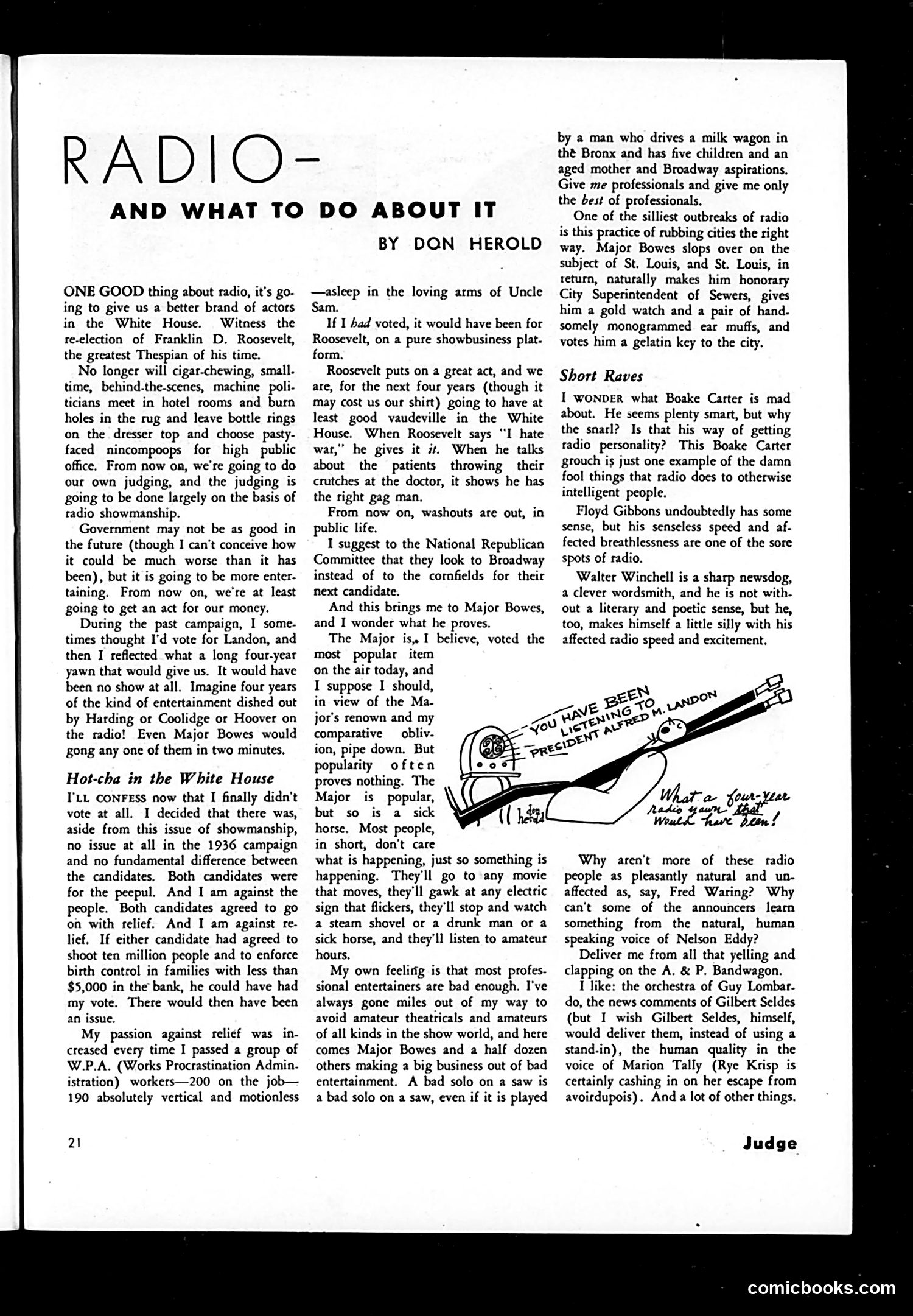
A restored page from Judge, 1937-01. Page through the whole issue in the reader above.
📄 Transcribed text from this page (OCR, searchable)
Machine-transcribed from the original scan — historical spelling and the odd misread are preserved.
RADIO- AND WHAT TO DO ABOUT IT BY DON HEROLD ONE GOOD thing about radio, it’s go- ing to give us a better brand of actors in the White House. Witness the re-election of Franklin D. Roosevelt, the greatest Thespian of his time. No longer will cigar-chewing, small- time, behind-the-scenes, machine poli- ticians meet in hotel rooms and burn holes in the rug and leave bottle rings on the dresser top and choose pasty- faced nincompoops for high public office. From now on, we're going to do our own judging, and the judging is going to be done largely on the basis of radio showmanship. Government may not be as good in the future (though I can’t conceive how it could be much worse than it has been), but it is going to be more enter- taining. From now on, we're at least going to get an act for our money. During the past campaign, I some- times thought I'd vote for Landon, and then I reflected what a long four-year yawn that would give us. It would have been no show at all. Imagine four years of the kind of entertainment dished out by Harding or Coolidge or Hoover on the radio! Even Major Bowes would gong any one of them in two minutes. Hot-cha in the White House I'LL CONFESS now that I finally didn’t vote at all. I decided that there was, aside from this issue of showmanship, no issue at all in the 1936 campaign and no fundamental difference between the candidates. Both candidates were for the peepul. And I am against the people. Both candidates agreed to go on with relief. And I am against re- lief. If either candidate had agreed to shoot ten million people and to enforce birth control in families with less than $5,000 in the bank, he could have had my vote. There would then have been an issue. My passion against relief was in- creased every time I passed a group of W.P.A. (Works Procrastination Admin. istration) workers—200 on the job— 190 absolutely vertical and motionless 21 —asleep in the loving arms of Uncle Sam. If I bad voted, it would have been for Roosevelt, on a pure showbusiness plat- form. Roosevelt puts on a great act, and we are, for the next four years (though it may cost us our shirt) going to have at least good vaudeville in the White House. When Roosevelt says “I hate war,” he gives it it. When he talks about the patients throwing their crutches at the doctor, it shows he has the right gag man. From now on, washouts are out, in public life. I suggest to the National Republican Committee that they look to Broadway instead of to the cornfields for their next candidate. And this brings me to Major Bowes, and I wonder what he proves. The Major is, I believe, voted the most popular item on the air today, and I suppose I should, in view of the Ma. jor's renown and my comparative — obliv- ion, pipe down. But popularity often proves nothing. The Major is popular, but so is a sick horse. Most people, in short, don’t care what is happening, just so something is happening. They'll go to any movie that moves, they'll gawk at any electric sign that flickers, they'll stop and watch a steam shovel or a drunk man or a sick horse, and they'll listen to amateur hours. My own feelirig is that most profes- sional entertainers are bad enough. I've always gone miles out of my way to avoid amateur theatricals and amateurs of all kinds in the show world, and here comes Major Bowes and a half dozen others making a big business out of bad entertainment. A bad solo on a saw is a bad solo on a saw, even if it is played by a man who drives a milk wagon in thé Bronx and has five children and an aged mother and Broadway aspirations. Give me professionals and give me only the best of professionals. One of the silliest outbreaks of radio is this practice of rubbing cities the right way. Major Bowes slops over on the subject of St. Louis, and St. Louis, in return, naturally makes him honorary City Superintendent of Sewers, gives him a gold watch and a pair of hand- somely monogrammed ear muffs, and votes him a gelatin key to the city. Short Raves I wonpER what Boake Carter is mad about. He seems plenty smart, but why the snarl? Is that his way of getting radio personality? This Boake Carter grouch is just one example of the damn fool things that radio does to otherwise intelligent people. Floyd Gibbons undoubtedly has some sense, but his senseless speed and af- fected breathlessness are one of the sore spots of radio. Walter Winchell is a sharp newsdog, a clever wordsmith, and he is not with. out a literary and poetic sense, but he, too, makes himself a little silly with his affected radio speed and excitement. Why aren't more of these radio people as pleasantly natural and un- affected as, say, Fred Waring? Why can’t some of the announcers learn something from the natural, human speaking voice of Nelson Eddy? Deliver me from all that yelling and clapping on the A. & P. Bandwagon. I like: the orchestra of Guy Lombar- do, the news comments of Gilbert Seldes (but I wish Gilbert Seldes, himself, would deliver them, instead of using a stand-in), the human quality in the voice of Marion Tally (Rye Krisp is certainly cashing in on her escape from avoirdupois). And a lot of other things. Judge comicbooks.com