
Judge, 1936-12 · page 18 of 53
Judge — December 1936 — page 18: what you’re looking at
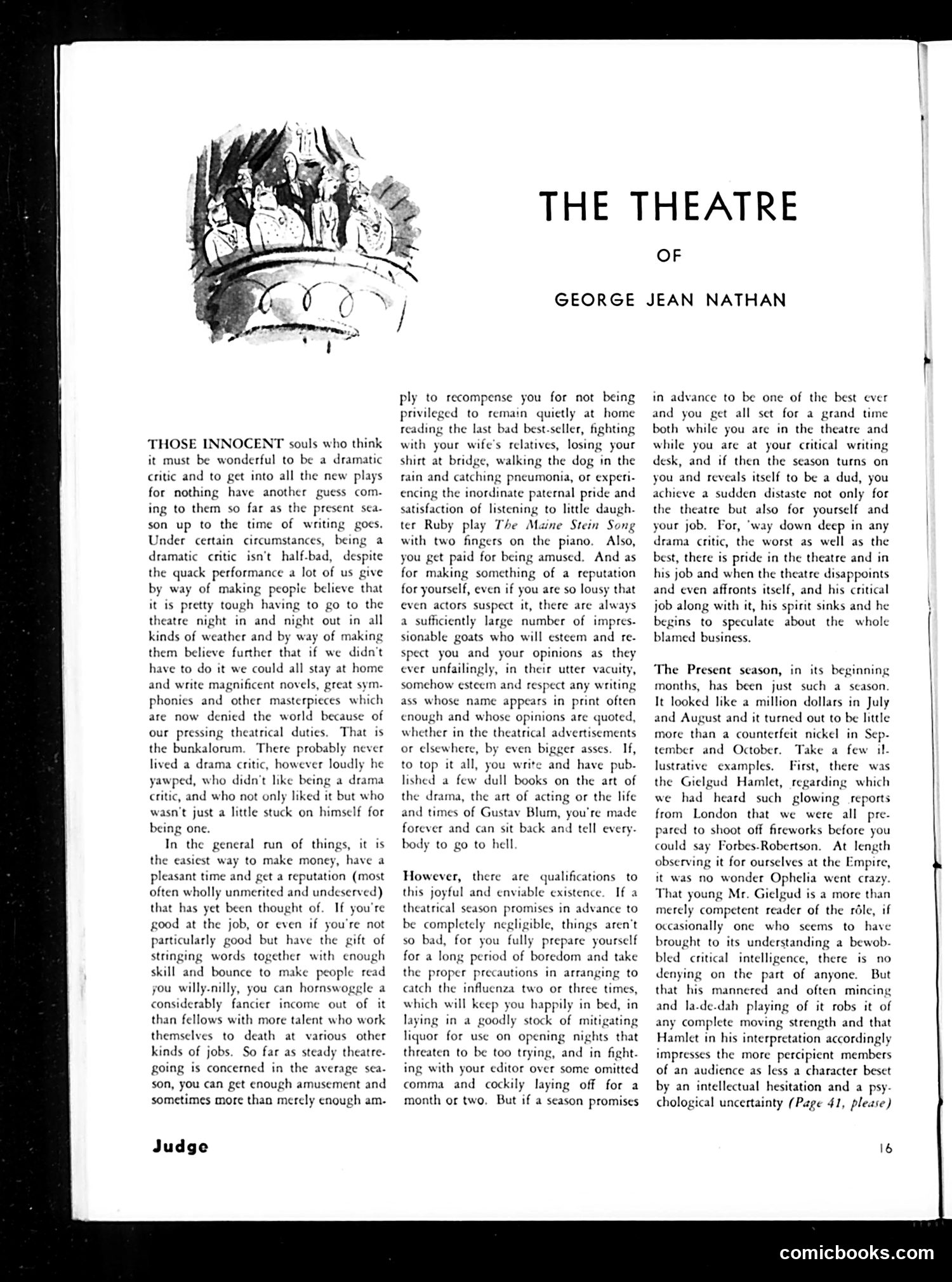
A restored page from Judge, 1936-12. Page through the whole issue in the reader above.
📄 Transcribed text from this page (OCR, searchable)
Machine-transcribed from the original scan — historical spelling and the odd misread are preserved.
THOSE INNOCENT souls who think it must be wonderful to be a dramatic critic and to get into all the new plays for nothing have another guess com- ing to them so far as the present sea- son up to the time of writing gocs. Under certain circumstances, being a dramatic critic isn’t half-bad, despite the quack performance a lot of us give by way of making people believe that it is pretty tough having to go to the theatre night in and night out in all kinds of weather and by way of making them believe further that if we didn’t have to do it we could all stay at home and write magnificent novels, great sym- phonies and other masterpieces which are now denied the world because of our pressing theatrical duties. That is the bunkalorum. There probably never lived a drama critic, however loudly he yawped, who didn’t like being a drama critic, and who not only liked it but who wasn’t just a little stuck on himself for being one. In the general run of things, it is the easiest way to make mone pleasant time and get a reputation (most often wholly unmerited and undeserved) that has yet been thought of. If you're good at the job, or even if you're not particularly good but have the gift of stringing words together with enough skill and bounce to make people read you willy-nilly, you can hornswoggle a considerably fancier income out of it than fellows with more talent who work themselves to death at various other kinds of jobs. So far as steady theatre. going is concerned in the average sea- son, you can get enough amusement and sometimes more than merely enough am. , have a Judge GEORGE ply to recompense you for not being privileged to remain quietly at home reading the last bad best-seller, fighting with your wife's relatives, losing your shirt at bridge, walking the dog in the rain and catching pneumonia, or experi- encing the inordinate paternal pride and satisfaction of listening to little daugh. ter Ruby play The Maine Stein Song with two fingers on the piano. Also, you get paid for being amused. And as for making something of a reputation for yourself, even if you are so lousy that even actors suspect it, there are always a sufficiently large number of impres- sionable goats who will esteem and re- spect you and your opinions as they ever unfailingly, in their utter vacuity, somchow esteem and respect any writing ass whose name appears in print often enough and whose opinions are quoted, whether in the theatrical advertisements or elsewhere, by even bigger asses. If, to top it all, you write and have pub. lished a few dull books on the art of the drama, the art of acting or the life and times of Gustav Blum, you're made forever and can sit back and tell every- body to go to hell However, there are qualifications to this joyful and enviable existence. If a theatrical season promises in advance to be completely negligible, things aren't so bad, for you fully prepare yourself for a long period of boredom and take the proper precautions in arranging to catch the influenza two or three times, which will keep you happily in bed, in laying in a goodly stock of mitigating liquor for use on opening nights that threaten to be too trying, and in fight. ing with your editor over some omitted comma and cockily laying off for a month or two. But if a season promises THE THEATRE OF JEAN NATHAN in advance to be one of the best ever and you get all set for a grand time both while you are in the theatre and while you are at your critical writing desk, and if then the season turns on you and reveals itself to be a dud, you achieve a sudden distaste not only for the theatre but also for yourself and your job. For, ‘way down deep in any drama critic, the worst as well as the best, there is pride in the theatre and in his job and when the theatre disappoints and even affronts itself, and his critical job along with it, his spirit sinks and he begins to speculate about the whole blamed business. The Present season, in its beginning months, has been just such a season. It looked like a million dollars in July and August and it turned out to be little more than a counterfeit nickel in Sep- tember and October. Take a few il. lustrative examples. First, there was the Gielgud Hamlet, regarding which we had heard such glowing reports from London that we were all pre- pared to shoot off fireworks before you could say Forbes-Robertson. At length observing it for ourselves at the Empire, it was no wonder Ophelia went crazy. That young Mr. Gielgud is a more than merely competent reader of the rdle, if occasionally one who scems to have brought to its understanding a bewob- bled critical intelligence, there is no denying on the part of anyone. But that his mannered and often mincing and la-de-dah playing of it robs it of any complete moving strength and that Hamlet in his interpretation accordingly impresses the more percipient members of an audience as less a character beset by an intellectual hesitation and a psy- chological uncertainty (Page 41, please) 16 comicbooks.com