
Judge, 1936-04 · page 3 of 36
Judge — April 1936 — page 3: what you’re looking at
What you’re looking at
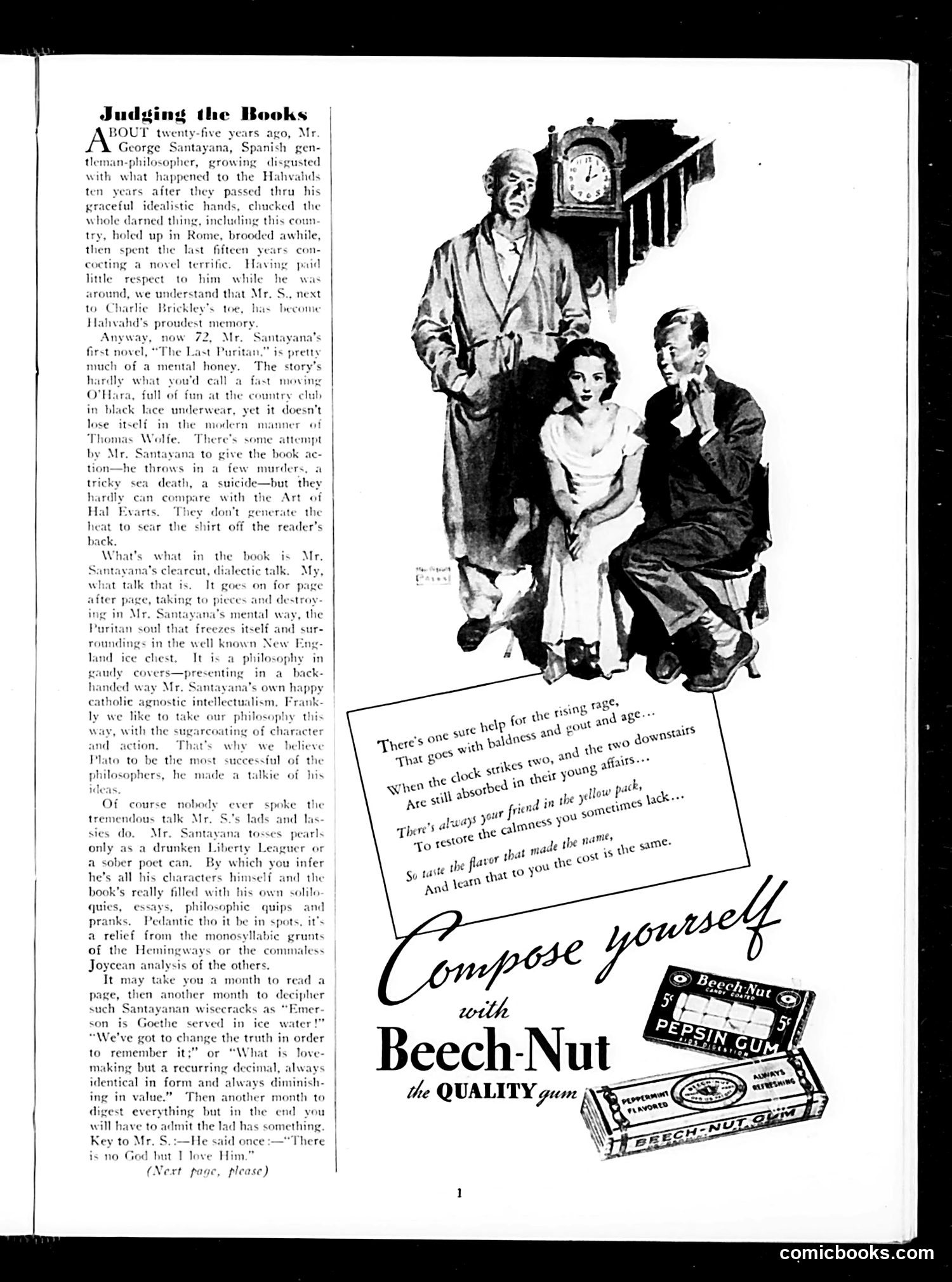
# "Judging the Books" - Judge Magazine Book Review This page contains a book review of George Santayana's novel "The Last Puritan," alongside a Beech-Nut gum advertisement. The reviewer critiques Santayana's work as a "mental honey"—superficially pleasant but lacking substance. The review dismisses the plot as derivative (comparing it unfavorably to Hal Eaarts' work) and mocks the author's philosophical digressions throughout the narrative. The satirical point appears to target Santayana's pretentious intellectualism and his tendency to interrupt fictional storytelling with abstract philosophy. The reviewer suggests the book would bore general readers despite Santayana's reputation as a serious thinker. The advertisement uses this critique as an ironic juxtaposition—suggesting Beech-Nut gum provides more genuine comfort than Santayana's intellectual musings.
📄 Transcribed text from this page (OCR, searchable)
Machine-transcribed from the original scan — historical spelling and the odd misread are preserved.
Judging the Books Avot twenty-five years ago, Mr George Santayana, Spanish gen- tleman-philosopher, growing disgusted with what happened to the Hahvahds ten years after they passed thru his graceful idealistic hands, chucked the whole darned thing, including this coun . holed up in Rome, brooded awhile, n spent the last fifteen years con- tl cocting a ne el terrific. Having paid little respect. to him while he was around, we understand that Mr. S., next to ¢ lie Brickley’s toe, has Hahvahd’s proudest memory Anyway, now Mr. first novel, “The Last Puritan,” is pretty much of a mental honey. The story's hardly what you'd call a’ fast’ mov O'Hara, full of fun at the country club in black lace underwear, yet it doesn't lose itself in) the mod Thomas Wolfe. 7 by Mr. Santayana to tion—he throws in a manner of some atter € the book ac- w murders, tricky sea de a suicide—but the: hardly can mare with the Art of Hal Evarts. They d heat to sear the shirt Vt generate the the reader's book is Mr. ctic talk. My, what talk that after 7 ey takir ing in Mr. Santayana’s mental way, the Puri soul that freezes itself and sur- roundings in the well known New Eng land ii e chest. It is a philosophy i psenting in a back- 1a’s own happy ystic intellectualism, Frank ly we like to take our philos audy covers— handed way Mr catholi¢ ag wt way, wi Plato to be the most suc philosophers, he made ideas » the sugarcoating of urcacte om. That's why we believe ssful of the Ikie of his Of course nobody us talk Mr. S." Mr. Santay na tosses pearl as a drunken Liberty L ber poet can, By which you infer 's all his characters himself and the book's really filled with his own solile quies, essays, ph Pedantic tho it be in spots, it’s from the monosyllabic grunts of the Hemingways or the commaless analysis of the others. ke you a month to read a another month to cks as * son is Goethe served in ice water “We've got to change the truth in order to remember it;” or “What is love- making but a recurring decimal, always identical in form and always diminish- ing in value.” Then another month to digest everything but in the end you will have to admit the lad h Key to Mr. S.:—He said J but I love Him.” (Next page, please) aguer OF sher ner: ci Santay Nn wise something —"There is no pack low packs he yew tg Wack eae romerimes | " mney Je the na” - same: qavor that ¢ cost 1S ne So taste the fla a to you J carn 1 And le by wtlh Beech-Nut- the QUALITY gan NY; ANY comicbooks.com