
Judge, 1936-04 · page 16 of 36
Judge — April 1936 — page 16: what you’re looking at
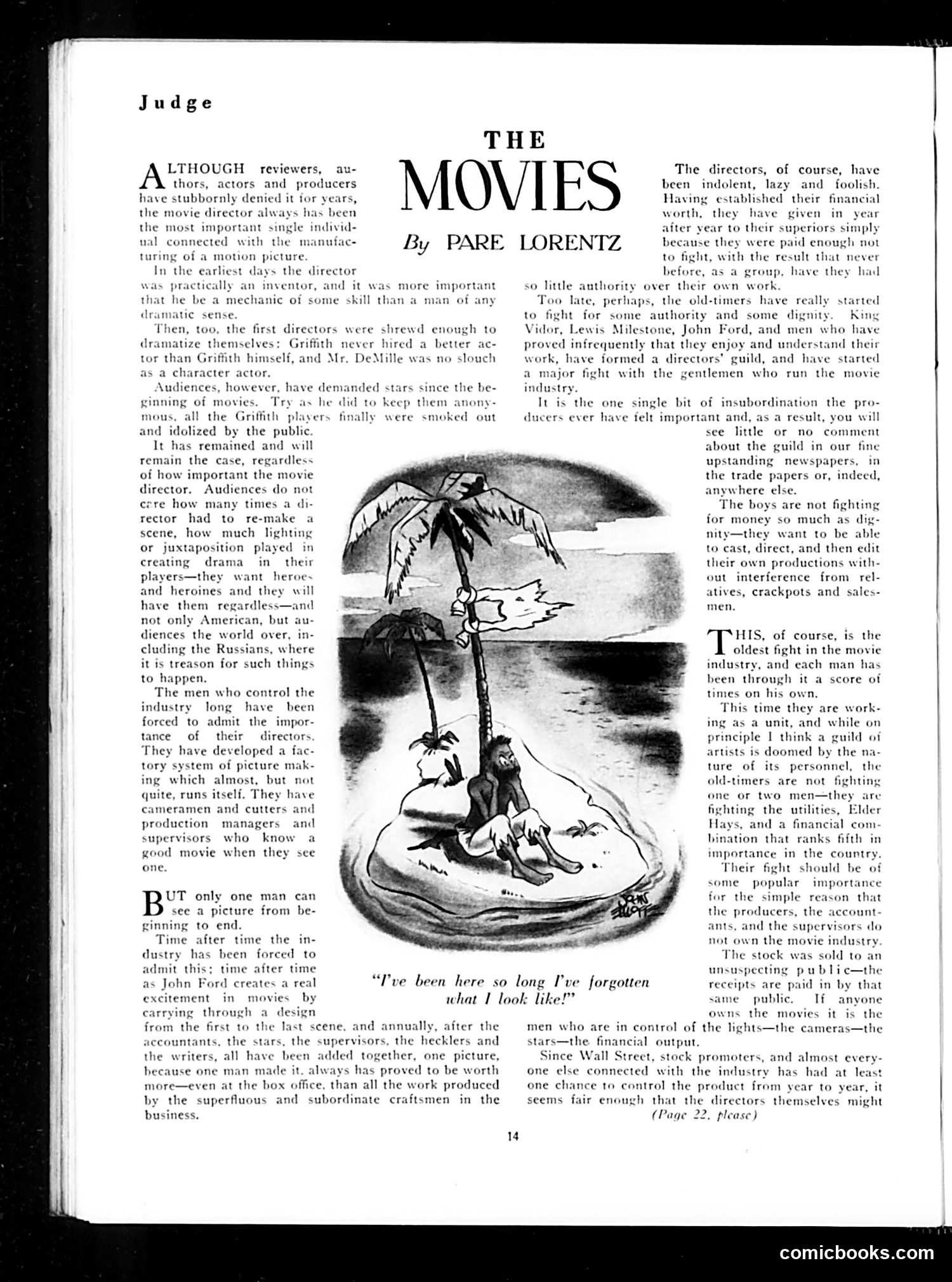
A restored page from Judge, 1936-04. Page through the whole issue in the reader above.
📄 Transcribed text from this page (OCR, searchable)
Machine-transcribed from the original scan — historical spelling and the odd misread are preserved.
Judge THE been indolent, lazy and foolish. Having established their financial By PARE LORENTZ LTHOUGH reviewers, au- thors, actors and producers have stubbornly denied it for years, the movie director always has been the most important single individ- ual connected with the manufac- turing of a motion picture. In the earliest days the director aly an i that he be a mechanic of some skill than a man of any dramatic sense. s prac ventor, and it was more ort Then, too, the first directors were shrewd enough to dramatize themselves: Griffith never hired a better ac- tor than Griffith himself, and Mr. DeMille was no slouch as a character actor. Au ginning of movies. Try as he did to keep them anony- mous, neces, however, have demanded stars since the be- all the Griffith players finally were smoked out and idolized by the public It has remained and will remain the case, regardless of how important the movie director. Audiences do not cere how many times a di- rector had to re-make a scene, how much lighting or juxtaposition played in creating drama in their players—they want heroes and heroines and they will have them regardless—and not only American, but au- diences the world over, cluding the Russians, where it is treason for such things to happen. The men who control the industry long have been forced to admit the impor- tance of their directors. They have developed a fac- tory system of picture mak- ing which almost, but not quite, runs itself. They have cameramen and cutters and production managers and supervisors who know a good movie when they see one. 1 UT only one man can see a picture from be- nning to end. Time after time the in- dustry has been forced to admit this; time after time as John Ford creates a real excitement in movies by carrying through a design from the first to the last scene, and annually, after the untants, the stars, the supervisors, the hecklers and Il have been added together, one picture, Iways has proved to be worth more—even at the box office, than all the work produced by the superfluous and subordinate craftsmen in the business. ace the writers, because one man made it “Tve been here so long I've forgotten what 1 look like!’ same public. If anyone The directors, of course, have worth, they have given in year after year to their superiors simply because they were paid enough not to fight, with the result that never before, as a group, have they had over their own work s, the old-timers have really sta to fight for some authority and some dignity Vidor, Lewis Milestone, John Ford, and men who have proved infrequently that they enjoy and understand their work, have formed a directors’ guild, and have started a major fight with the gentlemen who run the movie industry. so little author late, perl It is the one single bit of insubordination the pro- ducers ever have felt important and, as a result, you will see little or no comment about the guild in our fine upstanding newspapers, in the trade papers or, indeed, anywhere else, The boys are not fighting for money so much as dig- nity—they want to be able to cast, direct, and then edit their own productions with- out interference from rel- atives, crackpots and sales- men, HIS, of course, is the oldest fight in the movie industry, and each man has been through it a score of times on his own, This time they ing as a unit, principle I think a ¢ artists is doomed by the na- ture of its personnel, the old-timers are not fighting one or two men—they are fighting the utilities, Elder Hays, and a financial com bination that ranks fifth in importance in the country. Their fight should be of some popular importance for the simple reason that the producers, the account re work- ants, and the supervisors do not own the movie industry The stock was sold to an unsuspecting public—the receipts are paid in by that owns the movies it is the men who are in control of the lights—the stars—the financial output. Since Wall Street, stock promoters, and almost every- one else connected with the industry has had at lea one chance to control the product from year to year, it meras—the seems fair enough that the directors themselves might age 22, please) comicbooks.com