
Judge, 1935-12 · page 29 of 41
Judge — December 1935 — page 29: what you’re looking at
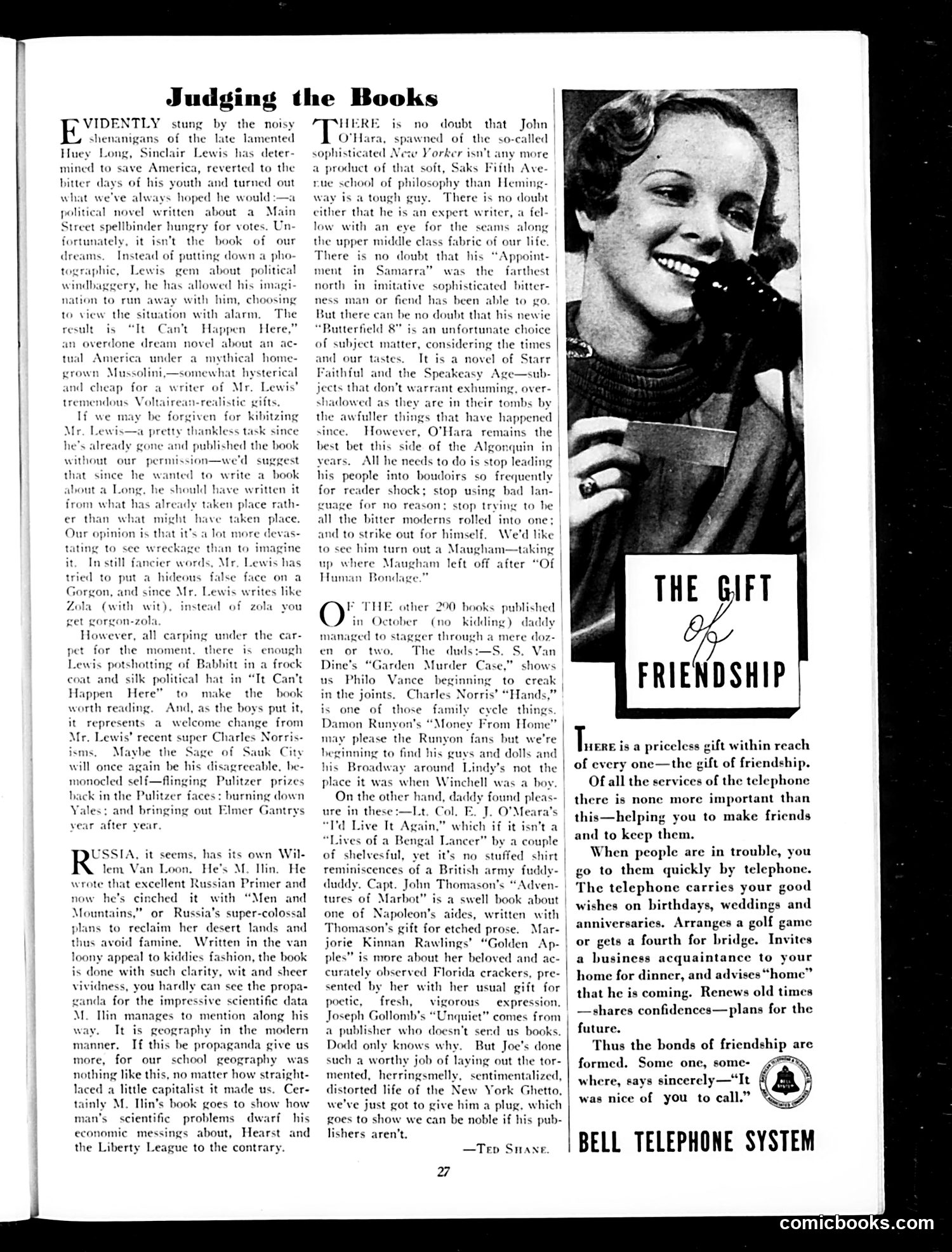
A restored page from Judge, 1935-12. Page through the whole issue in the reader above.
📄 Transcribed text from this page (OCR, searchable)
Machine-transcribed from the original scan — historical spelling and the odd misread are preserved.
VIDENTLY shenanigans of the late Huey Long, Sinclair Lewis has deter- stung by the noisy mented mined to save America, reverted to the bitter days of his youth and turned out what we've always hoped he would :—a political novel written about a Mai Street spellbinder hungry for votes. Un- fortunately, it isn't the book of our dre: Instead of putting down a phi tographic, Lewis gem about politic windbaggery ms e¢ has allowed his imagi nation to run away with hi to view the situation with alarm. T result “It Can't Happen Here verdone dream novel about an ac- choosing is tual America under a mythical home- Mussolini grown —somewhat hysterical riter of Mr. ealistic gifts, and Lewis’ trem If we may be forgiven for kibitzing Mr. Lewis—a pretty thankless task since he’s already gone and published the book without i—we'd that he wanted to write a about a Long, h our permis suggest book e should have written it from what has already taken place rath- er than t might have taken place. Our opinion is that it’s a lot tating to see wrecka it. Instill fancier we tried to. put Gorgon, and Zola wit) get gorgon-zola. However, all carping under the car- for the moment. there ough Lewis potshotting of Babbitt in a frock coat and silk political hat in “Tt Can't Happen Here” to make the worth reading. And, as the boys put it, it represents welcome change from Mr, Lewis’ recent super Charles Norri isms, Maybe the of Sauk City will once again be his disagreeable, be- monocled self—fling Pulitzer prizes back in the Pulitzer faces: burning down Yal and bringing out Elmer Gantrys year after year. since w ie devas- than to in s. Mr. false face on a Mr. Lewis writes like instead of agine Lewis has rideous m1 (with zola you pet is ce boc age USSIA, it seems, has its own Wil- lem Van Loon, He’s M. Hin. He wrote that excellent Russian Primer and now he’s cinched it with “Men and Mountains,” or Russia’s super-colossal plans to reclaim her desert lands and thus avoid famine. Written in the van loony appeal to kiddies fashion, the book is done with such clarity, wit and sheer vividness, you hardly can see the propa- ganda for the impressive scientific data M. Tin manages to mention along his way. It is geography in the modern manner. If this be propaganda give us more, for our school geography was nothing like this, no matter how straight- laced a little capitalist it made us. Cer- tainly M. Ilin’s book goes to show how man’s scientific problems dwarf economic messings about, Hearst the Liberty League to the contrary. his and Judging the Books HERE is no doubt that) John O'Hara, spawned of the so-called sophisticated New Yorker isn’t any more a product of that soft, Saks Fifth Ave rue school of philosophy than Heming way is a tough guy. There is no doubt cither that he is an expert writer, a fel- low with an eye for the seams along | the upper middle class fabric of our life. There is no doubt that his “Appoint- ment in rra” was the farthest north in imitative sophisticated bi ness man or fiend has been able to 3ut there can be no doubt that his newi “Butterfield 8) an unfortunate choic of subject matter, considering the times and our tastes. It is a novel of Starr Faithful and the Speakeasy Age—sub- jects that don’t warrant exhuming, over- e in their tombs by the awfuller things that have happened since. However, O'Hara remains the best bet this side of the Algon years. shadowed as the uin in All he needs to do is stop leading his people into boudoirs so frequently for reader shock; stop using bad lan- guage f to he 1 the bitter moderns rolled into one: to strike out for himself. We'd like see him turn out a Maugham—taking up where Maugham left off after “Of Human Be O THE other 290 books published October kidding) daddy managed to stagger through a mere doz- en or two. The duds:—S. S. Van Dine’s “Garden Murder Case,” shows us Philo Vance beginning to creak in the joints. Charles Norris’ “Hands,” is one of those family cycle thi Damon Runyon's “Money From Home” | please the Runy inning to * NO reason; stop tryit in (no e on fans but we're nd his guys and dolls and his Broadway around Lindy’s not the | place it was when Winchell was a boy. On the other hand, daddy found ple ure in these:—Lt. Col. E. J. O'Mear: “Td Live It Again,” which if it isn’t a “Lives of a Bengal Lancer” by a couplh of shelvesful, yet it’s no stuffed shirt reminiscences of a British army fuddy- duddy. Capt. John Thomason’s “Adven- tures of Marbot” is a swell book about one of Napoleon's aides, written with Thomason's gift for etched prose. Mar- jorie Kinnan Rawlings’ “Golden Ap- ples” is more about her beloved and ac- curately observed Florida crackers, pre- sented by her with her usual gift for poetic, “fresh, vigorous expression, Joseph Gollomb’s “Unquiet” comes from a publisher who doesn’t send us boc Dodd only knows why. But Joe's done such a worthy job of laying out the tor- mented, herringsmelly, sentimentalized, distorted life of the New York Ghetto, we've just got to give him a plug, which goes to show we can be noble if his pub- lishers aren’. —Tep Snane. 27 IFT FRIENDSHIP Tees is a priceless gift within reach of every one—the gift of friendship. Of all the services of the telephone there is none more important than this—helping you to make friends and to keep them. When people are in trouble, you go to them quickly by telephone. The telephone carries your good wishes on birthdays, weddin anniversaries. Arranges a golf game or gets a fourth for bridge. Invites s and ja business acquaintance to your home for dinner, and advises “home” that he is coming. Renews old times | —shares confidences—plans for the | future. Thus the bonds of friendship are formed. Some one, some- where, says sincerely —“It was nice of you to call.” BELL TELEPHONE SYSTEM comicbooks.com