
Judge, 1935-12 · page 18 of 41
Judge — December 1935 — page 18: what you’re looking at
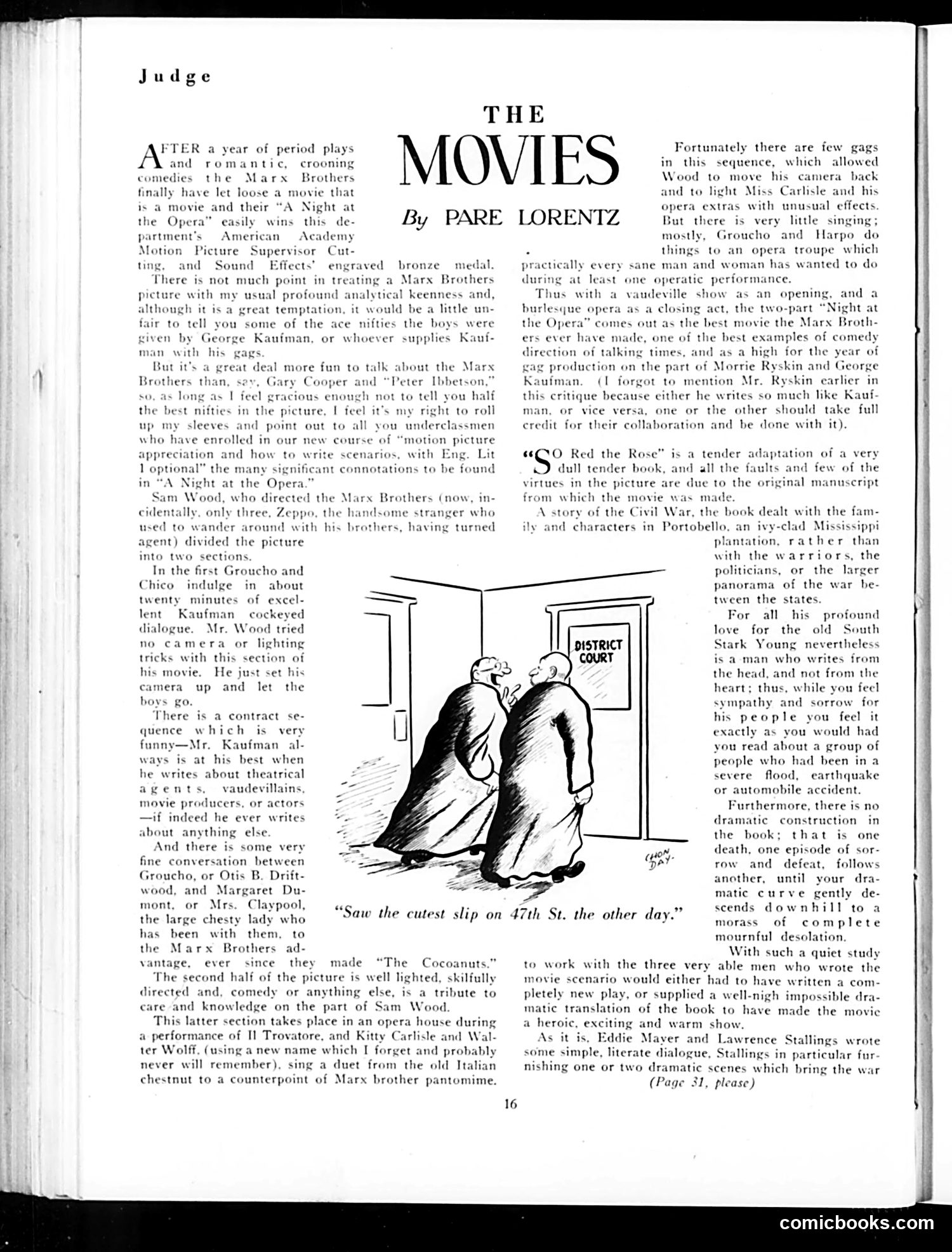
A restored page from Judge, 1935-12. Page through the whole issue in the reader above.
📄 Transcribed text from this page (OCR, searchable)
Machine-transcribed from the original scan — historical spelling and the odd misread are preserved.
Judge THE FTER a year of period plays rtunately there are few gags and romantic, crooning in this sequence, which allowed comedies the Marx Brothers Wood to move his camera back finally have let loose a movie that and to light Miss Carlisle and his is a movie and their “A Night at = a opera extras with unusual effects the Opera” easily wins this de- By PARE LORENTZ But there is very little singing; partment's American Academy mostly, Groucho and Harpo do Motion Picture Supervisor Cut- . things to an opera troupe which and Sound Effects’ engraved bronze medal. There is not much point in trea Marx Brothers picture with my usual profound analytical keenness and, although it is a great temptation, it little un- fair to tell you some of the ace nifties the boys were ven by George Kaufman supplies Kanf- n with his gags would be a or whoever m ut the \ arx Brothers sey, Gary Cooper and “Peter [bbetson, so, as long h not to tell you half the best nifties in the picture, [ feel it’s my right to roll up my sleeves and point out to all you underclassmen who have enrolled in our new course of “motion picture appreciation and how to write scenarios, with Eng. Lit 1 optional” the many significant connotations to be found in “A Night at the Opera.” Sam Wood, who directed the Marx Brothers (now, in- cidentally, only three, Ze the handsom as I feel gracious enow stranger who used to wander around with his brothers, having turned agent) divided the picture into two sections. In the first Groucho and Chico indulge in) about twenty minutes of excel- lent Kaufman cockeyed Mr. Wood tried no camera or lighting tricks with this section of his movie. He just set his camera up and let. the dialogue. There is a contract se- quence which is very funny—Mr. Kaufman al- ways is at his best when he writes about theatrical agents, audevillains, movie producers, or actors 2 —if indeed he ever writes about anything else. And there is some very fine conversation between Groucho, or Otis B. Drift- wood, and Margaret Du- mont, or Mrs jaypool, the large chesty lady who “Saw the cutest slip on has been with them. to the Marx Brothers ad- vantage, ever since they made “The Cocoanuts.” The second half of the picture is well lighted, skilfully comedy or anything else, is a tribute to e and knowledge on the part of Sam Wood This latter section takes place in an opera house during a performance of Il Trovatore, and Kitty Carlisle and Wal- ter Wolff, (using a new name which I forget and probably never will remember), sing a duet from the old Italian chestnut to a counterpoint of Marx brother pantomime. directed and 16 practically every sane man and woman has wanted to do during at least one operatic performance. Thus with a opening, and a burlesque opera as a closing act, the two-part “Night at the Opera” comes out as the best movie the Marx Broth- vaudeville show as an ers ever have made, one of the best examples of comedy direction of talking times, and as a high for the y gag production on the part of Morrie Ryskin and George Kaufman. (I forgot to mention Mr. Ryskin earlier in this critique because either he writes so much like Kauf man, or vice versa, the other should take full credit for their collaboration and be done with it). rar of one or «6CO Red the Rose” is a tender adaptation of OD dull tender book, and all the faults virtues in the picture are due to the original manuscript very nd few of the from which the movie was made. \ story of the Civil War, the book dealt with the fam- and characters in Portobello, an ivy-clad Mississippi plantation, rather than with the warriors, the politicians, or the larger panorama of the war be- tween the states. For all his profound love for the old South Stark Young nevertheless is aman who writes from the head, and not from the heart; thus, while you feel sympathy and sorrow for his people you feel it ly as you would had you read about a group of people who had been in a severe flood, earthquake or automobile accident. DISTRICT Furthermore, there is no dramatic construction in the book; that is one (uot, death, one episode of sor- parr row and defeat, follows another, until your dra- matic curve gently de- scends downhill to a morass of complete mournful desolation. With such a quiet study to work with the three very able men who wrote the movie scenario would either had to have written a com- pletely new play, or supplied a well-nigh impossible dra- matic t ation of the book to have made the movie a heroic, exciting and warm show. As it is, Eddie Mayer and Lawrence Stallings wrote some simple, literate dialogue, Stallings in particular fur- nishing one or two dramatic scenes which bring the war (Page 31, please) comicbooks.com