
Judge, 1935-11 · page 8 of 36
Judge — November 1935 — page 8: what you’re looking at
What you’re looking at
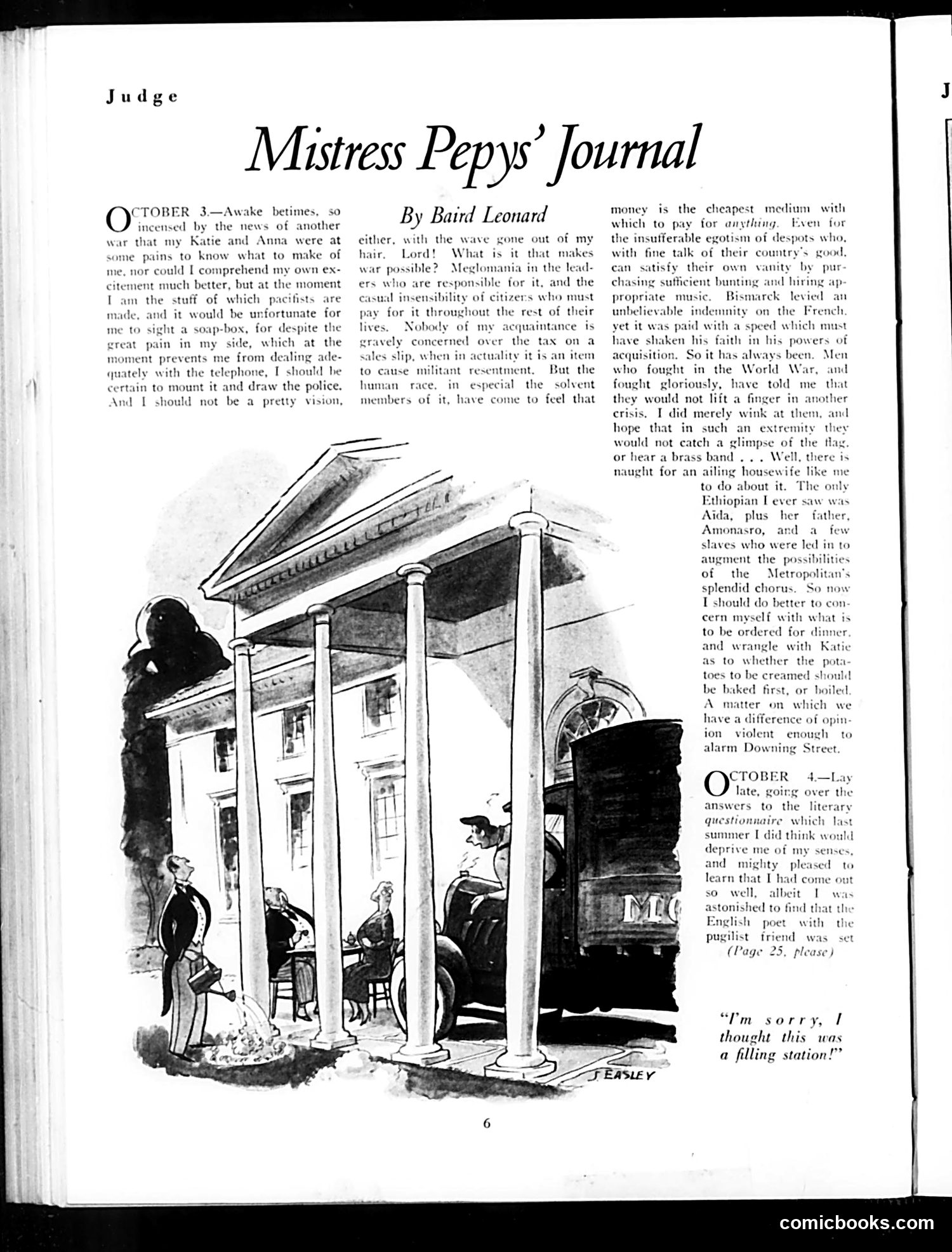
# "Mistress Pepys' Journal" by Baird Leonard This is a fictional satirical column mimicking Samuel Pepys' famous 17th-century diary. The October 3rd entry humorously complains about post-WWI social problems: tax complaints on yachts causing "militant resentment," widespread strikes, and general public discontent. The writer sarcastically hopes such crises won't reach Ethiopia or disrupt the Metropolitan Opera's chorus. The accompanying cartoon depicts a car arriving at what appears to be a gas station, with the caption "I'm sorry, I thought this was a filling station!" The joke plays on 1920s labor unrest—the uniformed figures and formal setting suggest the vehicle has mistakenly pulled up to some official or governmental building instead of a commercial gas pump, satirizing the period's confusion and disruption caused by strikes and social upheaval.
📄 Transcribed text from this page (OCR, searchable)
Machine-transcribed from the original scan — historical spelling and the odd misread are preserved.
Judge Mastress Pepys’ Journal By Baird Leonard either, with the wave gone out of my incensed by the news of another Katie and Anna were at some pains to know what to make of me, nor could [ comprehend my own ex- citement much better, but at the moment I am the stuff of which pacifist and it would be unf box, for despite the war that my Meglomania in the le ers who are responsible for it, war possible? casual insensibility of citizers wh out the rest of their for it throu Nobody of my quaintance is vent prevents me from dealing ade- les slip, when in quately with the telephone, I should he certain to mount it and draw the police. ctuality it is am item members of it, have come to feel that money is the cheapest medium with which to pay for anything. Even for the insufferable egotism of despots who, with fine talk of their country’s 1, can satisfy their own vanity by pur chasing sufficient buntin; a propriate music. Bismarck levied an unbelievable indemnity on the Fr yet it was paid with a speed which must have shaken his faith in his powers of acquisition. So it has always been. Men who fought in the World War, and fought gloriously, have told me that they would not lift a finger in another crisis. I did merely wink at them, and hope that in such an extremity they would not catch a glimpse of the flay. or hear a brass band... Well, t naught for an ailing housewife like bout it. The ¢ Ethiopian [ever saw was Aida, plus her father, Amonasro, a slaves who were led in to augment the possibilities of the Metropolitan's splendid chorus. So now I should do better to con cern myself with what is to be ordered for dinner and wrangle with Katie as to whether the pota- toes to be creamed shou be baked first, or boiler A matter on which we have a difference of opin ion violent enough to alarm Downing Street Thiring ap ach. to do doa few CTOBER late, going over the answers to the literary questionnaire which | summer I did think w deprive 4—Lay id ie of my senses, and mighty pleased to learn that I had come out so well, albeit Twas astonished to find that the English with the pugilist friend was set (Page 25, please) “Tm sorry, 1 thought this was a filling station!” comicbooks.com