
Judge, 1935-10 · page 16 of 36
Judge — October 1935 — page 16: what you’re looking at
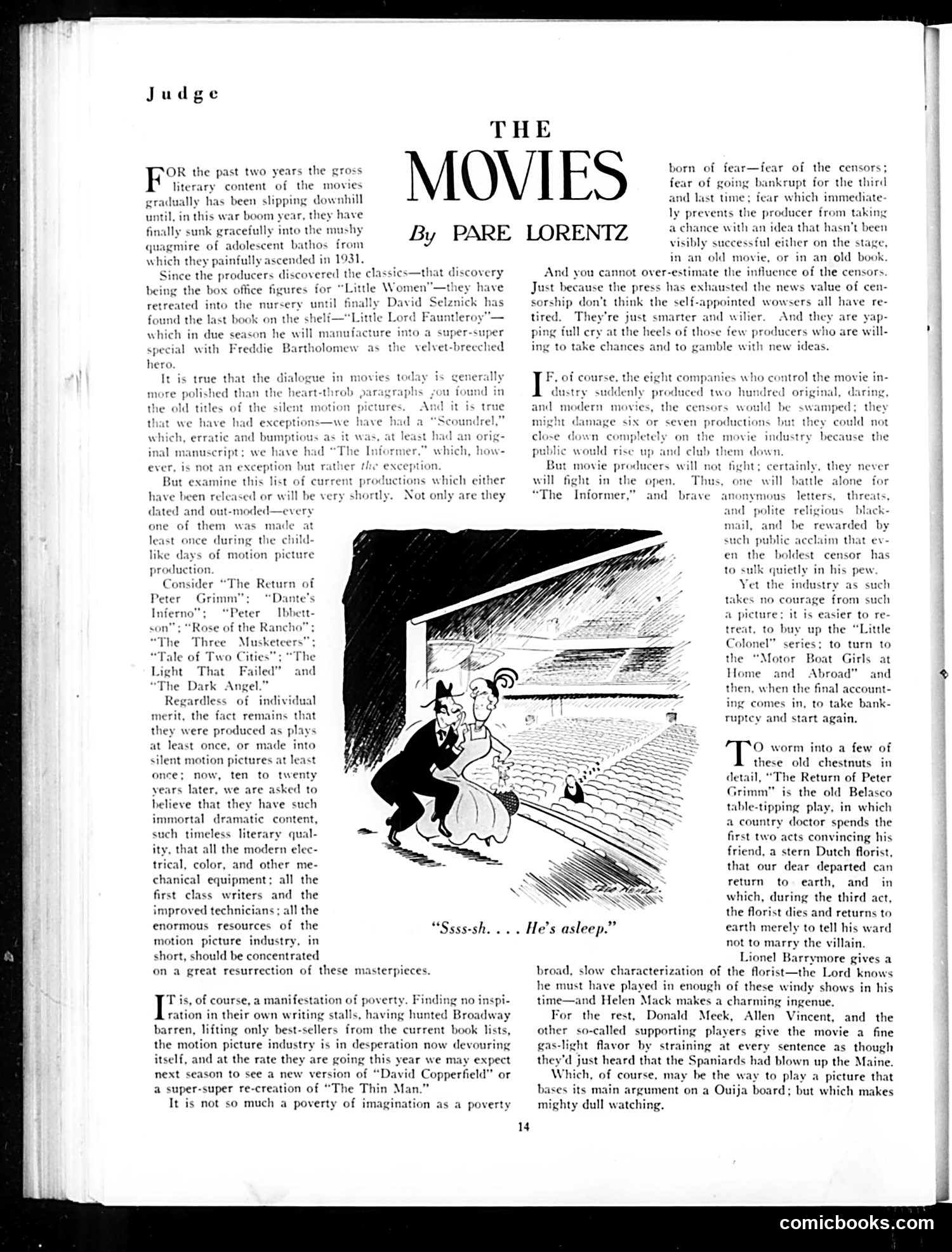
A restored page from Judge, 1935-10. Page through the whole issue in the reader above.
📄 Transcribed text from this page (OCR, searchable)
Machine-transcribed from the original scan — historical spelling and the odd misread are preserved.
Judge THE OR the past two years the gross F content the gradually has been slipping downhill have literary movies until, in this war boom year, th finally sunk gracefully into U quagmire of adolescent bathos from mushy which they painfully ascended in 1931. Since the producers discovered the classics—that discovery being the box office figures for “Little Women"— have retreated into the nursery until finally David Selznick has found the last book on the sheli—“Little Lord Fa which in due season he will manufacture into a super-super 3artholomew the ntleroy"— velvet-breeched. as special with Freddie hero, It is true that the dialo olished than the heart-thr dl tith we have had exceptic d bumy inal manuscript; we | ore the « es of siler . erratic ve ever, is not mn but r an except her the exception. But examine this list of currer ctions which either have been released or will be very 5 Not only are they dated and out-moded—every one of them was made at least once during the child- like days of motion picture production. Consider “The Return of Peter Grimm”; “Dant Inferno"; “Peter — Ibbett- son”; “Rose of the Ra i The Three Musketeers”; Pale of Two Cities”; “The Light Th Faile and “The Dark Angel.” Regardless of individual merit, the fact remains that they were produced as plays at least once, or made into silent motion pictures at least ¢; now, ten to years later, we are asked to believe that they have such immortal dramatic content, such timeless literary qual- ity, that all trical, color, and other me- chanical equipment; all the first class writers and the improved technici: Il the enormous resources of the motion picture industry, in short, should be concentrated on a great resurrection o ‘ho twenty modern elec- ns ; these masterpieces. T is, of course, a manifestation of poverty. Finding no inspi- ration in their own writing stalls, having hunted Broadway barren, lifting only best-sellers from the current book lists, the motion picture industry is in desperation now devouring self, and at the rate they are going this year we may expect next season to see a new version of “David Copperfield” or a super-super re-creation of “The Thin Man.” It is not so much a poverty of ima ination as a poverty 14 MOVIES By PARE LORENTZ “Ssss-sh. ... He’s asleep.” born of fear—fear of the censors; fear of going bankrupt for the third and last time; fear which immediate: ly prevents the producer from taking a chance with an idea that hasn't been visibly successful either on the stage, in an old movie, or in an old book. And you cannot over-estimate t Just because the press has exhausted the news value of cen- sorship don't think the self-appointed wowsers all have re- tired. They're just smarter and \ And they ping full ery at the heels of those few producers w influence of the censors. lier. are yap- ho are will- nd to gamble with new ideas. ing to take chances ht companies who control the movie in- 1 lenly produced two hund red original, daring, 1 be swamped; t + modern te ed it « 1 and movies, the censors w« ey t ey could not mage six or seven productions y ywn completely on the movie industry because the S would rise up and club t! 3ut_ movie producers will not will fight inthe “The Informer,” close ¢ pu lic em down fight; certainly, they never battle alone for will | ous letters, threats, one open. and brave an yn ud mail, and be rewarded by lite black- religious lic acclaim that ev- has to sulk quietly in his pew Yet the industry as such takes no courage from suc a picture; it is easier to re- treat, to buy up the “Little Colonel” series; to turn the “Motor Boat Girls at Home and Abroad” and then, when the final account- ing comes in, to take bank- ruptey and start again, such pul en the boldest censor to O worm into a few of these old chestnuts in detail, “The Return of Peter Grimm” is the old Belasco table-tipping play, in which a country doctor spends the first two acts convincing his friend, a stern Dutch florist, that our dear departed can return to earth, and in which, during the third act, the florist dies and returns to earth merely to tell his ward not to marry the villain. Lionel Barrymore gives a broad, slow characterization of the florist—the Lord knows he must have played in enough of these windy shows in his time—and Helen Mack makes a charming ingenue, For the rest, Donald Meek, Allen Vincent, and the other so-called supporting players give the movie a fine gas-light flavor by straining at every sentence as though they'd just heard that the Spaniards had blown up the Maine. Which, of course, may be the way to play a picture that bases its main argument on a Ouija board; but which makes mighty dull watching. comicbooks.com