
Judge, 1935-09 · page 22 of 36
Judge — September 1935 — page 22: what you’re looking at
A restored page from Judge, 1935-09. Page through the whole issue in the reader above.
📄 Transcribed text from this page (OCR, searchable)
Machine-transcribed from the original scan — historical spelling and the odd misread are preserved.
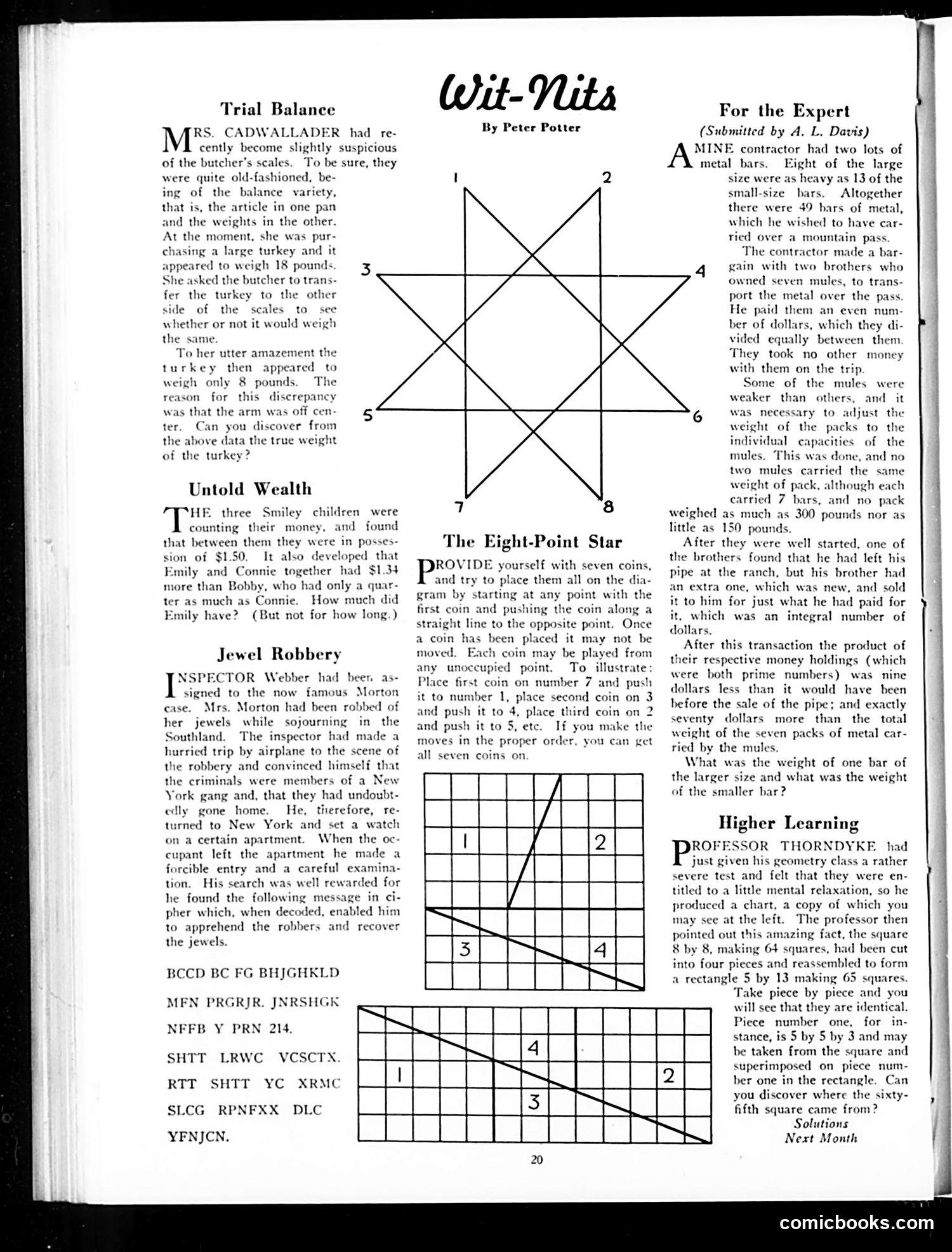
Trial Balance RS. CADWALLADER had re- cently become slightly suspicious of the butcher's scales. To be sure, they were quite old-fashioned, be- ing of the balance variety, that is, the article in one pan and the weights in the other. At the moment, she was pur- chasing a large turkey and it appeared to weigh 18 pounds. She asked the butcher to trans- fer the turkey to the other side of the scales to whether or not it would weigh the same. To her utter amazement the turkey then appeared to weigh only 8 pounds. The reason for this discrepan was that the arm was off ter. Can you discover from the above data the true weight of the turkey Untold Wealth HE three Smiley children were counting their money, and found that between them they were in posses- sion of $1.50. It also developed that Emily and Connie together had $1.34 more than Bobby, who had only a quar- ter as much as Connie. How much did Emily have? (But not for how long.) Jewel Robbery ] -ECTOR Webber hac signed to the now famous been as- Morton case. Mrs. Morton had been robbed of her jewels while sojourning in the Southland. The inspector had made a hurried trip by airplane to the scene of the robbery and convinced himself that the criminals were members of a N York gang and, that they had undoubt- edly gone home. He, therefore, re- turned to New York and set a watch on a certain apartment. When the oc- cupant left the apartment he made a forcible entry and a careful e tion. His search was well rewarc he found the following mes: pher which, when decoded, enabled him to apprehend the robbers and recover the jewels. Ww an d for age in ci- BCCD BC FG BHJGHKLD MFN PRGRJR. JNRSHGK NFFB Y PRN 214. (Wit-Vuts By Peter Potter 7 8 The Eight-Point Star ROVIDE yourself with seven coins, and try to place them all on the dia- gram by starting at any point with the first coin and pushing the coin along a the opposite point. Once placed it may not be y be played from point. To illustrate: Place first coin on number 7 and push it to number 1, place second coin on 3 nd push it to 4, place third coin on 2 and push it to 5, etc. If you make the moves in the proper order, you can get all seven coins on. moved. any unoccup' For the Expert (Submitted by A. L. Davis) MINE contractor had two lots of metal bars. tight of the large size were as heavy as 13 of the small-size bars. Altogether there were 49 bars of metal, which he wished to have car- ried over a mountain pass. The contractor made a bar- 4 gain with two brothers who owned seven mules, to trans- port the metal over the pass. He paid them an even num- ber of dollars, which they di- vided equally between them They took no other money with them on the trip. Some of the mules weaker than others, and it 6G Was necessary to adjust the weight of the packs to the individual capacities of the mules. This was done, and no two mules carried the same weight of pack, although each carried 7 bars, and no pac weighed as much as 300 pounds nor as little as 150 pounds. Aifter they were well started, one of the brothers found that he had left his pipe at the ranch, but his brother had an extra one, which was new, and sold it to him for just what he had paid for it, which was an integral number of dollars. After this transaction the product of their respective money holdings (which were both prime numbers) was nine dollars less than it would have been hefore the sale of the pipe; and exactly seventy dollars more than the total weight of the seven packs of metal car- ried by the mules. What was the weight of one bar of the larger size and what was the weight of the smaller bar? were Higher Learning ROFESSOR THORNDYKE. had just given his geometry class a rather severe test and felt that they were en- titled to a little mental relaxation, so he produced a chart, a copy of which you may see at the left. The professor then pointed out this amazing fact, the square 8 by 8, making 64 squares, had been cut into four pieces and reassembled to form a rectangle 5 by 13 making 65 squares. Take piece by piece and you will see that they are identical. Piece number one, for in- SHTT LRWC VCSCTX RTT SHTT YC XRMC SLCG RPNFXX DLC YFNJCN. stance, is 5 by 5 by 3 and may be taken from the square and superimposed on piece num- ber one in the rectangle. Can you discover where the sixty- fifth square came from? Solutions Next Month comicbooks.com