
Judge, 1935-06 · page 4 of 37
Judge — June 1935 — page 4: what you’re looking at
What you’re looking at
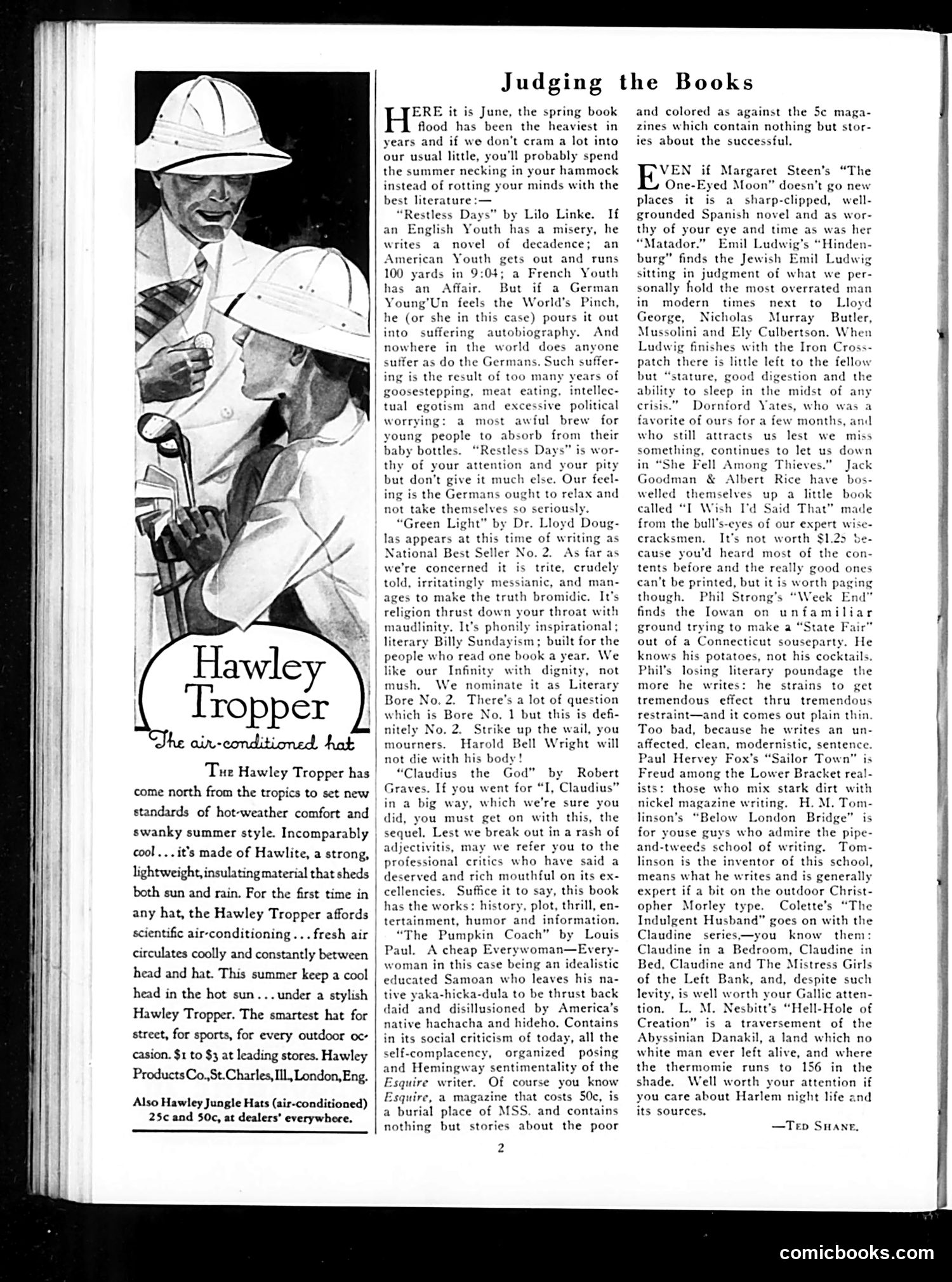
# Analysis of "Judging the Books" Page This page is primarily a **book review column** rather than political satire. The left side features an advertisement for the Hawley Tropper hat, showing a man in colonial/tropical dress examining the product. The bulk of the page comprises literary reviews by Ted Shane. The reviews discuss contemporary novels including works by Lilo Linke, Dr. Lloyd Douglas, Robert Graves, and Louis Paul, critiquing their literary merit and social commentary. Shane evaluates these books' quality, themes, and relevance to readers. The only potential satirical element is the implicit critique of certain authors' pretentiousness or social messaging within the book reviews themselves—a common feature of Judge's cultural commentary. However, this page functions primarily as consumer guidance for readers seeking summer reading recommendations.
📄 Transcribed text from this page (OCR, searchable)
Machine-transcribed from the original scan — historical spelling and the odd misread are preserved.
Tue Hawley Tropper has | come north from the tropics to set new | standards of hot-weather comfort and swanky summer style. Incomparably cool... it's made of Hawlite, a strong, lightweight, insulating material that sheds both sun and rain. For the first time in any hat, the Hawley Tropper affords head and hat. This summer keep a cool head in the hot sun... under a stylish Hawley Tropper. The smartest hat for street, for sports, for every outdoor oc- casion. $1 to $3 at leading stores. Hawley Products Co.,St.Charles, Ill, London,Eng. Also Hawley Jungle Hats (air-conditioned) 25c and 50c, at dealers’ everywhere. Judging the Books RE it is June, the spring book flood has been the heaviest in years and if we don't cram a lot into our usual little, you'll probably spend the summer necking in your hammock instead of rotting your minds with the best literature: “Restless Days” by Lilo Linke. If an English Youth has a misery, he writes a novel of decadence; an American Youth gets out and runs 100 yards in 9:04; a French Youth has an Affair. But if a German Young’Un feels the World’s Pinch, he (or she in this case) pours it out into suffering autobiography. And nowhere in the world does anyone suffer as do the Ger s. Such suffer- ing is the result of too many years of goosestepping, meat eating, intellec- tual egotism and excessive political worrying: a most awful brew for young people to absorb from their baby bottles. “Restless Days” is wor- thy of your attention and your pity but don’t give it much else. Our feel ing is the Germans ought to relax and not take themselves so seriously. “Green Light” by Dr. Lloyd Doug- las appears at this time of writing as National Best Seller No. 2. As far as we're concerned it is trite, crudely told, irritatingly messianic, and man- ages to make the truth bromidic. It’s religion thrust down your throat with maudlinity. It's phonily inspirational ; literary Billy Sundayism; built for the people who read one book a year. We like our Infinity with dignity, not mush, We nominate it as Literary Bore No. 2. There's a lot of question which is Bore No. 1 but this is defi- nitely No. 2. Strike up the wail, you mourners. Harold Bell Wright will not die with his body! “Claudius the God" by Robert Graves. If you went for “I, Claudius” in a big way, which we're sure you did, you must get on with this, the sequel. Lest we break out in a rash of adjectivitis, may we refer you to the professional critics who have said a deserved and rich mouthful on its ex- cellencies. Suffice it to say, this book has the works: history, plot, thrill, en- | tertainment, humor and information. scientific air-conditioning... fresh air | circulates coolly and constantly between | “The Pumpkin Coach” by Louis Paul. A cheap Everywoman—Every- woman in this case being an ide educated Samoan who leaves his na- tive yaka-hicka-dula to be thrust back daid and disillusioned by America’s native hachacha and hideho, Contains in its social criticism of today, all the self-complacency, organized posing and Hemingway sentimentality of the Esquire writer. Of course you know quire, a magazine that costs 50c, is a burial place of MSS. and contains nothing but stories about the poor 2 and colored as against the 5c maga- zines which contain nothing but stor- ies about the successful. JEN if Margaret Steen’s “The One-Eyed Moon” doesn’t go new places it is a sharp-clipped, well- grounded Spanish novel and as wor- thy of your eye and time as was her “Matador.” Emil Ludwig's “Hinden- burg” finds the Jewish Emil Ludwig sitting in judgment of what we per- sonally hold the most overrated man in modern times next to Lloyd George, Nicholas Murray Butler, Mussolini and Culbertson. When Ludwig finishes with the Iron Cross- patch there is little left to the fellow but “stature, good digestion and the ability to sleep in the midst of a cris Dornford Yates, who was a favorite of ours for a few months, and who still attracts us lest we miss something, continues to let us down in “She Fell Among Thieves.” Jack Goodman & Albert Ri have bos- welled themselves up little book called “I Wish I'd Said That” made from the bull’s-eyes of our expert wi cracksmen. It’s not worth $1.2) ¢ cause you'd heard most of the con- tents before and the re ood ones can’t be printed, but it is worth paging though. Phil Strong’s “Week End” finds the Iowan on unfamiliar ground trying to make a “State Fair” out of a Connecticut souseparty. He knows his potatoes, not his cocktails. Phil’s losing literary poundage the more he writes: he strains to get tremendous effect thru tremendous restraint—and it comes out plain thin Too bad, because he writes an un- affected, clean, modernistic, sentence. Paul Hervey Fox's “Sailor Town” is Freud among the Lower Bracket real- ists: those who mix stark dirt with nickel magazine writing. H. M. Tom- linson’s “Below London Bridge” is for youse guys who admire the pipe- and-tweeds school of writing. Tom- linson is the inventor of this school, means what he writes and is generally expert if a bit on the outdoor Christ- opher Morley type. Colette’s “The Indulgent Husband” goes on with the Claudine series—you know them: Claudine in a Bedroom, Claudine in Bed, Claudine and The Mistress Girls of the Left Bank, and, despite such levity, is well worth your Gallic atten- tion, L. M. Nesbitt’s “Hell-Hole of Creation” is a traversement of the Abyssinian Danakil, a land which no white man ever left alive, and where the thermomie runs to 156 in the shade. Well worth your attention if ou care about Harlem night life and its sources. —Tep SHane. comicbooks.com