
Judge, 1935-06 · page 27 of 37
Judge — June 1935 — page 27: what you’re looking at
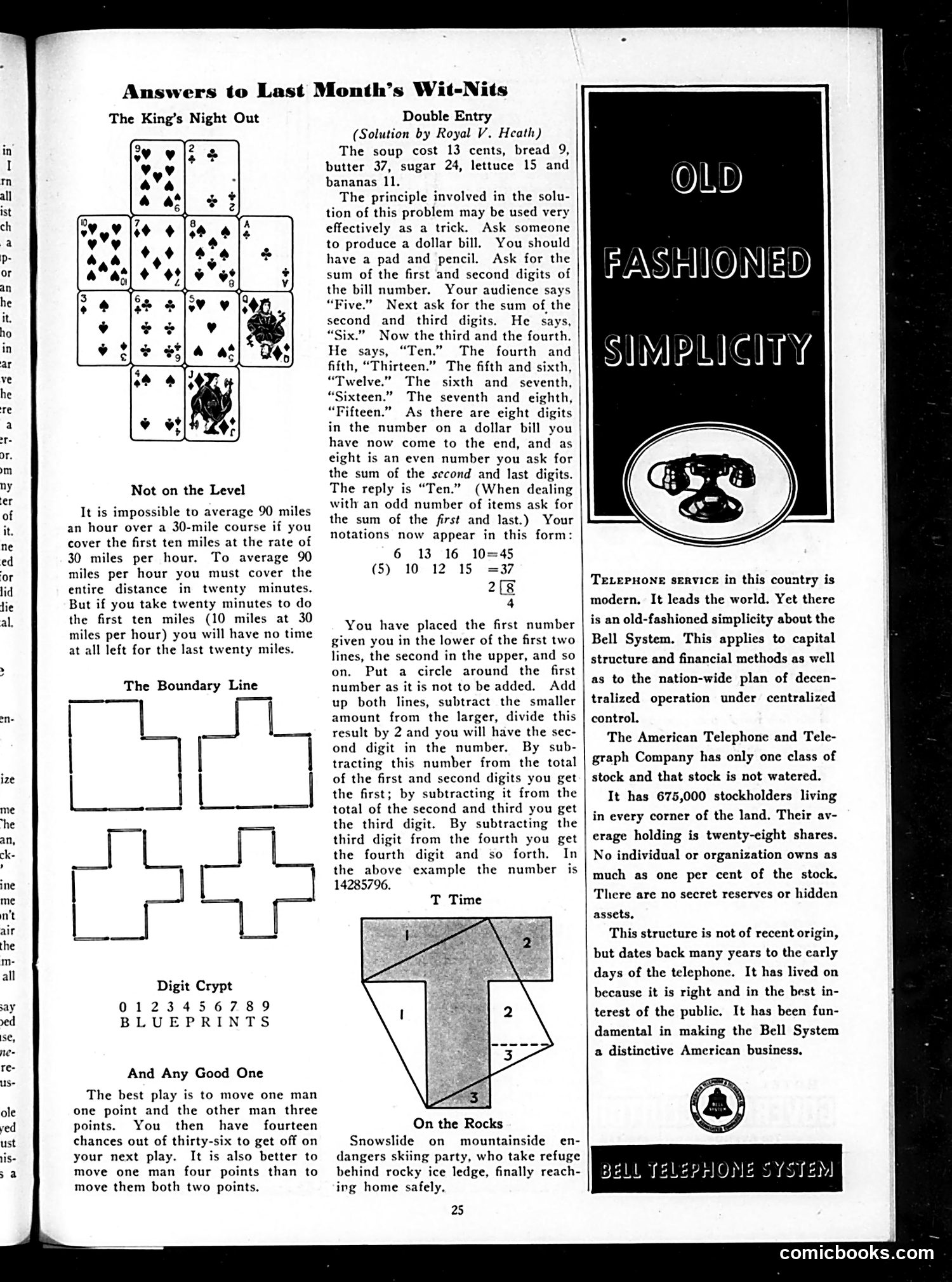
A restored page from Judge, 1935-06. Page through the whole issue in the reader above.
📄 Transcribed text from this page (OCR, searchable)
Machine-transcribed from the original scan — historical spelling and the odd misread are preserved.
me ‘he an, ck- ine me n’t air the m- all say ole ved ust Lis sa Answers to Last Month’s Wit-Nits The King’s Night Out f+ tot to ot Not on the Level It is impossible to average 90 miles an hour over a 30-mile course if you cover the first ten miles at the rate of 30 miles per hour. To average 90 miles per hour you must cover the entire distance in twenty minutes. But if you take twenty minutes to do the first ten miles (10 miles at 30 miles per hour) you will have no time at all left for the last twenty miles. The Boundary Line ch Digit Crypt 0 B EPRIN And Any Good One The best play is to move one man one point and the other man three points. You then have fourteen chances out of thirty-six to get off on your next play. It is also better to move one man four points than to move them both two points. Double Entry (Solution by Royal V. Heath) The soup cost 13 cents, bread 9, butter 37, sugar 24, lettuce 15 and bananas 11. The principle involved in the solu- tion of this problem may be used very effectively as a trick. Ask someone to produce a dollar bill. You should have a pad and pencil. Ask for the sum of the first and second digits of the bill number. Your audience says “Five.” Next ask for the sum of, the second and third digits. He says, “Six.” Now the third and the fourth. | He says, “Ten.” The fourth and | fifth, “Thirteen.” The fifth and sixth, “Twelve.” The sixth and seventh, “Sixteen.” The seventh and eighth, “Fifteen.” As there are eight digits in the number on a dollar bill you have now come to the end, and as eight is an even number you ask for the sum of the second and last digits. The reply is “Ten.” (When dealing with an odd number of items ask for the sum of the first and last.) Your notations now appear in this form: 6 13 16 (3) You have placed the first number given you in the lower of the first two lines, the second in the upper, and so on. Put a circle around the first number as it is not to be added. Add up both lines, subtract the smaller amount from the larger, divide this result by 2 and you will have the sec- ond digit in the number. By sub- tracting this number from the total of the first and second digits you get | the first; by subtracting it from the total of the second and third you get the third digit. By subtracting the third digit from the fourth you get the fourth digit and so forth. In the above example the number is 14285796. T Time On the Rocks Snowslide on mountainside en- dangers skiing party, who take refuge behind rocky ice ledge, finally reach- ing home safely. 25 TeLePHone service in this country is modern. It leads the world. Yet there is an old-fashioned simplicity about the Bell System. This applies to capital structure and financial methods as well as to the nation-wide plan of decen- tralized operation under centralized control. The American Telephone and Tele- graph Company has only one class of stock and that stock is not watered. It has 675,000 stockholders living in every corner of the land. Their av- erage holding is twenty-eight shares. No individual or organization owns as much as one per cent of the stock. There are no secret reserves or hidden assets, This structure is not of recent origin, but dates back many years to the early days of the telephone. It has lived on because it is right and in the best in- terest of the public. It has been fun- damental in making the Bell System a distinctive American business, comicbooks.com