
Judge, 1935-06 · page 20 of 37
Judge — June 1935 — page 20: what you’re looking at
A restored page from Judge, 1935-06. Page through the whole issue in the reader above.
📄 Transcribed text from this page (OCR, searchable)
Machine-transcribed from the original scan — historical spelling and the odd misread are preserved.
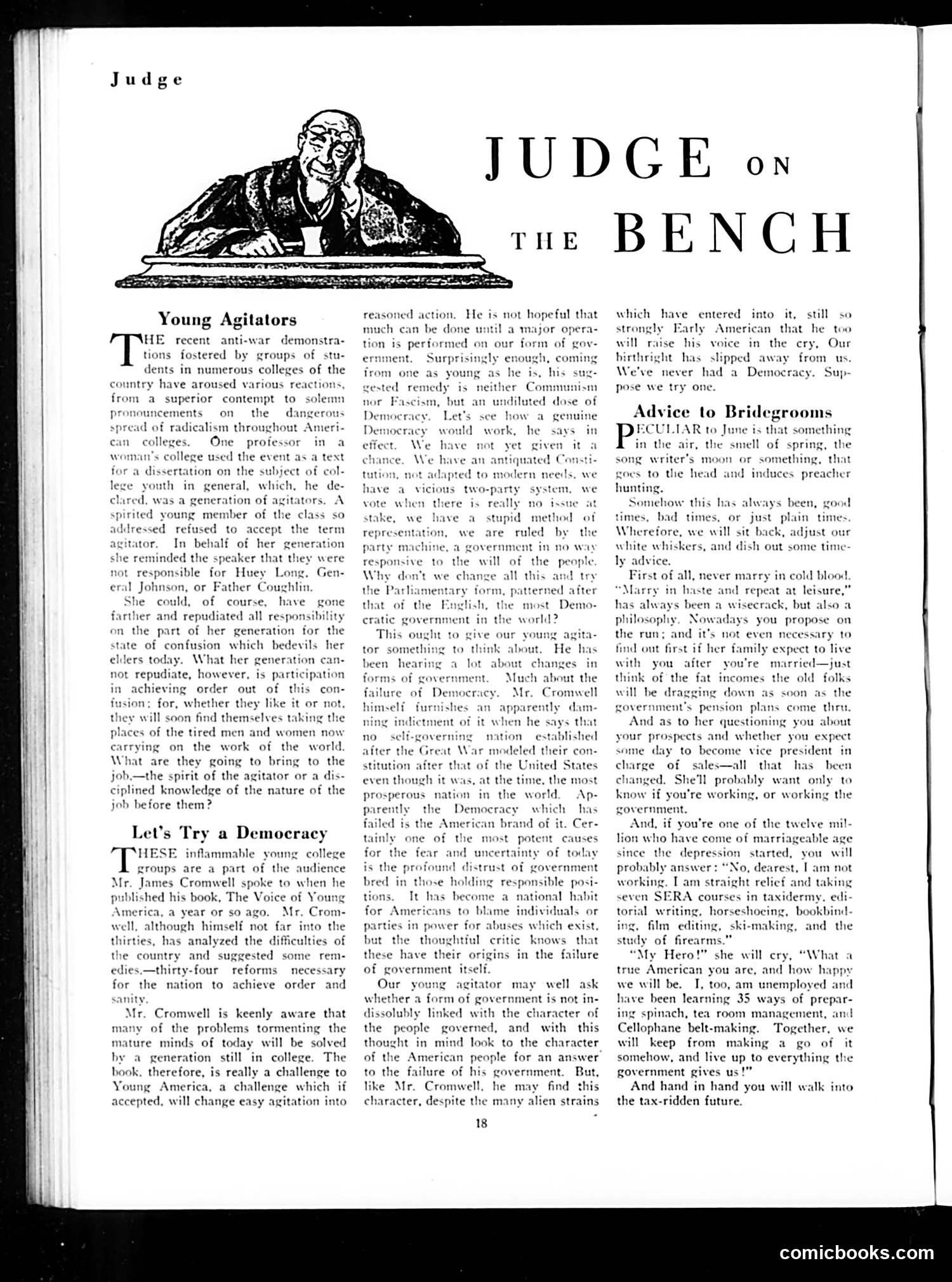
Young Agitators HE recent anti-war demonstra- tions fostered by groups of stu- dents in numerous colleges of the have aroused various reactions, superior contempt to solemn pronouncements on the count from dangerous spread of radicalism throughout Ameri- i} . One woman's college used the ev can professor in a nt as a text for a dissertation on the subject of col- lege youth in general, which, he de- clared, was a generation of agitators. A spirited young member of the class so refused to accept the term In behalf of her generation she reminded the speaker that tl were addressed agitator. not responsible for Huey Long, Gen- eral Johnson, or Father Coughlin: She could, of course, have gone 1 repudiated all responsibility part of her generation for the state of confusion which bedevils her What her generat not repudiate, however, is participation in achieving order out of this con- : for, whether they like it or not, 1 soon find themselves taking the places of the tired men and women now carrying on the work of the world. What are they going to bring to the job,—the spirit of the agitator or a dis- ciplined knowledge of the nature of the job before them? farther on the lers toda: on can- fusion they w Let’s fry a Democracy HESE inflammable your groups are a part of the audience Mr. James Cromwell spoke to when he colleg: published his book, The Voice of Young America, a year or so ago. Mr. Crom- well, although himself not far into the thirties, has analyzed the difficulties of t country and suggested some rem- edies.—thirty-four reforms for the nation to achieve sanity. Mr. Cromwell is keenly aware that many of the problems tormenting the mature minds of today will be solve by a generation still in college. The book, therefore, is really a challenge to Young America, a challenge which if accepted, will change easy agitation i necessary order and THE reasoned action. He is not hopeful that much can be done until a major opera- tion is performed on our form of gov- Surprisingly enough, coming as young as he is, his sug- gested remedy is neither Communism nor Fascism, but an undiluted dose of Let’s see how a work, he effe Ve have yet chance. W tution, adapted to mor Democracy, genuine Democracy would says in given it a tiquated Con 1 e have ana noneeds, we have a vicious two-party system, we vote when there is really no issue at stupid method of . we are ruled by the way stake, we have a representa party machine, a government in n will of the ie all this responsive to the Why don't the Parliame that of the EF: crati we c 1 try ry form, patterned after Demo- ish, the most world? young agita- government in This ought to give our g to think about. He has about changes in nmen! Much about the Democracy. Mr. Cromwell ishes an dam- nent of it when he says that tor somethi be hearing a lot forms of gove failure of aseli apparently governing established aft he Great War modeled their con- stitution after that of the United States even though it was, at the t nation in. the parently the nation me, the most world. Ap- prosperous Democracy tain! e of the rst pot for the fear and uncertainty of is the profound distrust of gi bred in those holding responsible posi- tions. It has become a national habit for Americans to blame individuals or parties in power for abuses which exist, but the thoughtful critic knows that these have their origins in the failure of government itself. Our youn! itator well ask whether a form of government is not in- dissolubly linked with the character of the people governed, and with this thought in mind look to the character of the American people for an answer to the failure of his government. But, like Mr. Cromwell, he may find this character, despite the many alien strains 18 . vernment may BENCH which have entered into it, still so strongly Early American that he too will raise his voice in the cry, Our birthright has slipped away from us. We've never had a Democracy. Sup- pose we try one. Advice to Bridegrooms P ECULIAR to June is that something in the air, the smell of spring, the song writer’s moon or something, th goes to the head and induces preacher hunting. Somehow this has always been, go« times, bad just plain. times Wherefore, we will sit back, adjust our white whiskers, and dish out some time- ly advice. First of all, never marry in cold blood “Marry in haste and repeat at leisure, has always been a wisecrack, but also a philosophy, Nowadays you propose on the run; and it’s not even necessary to find out first if her family expect to live with you after you're think of the fat incomes the old will times, or married—just folks be dragging down as soon as the government's pension plans come thru. And as to her questioning you about your prospects and whether you expect some to become vice president in charge of sales—all that has been changed. She'll probably want only to know if you're working, or working the government. And, if you're one of the twelve mil- lion who have come of marriageable age since the depression started, you will probably answer: “No, dearest, Iam not working. I am straight relief and taking seven SERA courses in taxidermy, edi- torial writing, horseshocing, bookbind- ing, film editing, ski-making, and the study of firearms.” fy Hero!” she will ery, “What a true American you are, and how happy we will be, I, too, am unemployed and have been learning 35 ways of prepar- ing spinach, tea room management, and Cellophane belt-making. Together, we will keep from making a go of it somehow, and live up to everything the government gives us And hand in hand you will walk into the tax-ridden future. comicbooks.com