
Judge, 1935-06 · page 16 of 37
Judge — June 1935 — page 16: what you’re looking at
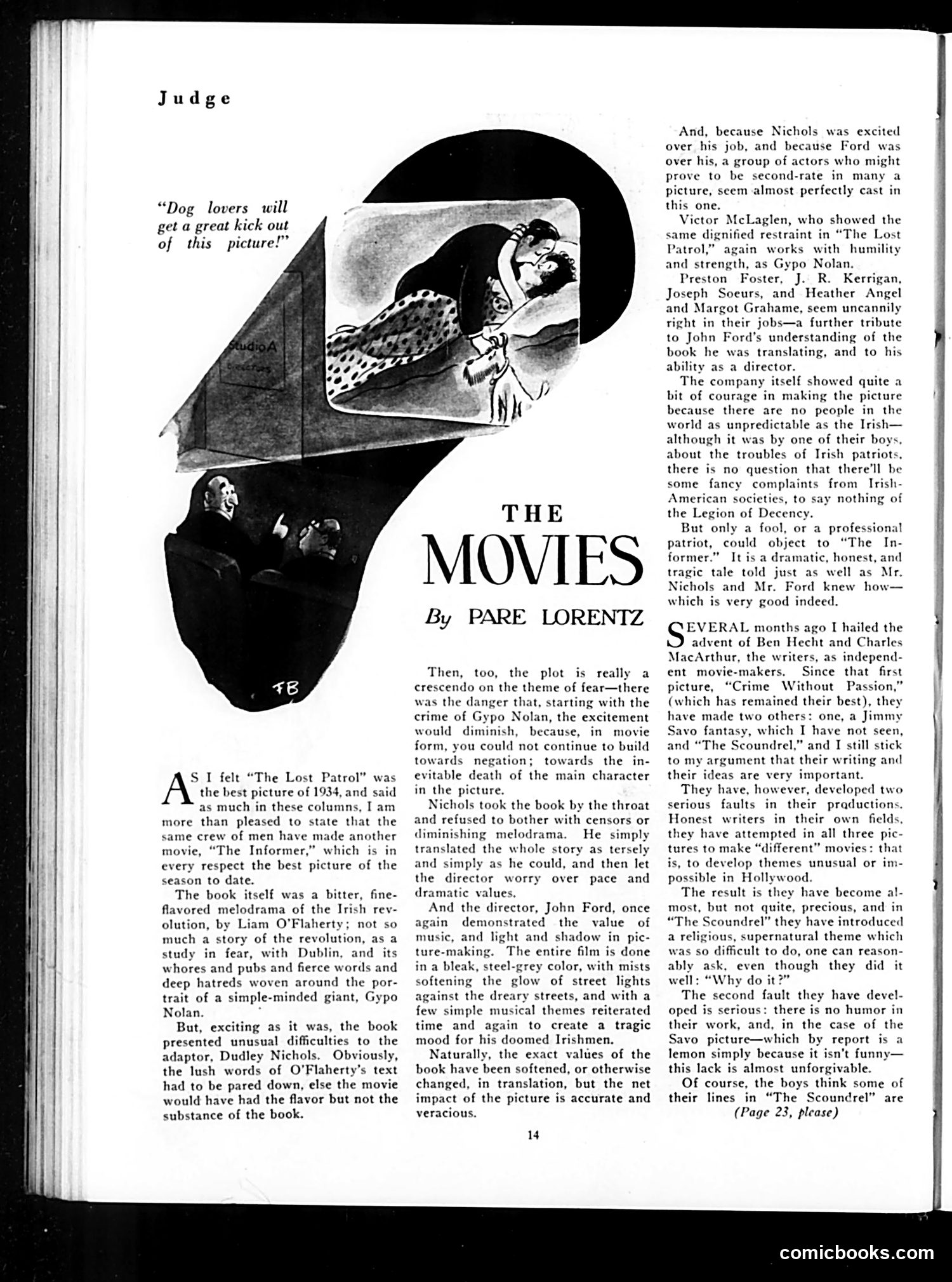
A restored page from Judge, 1935-06. Page through the whole issue in the reader above.
📄 Transcribed text from this page (OCR, searchable)
Machine-transcribed from the original scan — historical spelling and the odd misread are preserved.
Judge “Dog lovers will get a great kick out of this picture!” S I felt “The Lost Patrol” was the best picture of 1934, and said as much in these columns, I am more than pleased to state that the same crew of men have made another movie, “The Informer,” which is in every respect the best picture of the season to date. The book itself was a bitter, fine- flavored melodrama of the Irish rev- olution, by Liam O'Flaherty; not so much a story of the revolution, as a study in fear, with Dublin, and its whores and pubs and fierce words and deep hatreds woven around the por- trait of a simple-minded giant, Gypo Nolan. y But, exciting as it was, the book presented unusual difficulties to the adaptor, Dudley Nichols. Obviously, the lush words of O’Flaher text had to be pared down, else the movie would have had the flavor but not the substance of the book. MOVIES By PARE LORENTZ Then, too, the plot is really a crescendo on the theme of fear—there was the danger that, starting with the crime of Gypo Nolan, the excitement would diminish, because, in movie form, you could not continue to build towards negation; towards the in- evitable death of the main character in the picture. Nichols took the book by the throat and refused to bother with censors or diminishing melodrama. He simply translated the whole story as tersely and simply as he could, and then let the director worry over pace and dramatic values. And the director, John Ford, once again demonstrated the value of music, and light and shadow in pic- ture-making. The entire film is done ina ble steel-grey color, with mists softening the glow of street lights against the dreary streets, and with a few simple musical themes reiterated time and again to create a tragic mood for his doomed Irishmen. Naturally, the exact values of the book have been softened, or otherwise changed, in translation, but the net impact of the picture is accurate and veracious. 14 And, because Nichols was excited over his job, and because Ford was over his, a group of actors who might prove to be second-rate in many a picture, seem almost perfectly cast in this one. Victor McLaglen, who showed the same dignified restraint in “The Lost Patrol,” again works with humility and strength, as Gypo Nolan. Preston Foster, J. R. Kerrigan, Joseph Soeurs, and Heather Angel and Margot Grahame, seem uncannily right in their jobs—a further tribute to John Ford's understanding of the book he was translating, and to his ability as a director. The company itself showed quite a bit of courage in making the picture because there are no people in the world as unpredictable as the Irish— although it was by one of their boys, about the troubles of Irish patriots, there is no question that there'll be some fancy complaints from Irish- American societies, to say nothing of the Legion of Decency. But only a fool, or a professional patriot, could object to “The In- former.” It is a dramatic, honest, and tragic tale told just as well as Mr, Nichols and Mr. Ford knew how— which is very good indeed. S EVERAL months ago I hailed the advent of Ben Hecht and Charles MacArthur, the writers, as independ- ent movie-makers. Since that first picture, “Crime Without Passion,” (which has remained their best), they have made two others: one, a Jimmy Savo fantasy, which I have not seen, and “The Scoundrel,” and I still stick to my argument that their writing and their ideas are very important. They have, however, developed two serious faults in their praductions. Honest writers in their own fields, they have attempted in all three pic- tures to make “different” movies: that is, to develop themes unusual or im possible in Hollywood. The result is they have become most, but not quite, precious, and in “The Scoundrel” they have introduced a religious, supernatural theme which was so difficult to do, one can reason- ably ask, even though they did it well: “Why do it?” The second fault they have devel- oped is serious: there is no humor in their work, and, in the case of the Savo picture—which by report is a lemon simply because it isn't funny this lack is almost unforgivable. Of course, the boys think some of their lines in “The Scoundrel” are (Page 23, please) comicbooks.com