
Judge, 1935-04 · page 19 of 36
Judge — April 1935 — page 19: what you’re looking at
A restored page from Judge, 1935-04. Page through the whole issue in the reader above.
📄 Transcribed text from this page (OCR, searchable)
Machine-transcribed from the original scan — historical spelling and the odd misread are preserved.
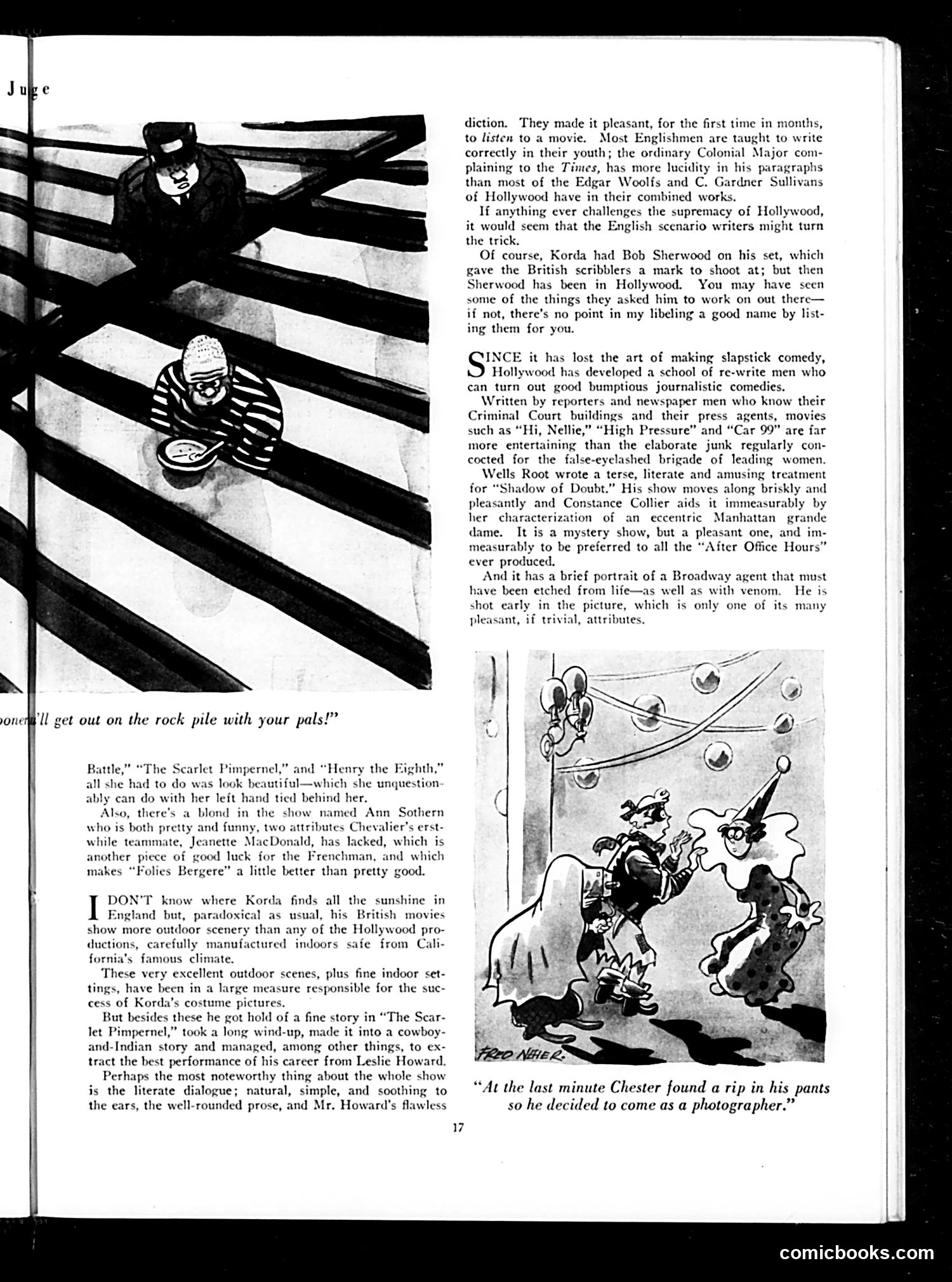
N one Il get out on the rock pile with your pals! | i | rp Battle,” “The Scarlet Pimpernel,” and “Henry the F all she had to do was look beautiful—which she unquestion: abl n do with her leit hand tied behind her, Also, there’s a blond in the show named Ann Sothern who is both pretty and funny, two attributes Chevalier’s erst- while teammate, Jeanette MacDonald, has lacked, which is another piece of good luck for the Frenchman, and which makes “Folies Bergere” a little better than pretty good. I DON’T know where Korda finds all the sunshine in England but, paradoxical as usual, his British movies show more outdoor scenery than any of the Hollywood pro- ductions, carefully manufactured indoors safe from Cali- fornia’s famous climate. These very excellent outdoor scenes, plus fine indoor set- tings, have been in a large measure responsible for the suc- cess of Korda’s costume pictures. But besides these he got hold of a fine story in “The Scar- let Pimpernel,” took a long wind-up, made it into a cowboy- and-Indian story and managed, among other things, to ex- tract the best performance of his career from Leslie Howard. Perhaps the most noteworthy thing about the whole show is the literate dialogue; natural, simple, and soothing to the ears, the well-rounded prose, and Mr. Howard's flawless diction. They made it pleasant, for the first time in months, to listen to a movie. Most Englishmen are taught to write correctly in their youth; the ordinary Colonial Major com- plaining to the Times, has more lucidity in his paragraphs than most of the Edgar Woolfs and C. Gardner Sullivans of Hollywood have in their combined works. If anything ever challenges the supremacy of Hollywood, it would seem that the English scenario writers might turn the trick. Of course, Korda had Bob Sherwood on his set, which gave the British scribblers a mark to shoot at; but then Sherwood has been in Hollywood. You may have n some of the things they asked him to work on out there if not, there’s no point in my libeling a good name by list- ing them for you. INCE it has lost the art of making slapstick comedy, Hollywood has developed a school of re-write men who can turn out good bumptious journalistic comedies. Written by reporters and newspaper men who know their Criminal Court buildings and their press agents, movies such as “Hi, Nellie,” “High Pressure” and “Car 99” are far more entertaining than the elaborate junk regularly con- cocted for the se-eyelashed brigade of leading women. Wells Root wrote a terse, literate and amusing treatment for “Shadow of Doubt.” His show moves along briskly and pleasantly and Constance Collier aids it immeasurably by her characterization of an eccentric Manhattan grande dame. It is a mystery show, but a pleasant one, and im- measurably to be preferred to all the “After Office Hours” ever produced, And it has a brief portrait of a Broadway agent that must have been etched from life—as well as with venom. He is shot early in the picture, which is only one of its many pleasant, if trivial, attributes. “At the last minute Chester found a rip in his pants so he decided to come as a photographer.” comicbooks.com