
Judge, 1935-04 · page 14 of 36
Judge — April 1935 — page 14: what you’re looking at
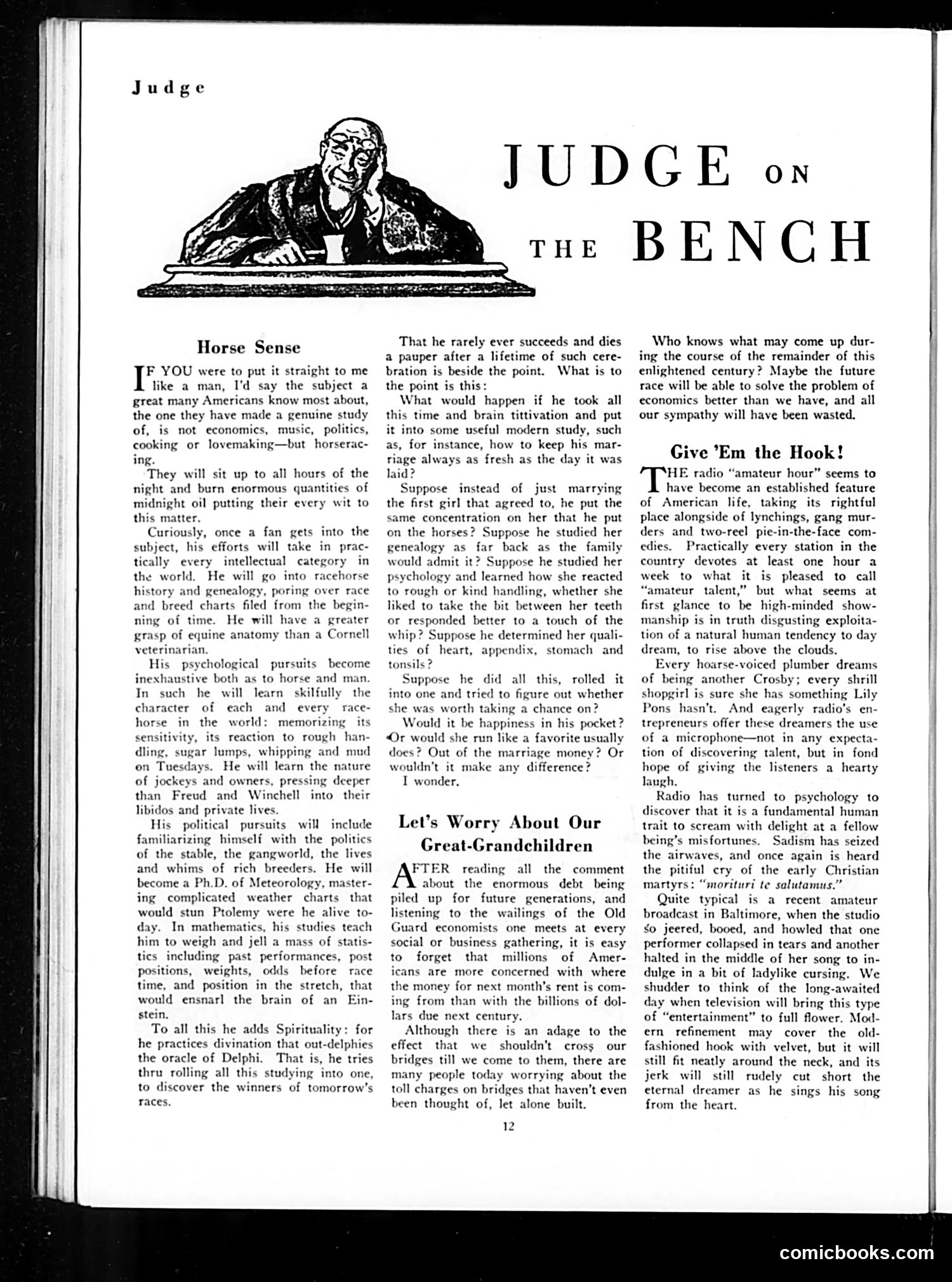
A restored page from Judge, 1935-04. Page through the whole issue in the reader above.
📄 Transcribed text from this page (OCR, searchable)
Machine-transcribed from the original scan — historical spelling and the odd misread are preserved.
Horse Sense F YOU were to put it straight to me like a man, I'd say the subject a great many Americans know most about, the one they have made a genuine study of, is not economics, music, politics, cooking or lovemaking—but horserac- ing. They will sit up to all hours of the night and burn enormous quantities of midnight oil putting their every wit to this matter. Curiously, once a fan gets into the subject, his efforts will take in prac- tically every intellectual category in the world. He will go into racehorse history and genealogy, poring over race and breed charts filed from the begin- ning of time. He will have a greater grasp of equine anatomy than a Cornell veterinarian. His psychological pursuits inexhaustive both as to horse and man. In such he will learn. skilfully the character of each and every horse in the world: memorizing its sensitivity, its reaction to rough han- dling, sugar lumps, whipping and mud on Tuesdays. He will learn the nature of jockeys and owners, pressing deeper than Freud and Winchell into their libidos and private lives. His political pursuits will include familiarizing himself with the politics of the stable, the gangworld, the lives and whims of rich breeders. He will become a Ph.D. of Meteorology, master- ing complicated weather charts that would stun Ptolemy were he alive to- day. In mathematics, his studies teach him to weigh and jell a mass of statis- tics including past performances, post positions, weights, odds before race time, and position in the stretch, t would ensnarl the brain of an Ein- stein. To all this he adds Spirituality: for he practices divination that out-delphies the oracle of Delphi. That is, he tries thru rolling all this studying into one, to discover the winners of tomorrow's races, become race- That he rarely ever succeeds and dies a pauper after a lifetime of such cere- bration is beside the point. What is to the point is this: What would happen if he took all this time and brain tittivation and put it into some useful modern study, such as, for instance, how to keep his mar- riage always as fresh as the day it was laid? Suppose instead of just marrying the first girl that agreed to, he put the same concentration on her that he put on the horses? Suppose he studied her genealogy as far back as the family would admit it? Suppose he studied her psychology and learned how she reacted to rough or kind handling, whether she liked to take the bit between her teeth or responded better to a touch of the whip? Suppose he determined her quali- ties of heart, appendix, stomach and tonsils? Suppose he did all this, rolled it into one and tried to figure out whether she was worth taking a chance on? Would it be happiness in his pocket? Or would she run like a favorite usually does? Out of the marriage money? Or wouldn't it make any difference? I wonder, Let’s Worry About Our Great-Grandchildren TER reading all the comment about the enormous debt being piled up for future generations, and listening to the wailings of the Old Guard economists one meets at every social or business gathering, is easy to forget that millions of Amer- icans are more concerned with where the money for next month's rent is com- ing from than with the billions of dol- lars due next century. Although there is an adage to the effect that we shouldn't cross our bridges till we come to them, there are many people today worrying about the toll charges on bridges that haven’t even been thought of, let alone built. 12 JUDGE on Who knows what may come up dur- ing the course of the remainder of this enlightened century? Maybe the future race will be able to solve the problem of economics better than we have, and all our sympathy will have been wasted. Give ’Em the Hook! HE radio “amateur hour” seems to ave become an established feature of American life, taking its rightful place alongside of lynchings, gang mur- ders and two-reel pie-in-the-face com- edies. Practically every station in the country devotes at least one hour a week to what it is pleased to call * eur talent,” but what seems at first glance to be high-minded show- manship is in truth disgusting exploita- tion of a natural human tendency to day dream, to rise above the clouds. Every hoarse-voiced plumber dreams of being another Crosby; every shrill shopgirl is sure she has something Lily Pons hasn't. And eagerly radio’s en- trepreneurs offer these dreamers the use of a microphone—not in any expecta- tion of discovering talent, but in fond hope of giving the listeners a hearty laugh. Radio has turned to psychology to discover that it is a fundamental human trait to scream with delight at a fellow being’s misfortunes. Sadism has seized the airwaves, and once again is heard the pitiful cry of the early Christian martyr: morituri te salutamus.’ Quite typical is a recent amateur broadcast in Baltimore, when the studio go jeered, booed, and howled that one performer collapsed in tears and another halted in the middle of her song to in- dulge in a bit of ladylike cursing. We shudder to think of the long-awaited day when television will bring this type of “entertainment” to full flower. Mod- ern refinement may cover the old- fashioned hook with velvet, but it will still fit neatly around the neck, and its jerk will still rudely cut short the eternal dreamer as he sings his song from the heart. comicbooks.com