
Judge, 1935-02 · page 11 of 36
Judge — February 1935 — page 11: what you’re looking at
What you’re looking at
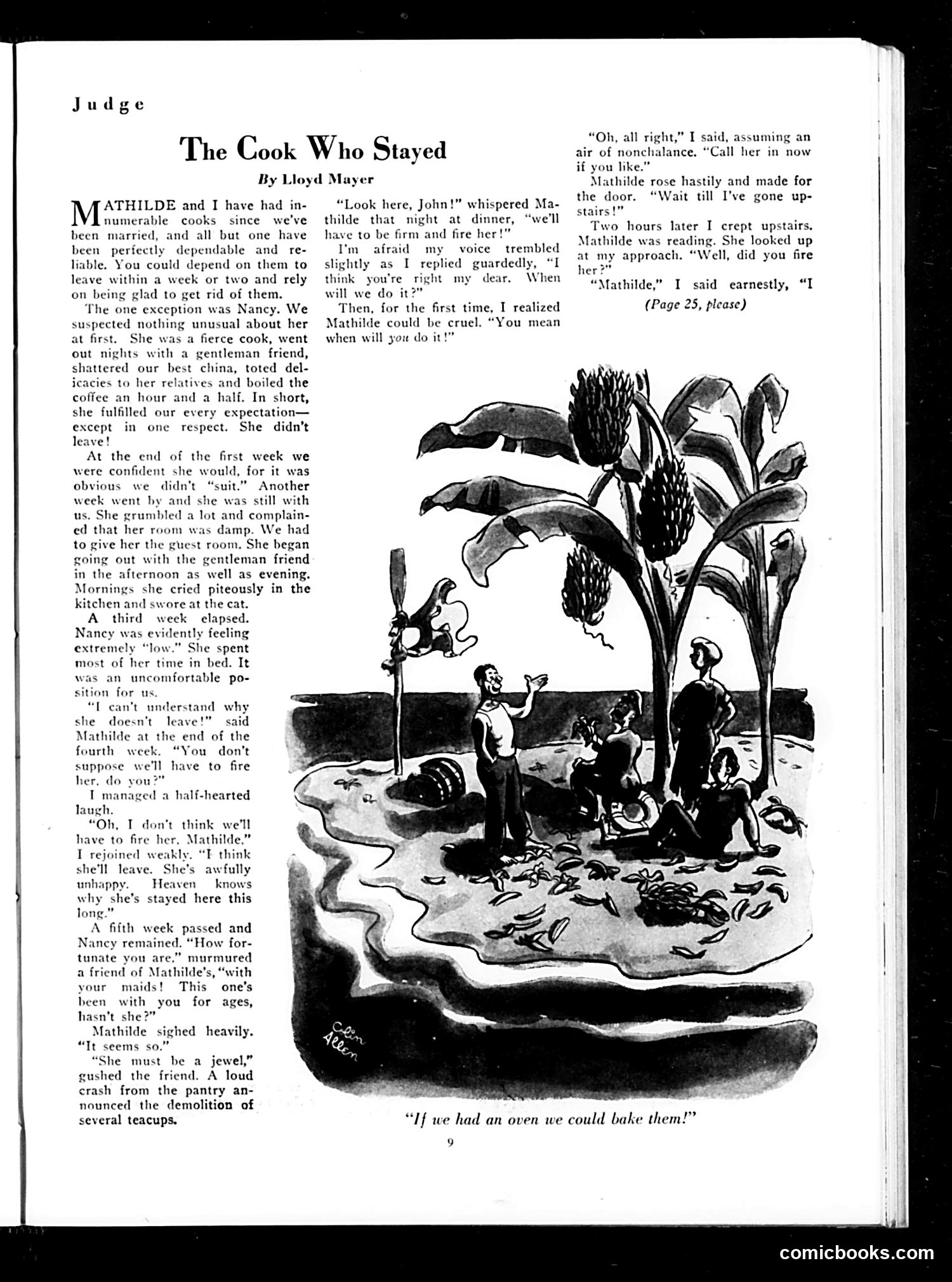
# "The Cook Who Stayed" - Explained for Modern Readers This is a humorous short story (not a political cartoon) satirizing the employment relationship between middle-class households and domestic workers in early 20th-century America. The joke centers on a reversal of expectations: employers could routinely dismiss unsatisfactory household staff, yet Nancy—who exhibits all the problematic behaviors they expect (breaks dishes, cries, neglects duties, takes excessive time off)—inexplicably *refuses to leave*. The narrator and his wife Mathilde expect her departure but find themselves unable to fire her, becoming increasingly uncomfortable as weeks pass. The satire mocks both employer squeamishness about confrontation and the power dynamics of domestic service. By the story's end (indicated by "Page 25, please"), the narrative suggests the employer has failed even to attempt firing her. The accompanying illustration shows people beneath a large cornstalk with the caption "If we had an oven we could bake them!"—likely relating to a subplot about food scarcity or agricultural hardship mentioned in the text.
📄 Transcribed text from this page (OCR, searchable)
Machine-transcribed from the original scan — historical spelling and the odd misread are preserved.
Judge The Cook Who Stayed By Lloyd Mayer ATHILDE and I have had in- numerable cooks since we've been married, and all but one have been perfectly dependable and re- liable. You could depend on them to leave within a week or two and rely on being glad to get rid of them. The one exception was Nancy. We suspected nothing unusual about her at first. She was a fierce cook, went out nights with a gentleman friend, shattered our best china, toted del- icacies to her relatives and boiled the coffee an hour and a half. In short, she fulfilled our every expectation— except in one respect. She didn’t leave! At the end of the first week we were confident she would, for it was obvious we didn’t “suit.” Another week went by and was still with us. She grumbled a lot and complain- ed that her room was damp. We had to give her the guest room. She began going out with the gentleman friend in the afternoon as well as evening, Mornings she cried piteously in the kitchen and swore at the cat. A third week elapsed. Nancy was evidently feeling extremely “low.” She spent most of her time in bed. It was an uncomfortable po- ition for us. “LT can't understand why she sn't- leave!" said Mathilde at the end of the fourth week. “You don't suppose we'll have to fire her, do you?” T managed a half-hearted laugh. “Oh, T don't think we'll have to fire her, Mathilde,” I rejoined weakly. “T think she'll leave. She’s awfully unhapp: Heaven knows why she’s stayed here this long.” A fifth week passed and Nancy remained. “How for- tunate you are.” murmured a friend of Mathilde’s, “with your maids! This one’s with you for ages, hasn't she?” Mathilde sighed heavily. “Tt seems so.” “She must be a jewel,” gushed the friend. A loud crash from the pantry an- nounced the demolition of several teacups. been “Look here, John!” whispered Ma- thilde that night at dinner, “we'll have to be firm and fire her!” I'm afraid my voice trembled slightly as I replied guardedly, “I think you're right my dear. When will we do it?” Then, for the first time, I realized Mathilde could be cruel. “You mean when will you do it!” “Oh, all right,” I said, assuming an air of nonchalance. “Call her in now if you like.” Mathilde rose hastily and made for the door. “Wait till I've gone up- stairs!” Two hours later I crept upstairs. Mathilde was reading. She looked up at my approach. “Well, did you fire her?” “Mathilde,” I. said earnestly, “I (Page 25, please) “If we had an oven we could bake them!” 9 comicbooks.com