
Judge, 1935-01 · page 3 of 40
Judge — January 1935 — page 3: what you’re looking at
What you’re looking at
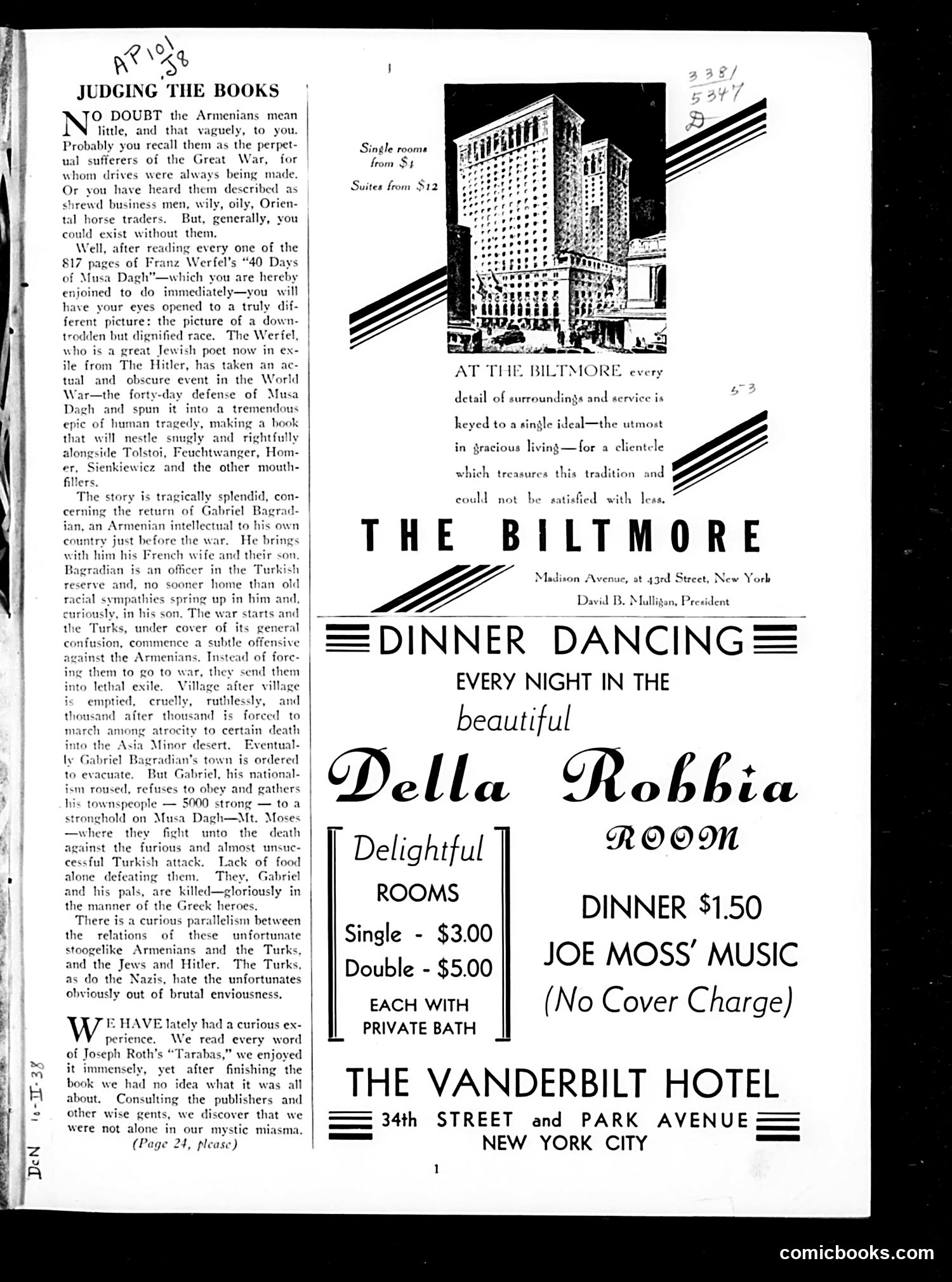
# Analysis This page is primarily **advertising**, not satire or political commentary. The left column contains a book review titled "JUDGING THE BOOKS" discussing Franz Werfel's "40 Days of Musa Dagh," a novel about Armenian suffering during WWI and conflict with Turks. The right side features hotel and restaurant advertisements for The Biltmore and The Vanderbilt Hotel in New York City, promoting amenities like dining, dancing in the "Della Robbia Room," and room rates ($3-$5 for single/double rooms). There is **no political cartoon** visible on this page. The only illustration is an architectural drawing of The Biltmore building. The content mixes literary criticism with period hospitality advertising typical of Judge magazine's revenue model.
📄 Transcribed text from this page (OCR, searchable)
Machine-transcribed from the original scan — historical spelling and the odd misread are preserved.
\ Ke Net JUDGING THE BOOKS O DOUBT the Armenians mean j t little, and that vaguely, to you, g Probably you recall them as the perpet- a | ual sufferers of the Great War, for fou $3 whom drives were always being made. . } Or you have heard them described as Suites from $12 , shrewd business men, wily, oily, Orien- é tal horse traders. But, generally, you could exist without them. Well, after reading every one of the 817 pages of Franz Werfel's “40 Dz of Musa Dagh’—which you are hereby enjoined to do immediately—you will have your eyes opened to a truly dif- ferent picture: the picture of a down- trodden but dignified race. The Werfel, who is a great Jewish poet now in ex- from The Hitler, has taken an ac- emia eae and obscure event in the World AT THE BILTMORE every var—the forty-day defense of Musa re detail of surroundings and service is h and spun it into a tremendous ugly and rightfully alongside Tolstoi, Feuchtwanger, Hom- nkiewicz and the other mouth- in gracious living —for a clientele er, fillers. The story is tragically splendid, con- could cerning the return of Gabriel Bagrad- jan, an Armenian intellectual to his own country just before the war. He brings T H E B | L T M 0 R E with him his French v i Bagradian is an offi reserve and, no soo} which treasures this tradition and not be satisfied with less. and their son er in the Turkish er home than old on Avenue, at 43rd Street, New York sympathies spring up in him ar starts a the Turks, under cover of its ge confusion, commence a subtle offensive st the Armenians. Instead of fore- “ees = DINNER DANCING = nto lethal exile, Village after village EVERY NIGHT IN THE emptied, cr ruthle dl thousand after thousand is forced to b : | y to certain death eautifu march among atroc into the 1. Minor desert. Eventual- ly Gabriel Bagradian’s y n is ordered to evacuate. But Gabriel, his national- + ism roused, refuses to obey and gathers e a r 6) a a his townspeople — 5000 strong — to a old on Musa Dagh—Mt. Moses : e they fight unto the death : nine he tows ani amos mse | lT Delightful ROOM cessful Turkish a <. Lack of Food g . alone defeating and his pals, are tilled -zloriousty tn ROOMS the manner of k heroes. oa i DINNER $1.50 the relations of these unfortunate Single - $3.00 JOE MOSS’ stoogelike Armenians and the Turks, | MUSIC ; and the Jews and Hitler. The Turks. | hd Nai hate the untonunates | ff Double - $5.00 obviously out of brutal enviousness. ously Out oO: brutal enviousne: EACH WITH (No Cover Charge) E HAVE lately had a curious ex- PRIVATE BATH perience. We read every word of Joseph Roth’s “Tarabas,” we enjoyed fit immensely, yet after finishing. the other wise gents, we discover that we 34th STREET and PARK AVENUE == NEW YORK CITY David B. Mulligan, Presid nt usly, in his son, The | epic of human tragedy, making a book heyed to a single ideal—the utmost that will nestle smu were not alone in our mystic miasma. (Page 24, please) comicbooks.com