
Judge, 1935-01 · page 20 of 40
Judge — January 1935 — page 20: what you’re looking at
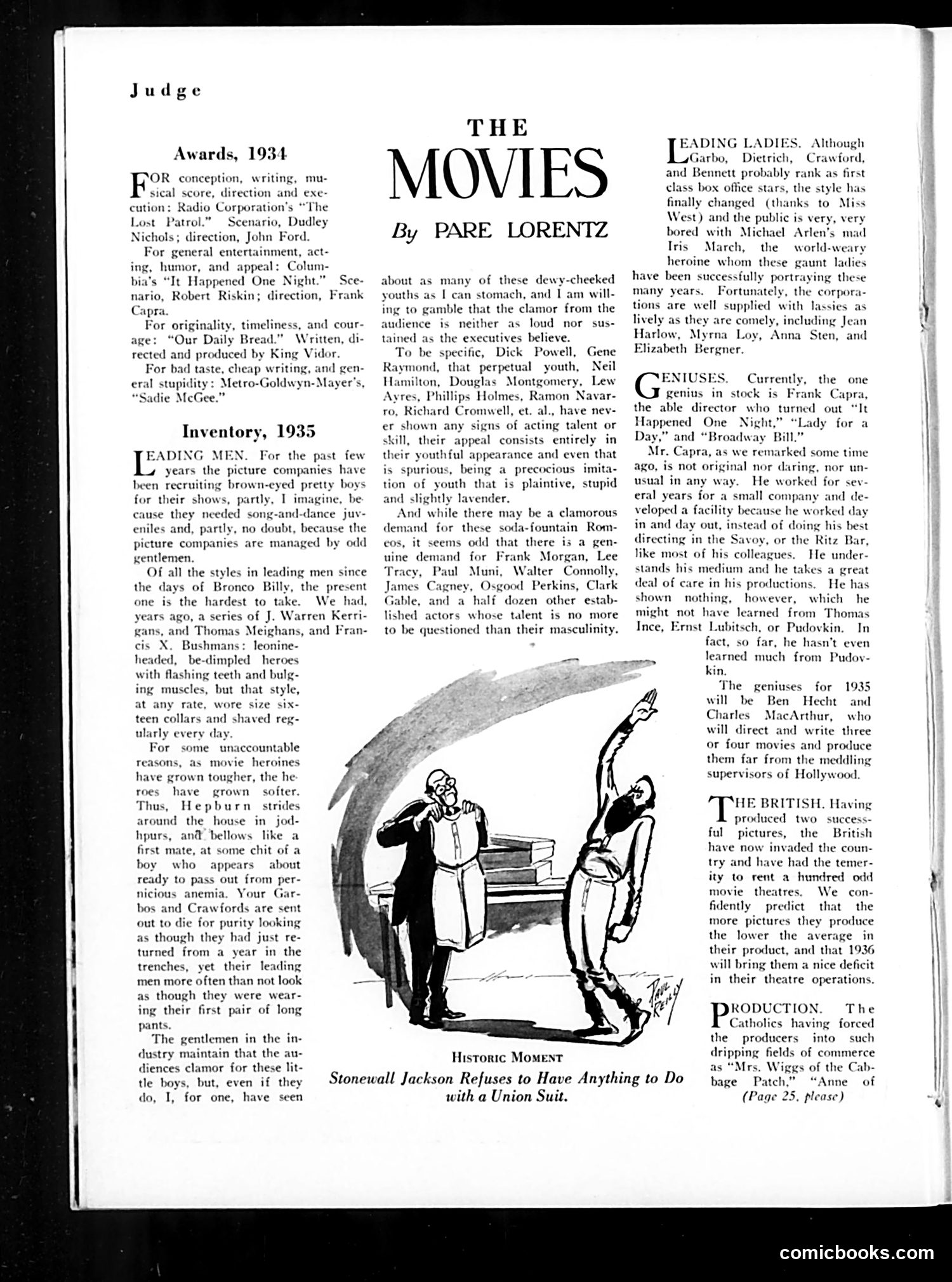
A restored page from Judge, 1935-01. Page through the whole issue in the reader above.
📄 Transcribed text from this page (OCR, searchable)
Machine-transcribed from the original scan — historical spelling and the odd misread are preserved.
Judge Awards, 1934 Fe conception, writing, mu- sical score, direction and exe- cution: Radio Corporation's “The Lost Patrol.” Scenario, Dudley Nichols; direction, John Ford. For general entertainment, act- ing, humor, and appeal: Colum- bia’s “It Happened One Night.” Sce- nario, Robert Riskin; direction, Frank ‘apra. For originality, timeliness, and cour- age: “Our Daily Bread.” Written, di- rected and produced by King Vidor. For bad taste, cheap writing, and gen- eral stupidity: Metro-Goldwyn-May “Sadie McGee.” Inventory, 1935 EADING MEN. For the past few _s years the picture companies have been recruiting brown-eyed pretty boys for their shows, partly, | imagine, be cause they needed song-and-dance juv- eniles and, partly, no doubt, because the picture companies are managed by odd gentlemen. Of all the styles in leading men since the days of Bronco Billy, the present one is the hardest to take. We had, years ago, a series of J. Warren Kerri- gans, and Thomas Meighans, and Fran- cis X. Bushmans: leonine- headed, be-dimpled heroes with flashing teeth and bulg- ing muscles, but that style, at any rate, wore size six- teen collars and shaved reg ularly every day. For some unaccountable reasons, as movie heroines have grown tougher, the he roes have grown softer. Thus, Hepburn. strides around the house in jod- hpurs, and bellows like a first mate, at some chit of a boy who appears about ready to pass out from per- nicious anemia. Your Gar- bos and Crawfords are sent out to die for purity looking as though they had just re- turned from a year in the trenches, yet their leading men more often than not look as though they were wear- ing their first pair of long pants. The gentlemen in the in- dustry maintain that the au- diences clamor for these lit- tle boys, but, even if they do, I, for one, have seen THE MOVIES By PARE LORENTZ about as many of these dewy-cheeked youths as [ can stomach, and I am will- ing to gamble that the clamor from the audience is neither as loud nor sus- tained as the executives believe. To be specific, Dick Powell, Gene Raymond, that perpetual youth, Neil Hamilton, Douglas Montgomery, Lew Ayres, Phillips Holmes, Ramon Navar- ro, Richard Cromwell, et. al., have nev- er shown any signs of acting talent or skill, their appeal consists entirely in their youthful appearance and even that is spurious, being a precocious imita- tion of youth that is plaintive, stupid and slightly lavender. And while there may be a clamorous demand for these soda-fountain Rom- eos, it seems odd that there is a gen- uine demand for Frank Morgan, Lee Tracy, Paul Muni, Walter Connolly, James Cagney, Osgood Perkins, Clark jable, and a half dozen other estab- lished actors whose talent is no more to be questioned than their masculinity. Historic Moment Stonewall Jackson Refuses to Have Anything to Do with a Union Suit. ADING LADIES. Although arbo, Dietrich, Crawford, and Bennett probably rank as first class box office stars, the style has finally changed (thanks to Miss West) and the public is very, very bored with Michael Arlen’s mad Iris March, the — world-weary heroine whom these gaunt ladies have been successfully portraying these many years. Fortunately, the tions are well supplied with lassies as lively as they are comely, including Jean Harlow, Myrna y, Anna Sten, and Elizabeth ( orpora- Jergner, ENIUSES. Currently, the one genius in stock is Frank Capra, the able director who turned out “It appened One Night,” "and “Broadway Bill.” as we remarked some time ago, is not original nor darin| usual in any way. He worked for sev- eral years for a small company and de- veloped a facility because he worked day in and day out, instead of doing his best directing in the Savoy, or the Ritz Bar, like most of his colleagues. He under- stands his medium and he takes a great deal of care in his productions. He has shown nothing, however, which he might not have learned from Thomas Ince, Ernst Lubitsch, or Pudovkin. In fact, so far, he hasn't even learned much from Pudov- kin. The geniuses for 1935 will be Ben Hecht and Charles MacArthur, who will direct and write three or four movies and produce them far from the meddling supervisors of Hollywood, udy for a . nor un- HE BRITISH. Having produced two success- ful pictures, the British have now invaded the coun- try and have had the temer- ity to rent a hundred odd movie theatres. We con- fidently predict. that the more pictures they produce the lower the average in their product, and that 1936 will bring them a nice deficit in their theatre operations. RODUCTION. The atholics having forced the producers into such dripping fields of commerce as “Mrs. Wiggs of the Cab- bage Patct “Anne of (Page — comicbooks.com