
Judge, 1934-11 · page 25 of 36
Judge — November 1934 — page 25: what you’re looking at
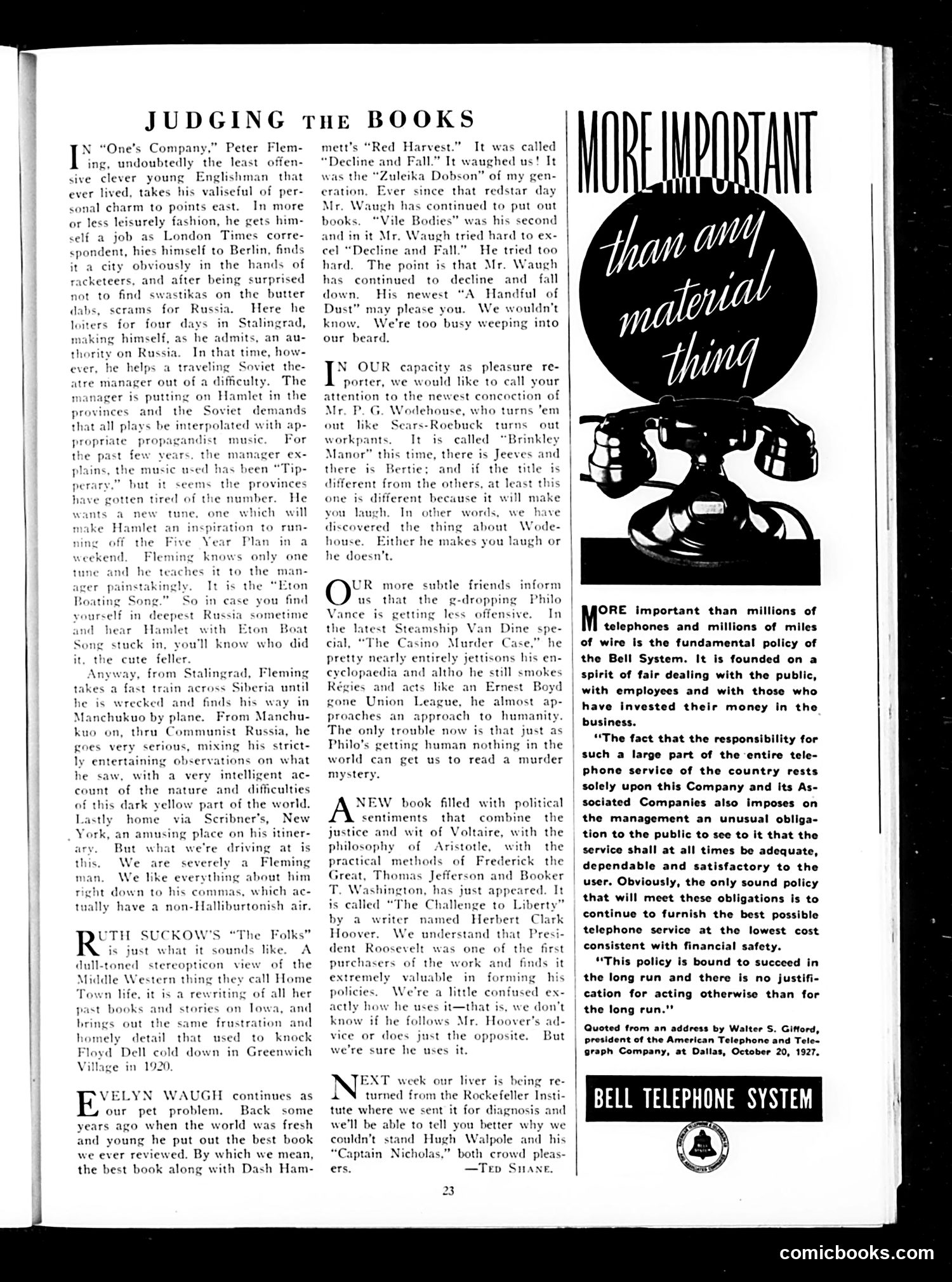
A restored page from Judge, 1934-11. Page through the whole issue in the reader above.
📄 Transcribed text from this page (OCR, searchable)
Machine-transcribed from the original scan — historical spelling and the odd misread are preserved.
JUDGING tne BOOKS N “One’s Company,” Peter Flem- ng, undoubtedly the least offen- sive clever young Englishman that ever lived, takes his valiseful of per- 1 charm to points east. In more or less leisurely fashion, he gets him- self a job as London Times corre- spondent, hies himself to Berlin, finds it a city obviously in the hands of racketeers, and after being surprised not to find swastikas on the butter dabs, scrams for Russia. Here he loiters for four days in Stalingrad, aking himself, as he admits, an au- rity on Russia. In that time, how ever, he helps a traveling Soviet the- atre manager out of a difficulty. The ng on Hamlet in the Soviet ager is pu and demands s be interpolated with ¢ inces at all pla pre propriate proy > p ve » manager ns, the music used has been “Tip- per’ but it seems the provinces have gotten tired of the number. He wants a tune. one which will ke H n inspiration to run- ning off five Year Plan in a weekend ws only one to the is the So in ca 1 he te man- mn g Son y st Russia sometime et with Boat . you'll know who did cute feller, ay, from Stalin a fast train a he is wrecked and finds his way in Manchukuo by plane. From Manchu- kuo on, thru Communist Russia, he goes very serious, mixing his strict- ly entertaining observations on what in dee Ha ear ton ud, Fleming iberia until takes TOSS he saw. with a very intelligent ac- count of the nature and difficulties this dark yellow part of the world, tly home via Scribner's, New an amusing place on his itiner- But what we're driving at is this. We are severely a Fleming man. We like everythir yout him right down to his commas, which a tually have a non-Halliburtonish air. UTH SUCKOW’S “The Folks” is t what it sounds like. A dull-toned. stereopticon. vie the Middle Western th all Home n life, it riting of all her they is a re past books and stories on Towa, and brings out the same frustration and homely detail that used to knock Floyd Dell cold do Village in 1920. n in Greenwich VELYN WAUGH continues as pet problem. Back some years ago when the world was fresh and young he put out the best book we ever reviewed. By which we mean, the best book Dash Ham- our along with mett’s “Red Harvest.” It was called “Decline and Fall.” It waughed us! It as the “Zuleika Dobson” of my gen- eration, Ever since that redstar day Mr. Waugh has continued to put out books. “Vile Bodies” was his second and in it Mr. Waugh tried hard to ex- cel “Decline and Fall.” He tried too hard. The point is that Mr. Waugh has continued to decline and fall His newest “A Handful of Dust” may please you. We wouldn't know. We're too busy weeping into our beard. down, N OUR capacity as pleasure re- porter, we would like to call your attention to the newest concoction of Mr. P. G. Wodehouse, who turns 'em out like Sears-Roebuck turns out workpants. It is called “Brinkley Manor” this time, there is Jeeves and there is Bertie: and if the hers, at le: use it w words, rent from the o erent bi In other we the thing W ther he makes you laugh or he doesn’t. you discove: about house. UR more subtle friends inform us that the g-dropping Philo Vance is getting less offensive. In the latest Steamship Van Dine spe- cial, “The Casino Murder Case,” he pretty rly entirely jettisons his en- cyclopaedia and altho he still smokes R s and acts like an Ernest Boyd gone Union League, he almost ap- proaches an approach to humanity. The only trouble now is that just Philo’s getting human nothing in the world get us to read a murder mystery. y ne as NEW book filled with polit sentiments that combine justice and wit of Voltaire, with philosophy of Aristotle, with the practical methods of Frederick the Great, Thomas Jefferson and Booker T. Washington, has just appeared. is called “The Challenge to Liberty by a writer named Herbert Clark Hoover. We understand that Presi dent Roosevelt was or purchasers of the work extremely valuable al the the in forming policies. We're a little confused ex- actly how he uses it—that is, we don’t know if he follows Mr. Hoover's ad- vice or does just the opposii But we're sure he uses it. EXT week our liver is being re- turned from the Rockefeller Insti- tute where we sent it for diagnosis and we'll be able to tell you better why we couldn’t stand Hugh Walpole and his “Captain Nicholas,” both crowd pleas- ers. —Tep Snane. 23 ORE important than millions of telephones and millions of miles of wire is the fundamental policy of the Bell System. It is founded on a spirit of fair dealing with the public, with employees and with those who have invested their money in the business. “The fact that the responsibility for such a large part of the entire tele- phone service of the country rests solely upon this Company and its As- sociated Companies also imposes on the management an unusual obliga- tion to the public to sce to it that the service shall at all times be adequate, | dependable and satisfactory to the user. Obviously, the only sound policy that will meet these obligations is to continue to furnish the best possible telephone service at the lowest cost consistent with financial safety. “This policy is bound to succeed in the long run and there is no justifi- cation for acting otherwise than for the long run.” Quoted from an address by Walter S. Gifford, president of the American Telephone and Tel graph Company, at Dallas, October 20, 1927. comicbooks.com