
Judge, 1934-11 · page 22 of 36
Judge — November 1934 — page 22: what you’re looking at
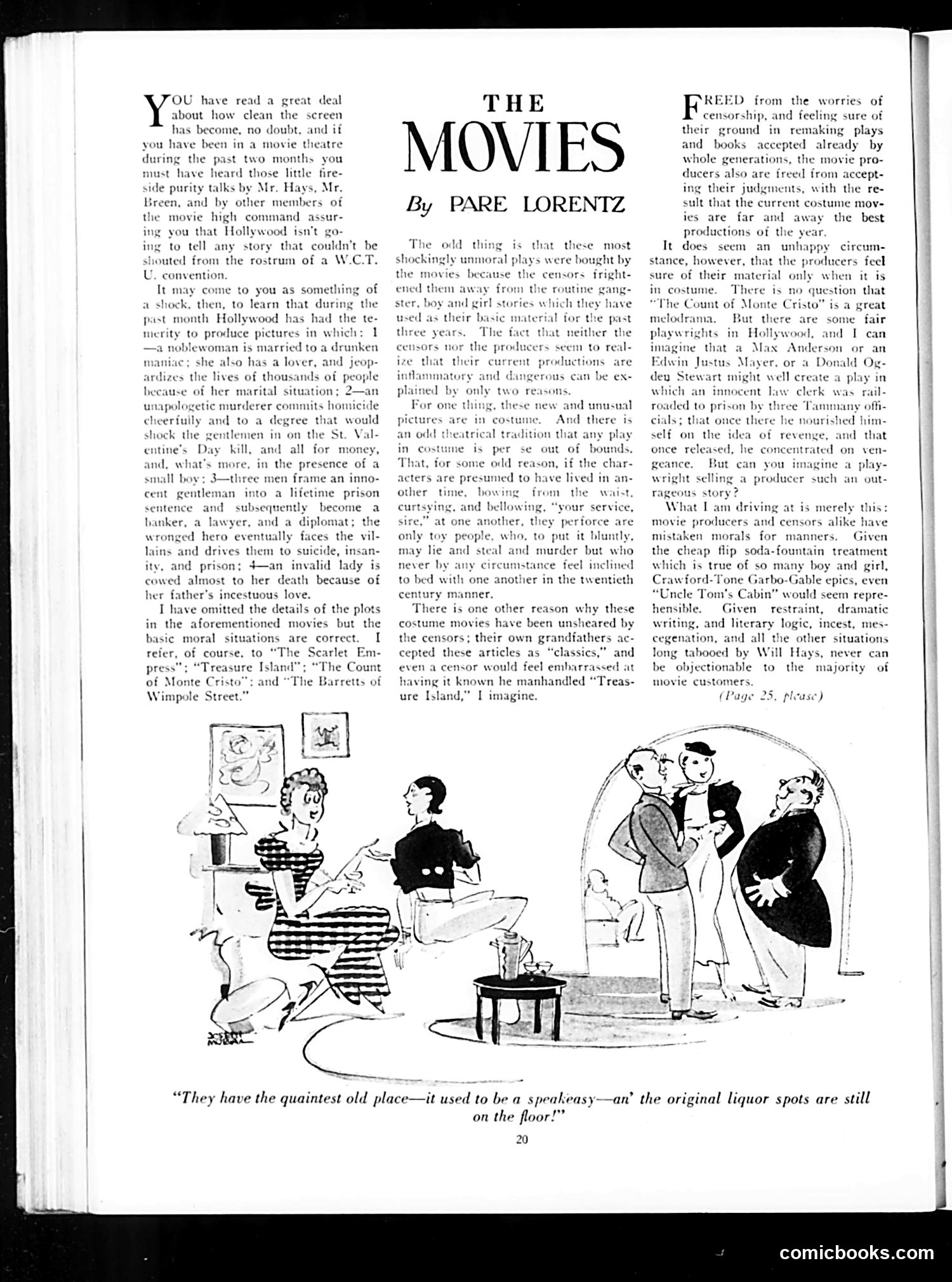
A restored page from Judge, 1934-11. Page through the whole issue in the reader above.
📄 Transcribed text from this page (OCR, searchable)
Machine-transcribed from the original scan — historical spelling and the odd misread are preserved.
OU have read a great deal pout how clean the screen has become, no doubt, and if you have been in a movie theatre during the past two months you must have heard those little fire- side purity talks by Mr. Hays, Mr. Breen, a nd by other members of the movie high command assur- ing you that Hollywood isn’t go- ing to tell any story that couldn't be shouted from the rostrum of a W.C.T. U. convention. It may come to you as something of a shock, then, to learn that during the past month Hollywood has had the te- merity to produce pictures in which: 1 lewoman is married to a drunken —a nol maniac; she also has a lover, and jeop- ardizes the lives of th usands of people because of her marital situat unapologetic murderer commits homicide cheeriuily and to a degree that would shock the gentlemen in on the St. Val- entine’s Day kill, and all for money, and, what's more, in the presence of a —three men frame an inno- cent gentleman into a lifetime prison subsequently be ea fiplomat; the eventually faces the vil- lains and drives them to suicide, insan- on; 2—an small boy: 3 sentence and banker, a lawyer, and a wronged he ity, and prison; 4—an invalid lady is cowed almost to her death because of her father’s incestuous love. I have omitted the details of the plots in the aforementioned movies but the basic moral situations are correct. I refer, of course, to “The Scarlet Em- press"; “Treasure Island”; “The Count of Monte Cristo”: and he Barretts of Wimpole Street.” THE MOVIES By PARE LORENTZ The odd thing is that the shockingly ur e most noral plays were bought by the movies because the censors fright- ened them away from the routin gang- hich they have rial for the past ster, y and girl stories used as their basic three year The fact that neither the censors nor producers seem to real- that their current productions are inflammatory and gerous can be ex- plained by only two rea For one thing, these new and unusual And there is heatrical tradition that any play une is per se out of bounds. That, for some odd reason, if the char- acters are presumed to have lived in an- other pictures are in costume. bowing from = the waist “your service r, they perforce are only toy people, who, to put it bluntly, may lie and steal and murder but who never by any ¢! time, ng, and bellowin sire,” at ¢ ne anoth y circumstance feel inclined to bed with one another in the twentieth century manner, There is one other reason why these costume movies have been unsheared by the censors; their own grandfathers ac- cepted these articles as and classics,” even a censor would feel embarrasse: ving it known he manhandled “Treas- ure Island,” I imagine. REED from the worries of censorship, and feeling sure of their ground in remaking plays and books accepted already by whole generations, the movie pro- ducers also are freed from accept- ing their judgments, with the re- sult that the current costume mov- ies are far and away the best productions of the year Tt does seem an unhappy circum- stance, however, that the producers feel sure of their material only when it is in costume. ere is no question that “The Count of Monte Criste great melodrama, But there are some fair playwrights in Hollywood, and I can imagine that a Max Anderson or an Edwin Justus Mayer, or a Donald Og- dey Stewart might well create a play in which an innocent Taw clerk was rail- roaded to prison by three Tammany offi- cials; that once there he nourished him- self on the idea of revenge, and that once rel geance. used, he concentrated ¢ nh ven- But can you imagine a play- wright selling a producer such an out- rageous story? What I am driving at is mere this: movie producers and censors alike have morals for manners. Given the cheap flip soda-fountain treatment which is true of so m and girl, Crawford-Tone Garbo-Gable epics, even “Uncle Tom's Cabin” would seem repre- hensibl Given restraint, dramatic writir nd literary logic, incest, mes- cegenation, and all the other situations long tabooed by Will Hays, never can be objectionable to the majority of movie customers, (Page 2. bo: lease) “They have the quaintest old place—it used to be a speakeasy—an’ the original liquor spots are still on the floor!” 20 comicbooks.com