
Judge, 1934-10 · page 4 of 36
Judge — October 1934 — page 4: what you’re looking at
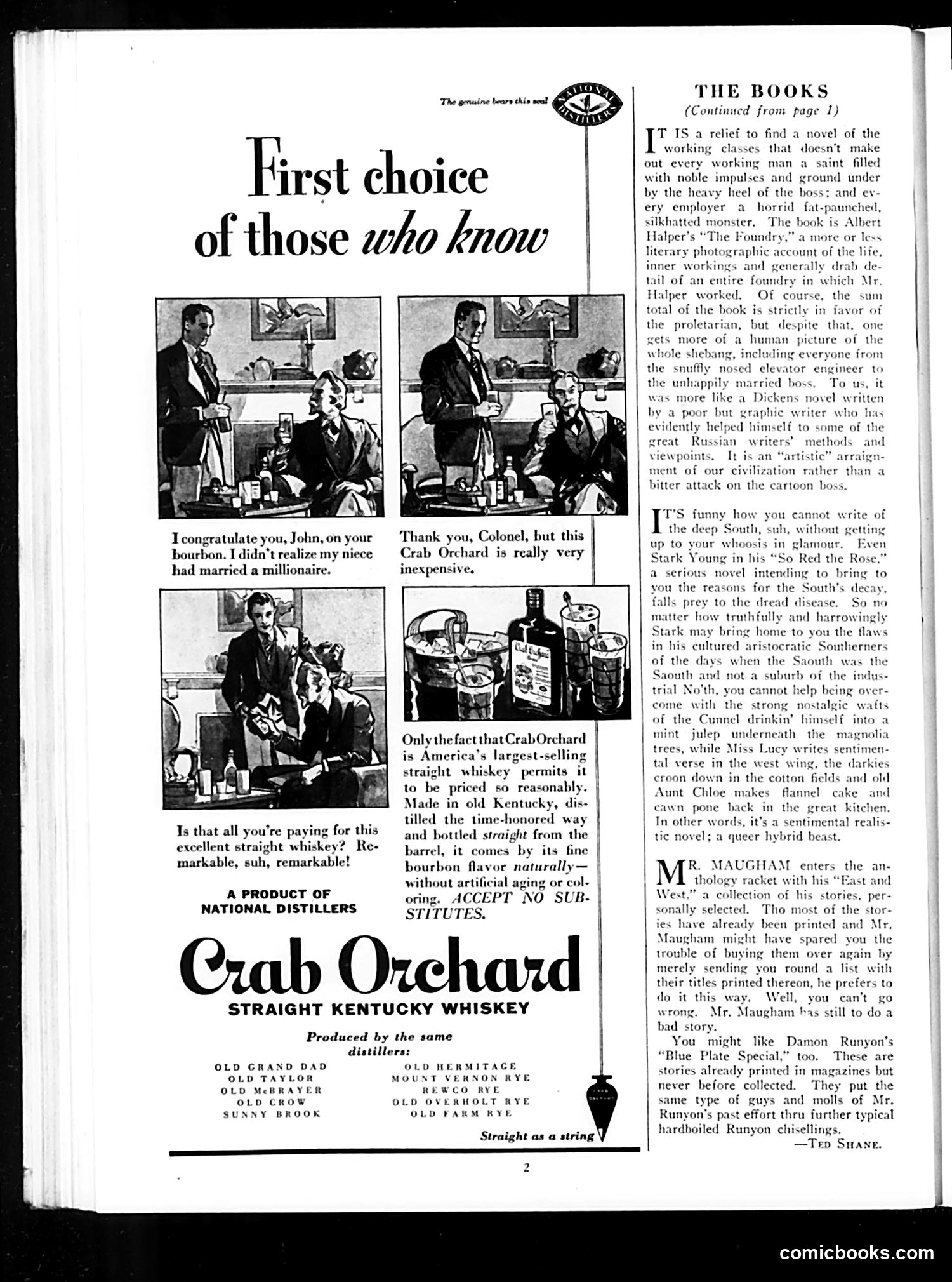
What you’re looking at
# Analysis This page is primarily a **Crab Orchard whiskey advertisement** rather than political satire. The comic panels show wealthy men in formal dress congratulating each other on business deals—one mentions marrying a millionaire's niece, another praises the whiskey's affordability despite its quality. The humor relies on **class-based satire**: the advertisement depicts the wealthy elite casually discussing money while drinking premium bourbon, implying that even America's richest find this whiskey appropriately priced. The joke targets both upper-class pretension and marketing to the affluent. The right column reviews books but contains no identifiable political figures or current events. The page appears designed to sell liquor to Judge's educated, affluent readership through gentle mockery of their own social circle.
📄 Transcribed text from this page (OCR, searchable)
Machine-transcribed from the original scan — historical spelling and the odd misread are preserved.
The genuine bears this seal irst choice of those who Anow | I congratulate you, John, on your bourbon. I didn’t realize my niece had married a millionaire. Is that all you're paying for this excellent straight whiskey? Re- markable, suh, remarkable! A PRODUCT OF NATIONAL DISTILLERS Crab Orchard Thank you, Colonel, but this inexpensive. Only the fact thatCrabOrchard straight whiskey permits it to be priced so reasonably Made in old Kentucky, ¢ tilled the time-honored wa and bottle barrel, it comes by its fine bourbon flavor naturally— without arti oring. ACCEPT NO SUB- STITUTE STRAIGHT KENTUCKY WHISKEY Produced by the same OLD GRAND DAD OLD TAYLOR OLD McBRAYER OLD Crow SUNNY BROOK distillers: OLD HERMITAGE MOUNT VERNON RYE REWCO RYE OLD OVERMOLT RYE OLD FARM RYE Straight as a string Crab Orchard is really very | is America’s largest-selling | THE BOOKS (Continued from page 1) T IS a relief to find a novel of the working classes that doesn’t make out every working man a saint filled with noble impulses and ground under by the heavy heel of the boss; and ev- ery employer a horrid fat-paunched, silkhatted monster. The book is Albert Halper's “The Foundry,” literary photog a more or less aphic account of the life, inner workings and generally drab de- tail of an entire foundry in which Mr Halper worked. Of the sum total of the book is strictly in favor of the proletarian, but despite that, 1e gets more of a human picture of the whole shebang, including everyc from the snuffly nosed elevator engineer to To us, it was more like a Dickens novel written the unhappily married boss. by a poor but graphic writer who has evidently help great) Russian viewpoints. It himself to some of the methods ar an “artistic” arraign- ment of our civilization rather than a bitter attack on the cartoon boss. writers’ I S funny how you cannot write the deep South, suh, without gettin: to your whoosis in glamour. Even Stark Young in his “So Red the Rose,” a serious novel intending to bring to you the reasons for the South's decay, falls prey to the dread dis . Sono matter how truthfully and harrowingly Stark may bring home to you the flaws ic Southerners of the days when the Saouth was the Saouth and not a suburb of the indus- trial No’th, you cannot help being over- come with the strong nostalgic wafts of the Cunnel drinkin’ himself into a julep underneath the magnolia trees, while Miss Lucy writes sentimen- tal verse in the west wing, the darkies croon down in the cotton fields and old Aunt Chloe makes flannel cake and cawn pone back in the great kitchen. In other words, it’s a sentimental realis- tic novel; a queer hybrid beast. in his cultured aristoc R. MAUGHAM enters the an- thology racket with his ast and West.” a collection of his stories, per- sonally se 1, Tho most of the stor- ies have already been printed and Mr. Maugham might have spared you the trouble of buying them over again by merely sending you round a list with their titles printed thereon, he prefers to do it this way. Well, you can't go Mr. Maugham has still to do a | bad story. You might like Damon Runyon’s “Blue Plate Special,” too. These are stories already printed in magazines but never before collected. They put the same type of guys and molls of Mr. Runyon’s past effort thru further typical hardboiled Runyon chisellings wrong. —Trep SHANE. comicbooks.com