
Judge, 1934-10 · page 22 of 36
Judge — October 1934 — page 22: what you’re looking at
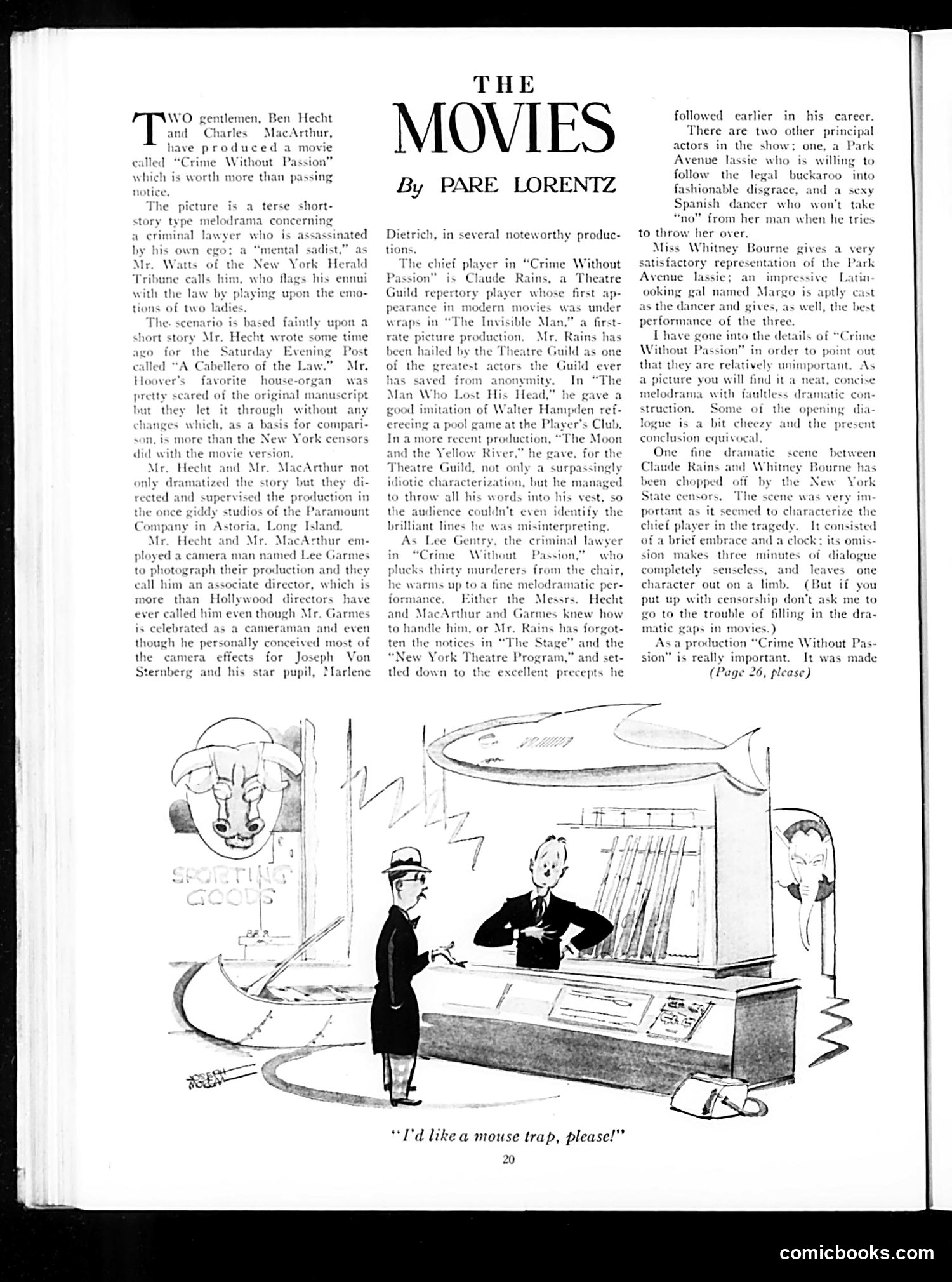
A restored page from Judge, 1934-10. Page through the whole issue in the reader above.
📄 Transcribed text from this page (OCR, searchable)
Machine-transcribed from the original scan — historical spelling and the odd misread are preserved.
3en Hecht MacArthur, ave produced a movie led “Crime Without Passion” which is worth more than passing Jemen, arles tice, The story type meloc picture is a terse short- ma concerning ho is assassinated “mental sadist,” as New York Herald o flags his ui a criminal lawyer by his own ego; r. Watts of the ‘Tribune calls 1 with the law by playing upon th tions of two ladies ed faintly upon a Hecht wrote some time Saturday Evening Post called “A Cabellero of the Law.” Mr. Hoover's was The. scenario is ba short story Mr ago for the favorite house-organ pretty scared of the original manu but they let it through hanges which, a basis for compari- is more than the New York censors did with the movie version Mr. Hecht and Mr. MacArth not y dramatized the cted and supervised th Company in Astoria, Long Ist Mr. Hecht a Mr. MacArthur em- ployed a camera man named Lee Garmes to photograph their production and they call him an as icl more than H ever called | without a nount te director, wh ywood dire even though Mr. Garmes meraman and even conceived most of effects for Joseph Von erg and his star pupil, Marlene is celebrated as a ¢ though he personally the camera THE MOVIES By PARE LORENTZ Dietri tions. The chief player in “Crime Without Pas * is Claude Rains, a Theatre Guild repertory player whose first h, in several noteworthy produc- ap- dern movies was under “The Invisible Man,” a first- Mr. Rains has tild as one actors the Guild ever nonymity. In “The » Lost His Head,” he gave a f Walter Hampden ref- um the Player's Club, Inamor t production, “The Moon and the Yellow he gave, for the Theatre Guild, not only a surpassingly pearance in wraps in rate pict been re productior tiled by the Theatre of the greatest has saved fron Man V good im River, iotic characterization, but he man. to throw all his words into ged s vest, so the audience couldn't even ide brilliant lines he As Lee Gentry, the er in “Cr Without who plucks ¢ y murderers from the chair, was misinterpreting, nal lawyer Passio he warms up to a fine melodramatic per- formance. Either the Messrs. Hecht and MacArthur and Garmes knew how to handle him, or Mr. Rains has fo! ten the notices in “The Stage” and the “New York Theatre Program, 1 set- tled down to the excellent precepts he “I'd like a mouse trap, please!” 20 followed earlier in his career. There are two other principal actors in the show; one, a Park Avenue lassie who is willing to follow the buckaroo fashionable disgrace SeXY anish dancer won't take no” from her man when he tries to throw her over. Miss Whitney Bourne gives a satisfactory representation of the Park Avenue lassie; an impressive Latin- ooking gal named Margo is aptly cast as the dancer and gives, as well, the best performance of the three. [ have gone into the details of “Crime Without P. that they are relatively unimportant. As legal into and a who very ion” in order to point out picture you will find ita neat, concise ith faultless dramatic con- ne of the dia- bit cheezy and the present conclusion eq ivocal One fine dramatic scene Claude Rains and Whitney Bourne has been chopped off by the New York between State ce . scene was very im portant as it seemed to characterize the chief player in the tragedy of a brief embrace and a clock: its omis- sion makes es ot dialogue mpletely senseless, and iracter out on a limb. (But if you put up with censorship don’t ask me to go to the trouble of filling in the dra- matic gaps in movies.) Asa production “Crime Wi! sion” is really important. It was made (Page 26, please) It consiste three mir leaves one comicbooks.com