
Judge, 1934-08 · page 24 of 36
Judge — August 1934 — page 24: what you’re looking at
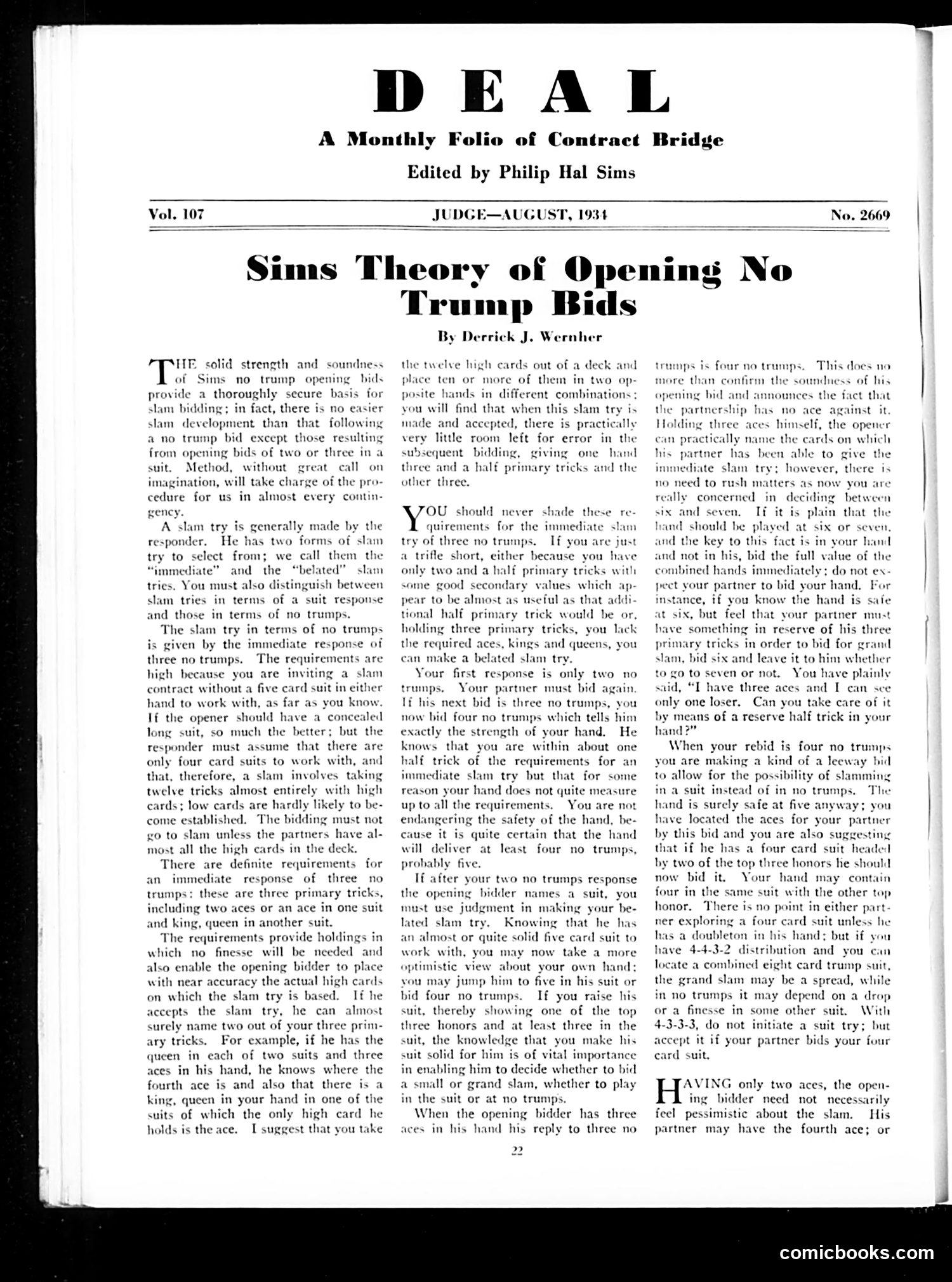
A restored page from Judge, 1934-08. Page through the whole issue in the reader above.
📄 Transcribed text from this page (OCR, searchable)
Machine-transcribed from the original scan — historical spelling and the odd misread are preserved.
DEAL A Monthly Folio of Contract Bridge Edited by Philip Hal Sims Vol. 107 T, 1934 Sims Theory of Opening No HE solid strength and soundness f Sims no trump opening | pro thoroughly secure basis for slam bidding; in fact, there is no easier slam development than that following ano trump bid except those resulting from opening bids of two or three in a suit. Method, without call on imagination, will take charge of the pro- cedure for us in almost every contin- gency. slam try is generally made by the responder. He has two forms of slam try to select from; we call them the “immediate” and the “belated” tries. You must also distinguish between slam tries in terms of a suit response and those in terms of no trumps. The slam try in terms of no trumps is given by the immediate response of three no trumps. The requirements are high because you are inviting a sla contract without a five card suit in either hand to work with, as far as you know If the opener should have a concealed long suit, so much the better; but the responder must assume that there are only four card suits to work with, and that, therefore, a slam involves taking twelve tricks almost entirely with high cards; low cards are hardly likely to be- come established. The bidding must not to slam unless the partners have al- " great most all the high cards in the d There are definite requirements for an immediate response of thr trumps: these are three primary tricks, including two aces or an ace in one suit and king, queen in another suit. The requirements provide holdings in which no finesse will be needed and also enable the opening bidder to place with near accu the actual high cards on which the slam try is based. If he accepts the slam try, he can almost me two out of your three prim- ary tricks. For example, if he has the queen in each of two suits and three aces in his hand, he knows where the fourth ace is and also that there is a king, queen in your hand in one of the suits of which the only high card he holds is the ace. I suggest that you take e no Trump Bids By Derrick J. Wernher the t elve high cards out of a deck and place ten or more of them in two op- posite hands in different combinations : you will find that when t slam try is made and accepted, there is practically very little room left for error in the subsequent bidding, giving one hand three and a half primary tricks and the other three. OU should never shade thes quirements for the immediate try of three no trumps. If you are just a trifle short, either because you have only two and a half primary tricks with some good secondary values which ap- pear to be almost as useful as that addi- tional half primary trick would be or, holding three primary tricks, you lack the required aces, kings and queens, you can make a belated slam try. Your first response is only two no trumps, Your partner must bid again If his next bid is three no trumps, you now bid four no trumps which tells him exactly the strength of your hand. He knows that you are within about one f trick of the requirements for an mediate slam try but that for some ason your hand does not quite measure up to all the requirements. You are not endangering the safety of the hand, be- cause it is quite certain that the hand lam will deliver at least four no trumps, probably five. If after your two no trumps response the opening bidder names a suit, you must use judgment in making your be- lated slam try. Knowing th an almost or quite solid five he has suit to work with, you may now take a more optimistic view about your own hand; you may jump him to five in his suit or bid four no trumps. If you raise his suit, thereby showing one of the top three honors and at least three in the suit, the knowledge that you make his suit solid for him is of vital importance in enabling him to decide whether to bid a small or grand slam, whether to pl: in the suit or at no trumps. When the opening bidder has three es in his hand his reply to three no y » This doe trum: four no truny no of his that the partnership has no ace against it. Holding s himself, the opener can practically name the cards on which his partner has more than ce m the soundne opening bid and announces the fa cen abl to give i ediate slam try however, there no need to rush matters as now y really concerned in’ deciding between Tf it is plain that the hand should be played at six or seve and the key to this fact is in your hand and not in his, bid the full value of the combined hands immediately ; do not ex- pect your partner to bid your hand. For instance, if you know the hand is safe t six, but feel that your partner my ave something in reserve of his three tricks in order to bid for grand J six and leave it to him whether to go to seven or not. You have plainly stid, “I have three aces and [ can see only one loser. are of it by means of a reserve half trick in your hand?” When your rebid is four no trun you are making a kind of a leeway to allow for the possibility of slamming in a suit instead of in no trumps. The hand is surely safe at five anyway; you have located the aces for your partner by this bid and you are also sugge that if he has a four card suit headed by two of the top three honors he should now bid it. Your hand may contain four in the same suit with the other top honor. There is no point in either part- ner exploring a four card suit unless he has a doubleton in his hand; but if you have 4-4-3-2 distribution and you can locate a combined eight card trump suit, the grand slam may be a spread, while in no trumps it may depend on a drop or a finesse in some other suit. With 4-3-3-3, do not initiate a suit try; but accept it if your partner bids your four card suit. six and seven. priv ur slam, bi VING only two aces, the open- ing bidder need not necessarily feel pessimistic about the slam. His partner may have the fourth ace; or comicbooks.com