
Judge, 1934-07 · page 16 of 36
Judge — July 1934 — page 16: what you’re looking at
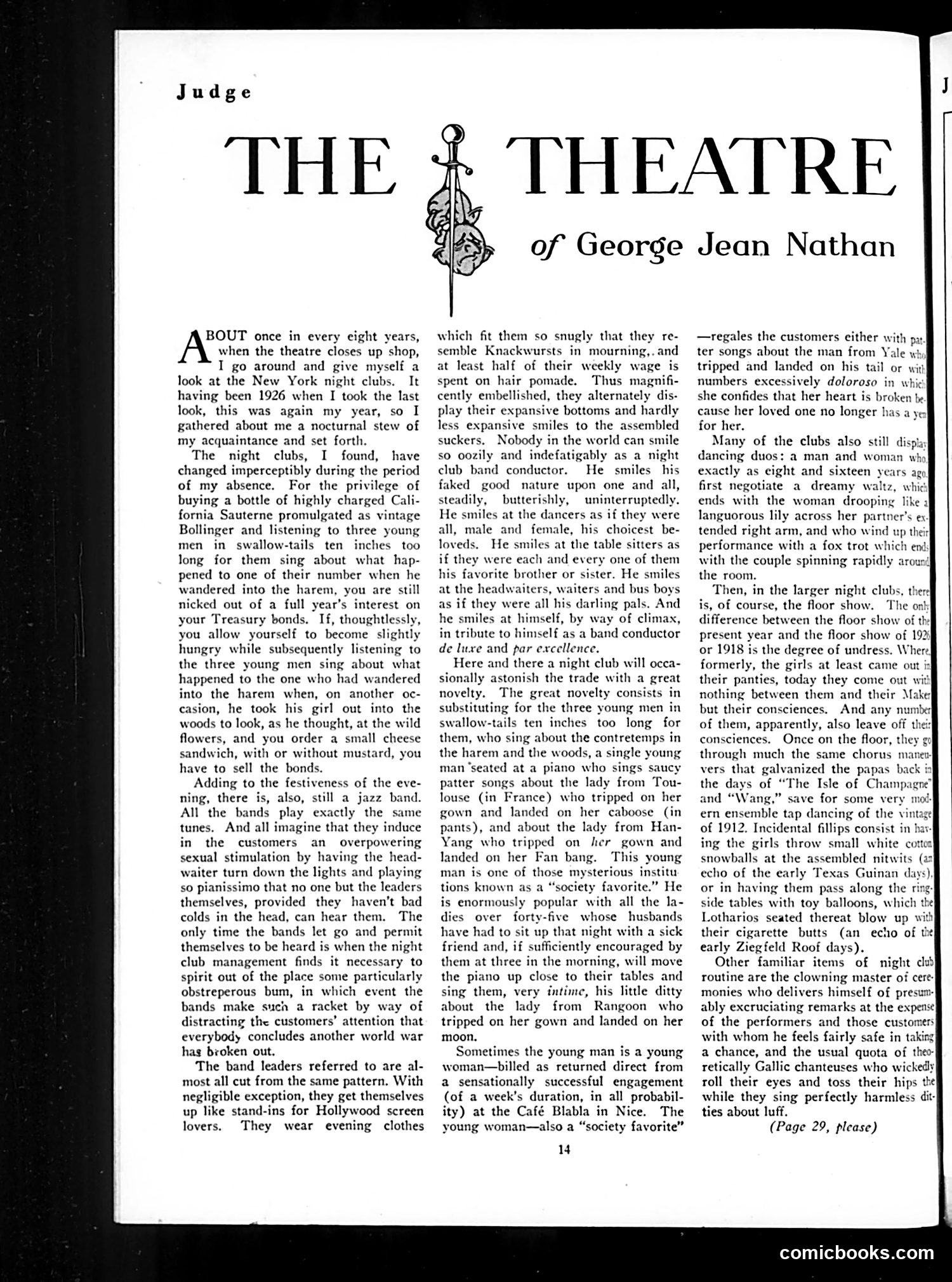
A restored page from Judge, 1934-07. Page through the whole issue in the reader above.
📄 Transcribed text from this page (OCR, searchable)
Machine-transcribed from the original scan — historical spelling and the odd misread are preserved.
BOUT once in every eight years, when the theatre closes up shop, I go around and give myself a look at the New York night clubs. It having been 1926 when I took the last look, this was again my year, so I gathered about me a nocturnal stew of my acquaintance and set forth. The night clubs, I found, have changed imperceptibly during the period of my absence. For the privilege of buying a bottle of highly charged Cali- fornia Sauterne promulgated as vintage Bollinger and listening to three young men in swallow-tails ten inches too long for them sing about what hap- pened to one of their number when he wandered into the harem, you are still nicked out of a full year’s interest on your Treasury bonds. If, thoughtlessly, you allow yourself to become slightly hungry while subsequently listening to the three young men sing about what happened to the one who had wandered into the harem when, on another oc- casion, he took his girl out into the woods to look, as he thought, at the wild flowers, and you order a small cheese sandwich, with or without mustard, you have to sell the bonds. Adding to the festiveness of the eve- ning, there is, also, still a jazz band. All the bands play exactly the ne tunes, And all imagine that they induce in the customers an overpowering sexual stimulation by having the head- waiter turn down the lights and playing so pianissimo that no one but the leaders themselves, provided they haven't bad colds in the head, can hear them. The only time the bands let go and permit themselves to be heard is when the night club management finds it necessary to spirit out of the place some particularly obstreperous bum, in which event the bands make such a racket by way of distracting the customers’ attention that everybody concludes another world war has broken out. The band leaders referred to are al- most all cut from the same pattern. With negligible exception, they get themselves up like stand-ins for Hollywood screen lovers. They wear evening clothes of George which fit them so snugly that they re- semble Knackwursts in mourning,.and at least half of their weekly wage is spent on hair pomade. Thus magnifi- cently embellished, they alternately dis- play their expansive bottoms and hardly less expansive smiles to the assembled suckers. Nobody in the world can smile so oozily and indefatigably as a night club band conductor. He smiles his faked good nature upon one and all, steadily, butterishly, uninterruptedly. He smiles at the dancers as if they were all, male and female, his choicest be- loveds. He smiles at the table sitters as if they were each and every one of them his favorite brother or sister. He smiles. at the headwaiters, waiters and bus boys as if they were all his darling pals. And he smiles at himself, by way of climax, in tribute to himself as a band conductor de luxe and par excellence. Here and there a night club will occa- sionally astonish the trade with a great novelty. The great novelty consists in substituting for the three young men in swallow-tails ten inches too long for them, who sing about the contretemps in the harem and the woods, a single young man ‘seated at a piano who sings saucy patter songs about the lady from Tou- louse (in France) who tripped on her gown and landed on her caboose (in pants), and about the lady from Han- Yang who tripped on her gown and landed on her Fan bang. This young man is one of those mysterious institu tions known as a “society favorite.” He is enormously popular with all the la- dies over forty-five whose husbands have had to sit up that night with a sick friend and, if sufficiently encouraged by them at three in the morning, will move the piano up close to their tables and sing them, very intime, his little ditty about the lady from Rangoon who tripped on her gown and landed on her moon. Sometimes the young man is a young woman—billed as returned direct from a sensationally successful engagement (of a week's duration, in all probabil- ity) at the Café Blabla in Nice. The young woman—also a “society favorite” 14 Jean Nathan —regales the customers either with P: ter songs about the man from Yale w tripped and landed on his tail or with numbers excessively doloroso in \ she confides that her heart is broken be. cause her loved one no longer has a ye for her. Many of the clubs also still disp dancing duos: a man and woman who exactly as eight and sixteen years ago. first negotiate a dreamy waltz, whic ends with the woman drooping like 3 languorous lily across her partner's ex tended right arm, and who wind up their performance with a fox trot which end with the couple spinning rapidly arour the room. Then, in the larger night clubs, ther is, of course, the floor show. The onk difference between the floor show of th present year and the floor show of 192: or 1918 is the degree of undress. Where. formerly, the girls at least came out i: their panties, today they come out nothing between them and their Make but their consciences. And any number of them, apparently, also leave off 1 consciences. Once on the floor, they through much the same chorus mai vers that galvanized the papas back the d: of “The Isle of Champagr: and “Wang,” save for some ve: ern ensemble tap dancing of the vin of 1912. Incidental fillips consist in ing the girls throw small white cottos snowballs at the assembled nitwits ( echo of the early Texas Guinan da or in having them pass along the ring side tables with toy balloons, which the Lotharios seated thereat blow up w their cigarette butts (an echo of t early Ziegfeld Roof days). Other familiar items of night cl routine are the clowning master of cere- monies who delivers himself of presw ably excruciating remarks at the expense of the performers and those customers with whom he feels fairly safe in taking a chance, and the usual quota of theo- retically Gallic chanteuses who wicked! roll their eyes and toss their hips while they sing perfectly harmless dit- ties about luff. (Page 29, please) comicbooks.com