
Judge, 1933-12 · page 10 of 37
Judge — December 1933 — page 10: what you’re looking at
What you’re looking at
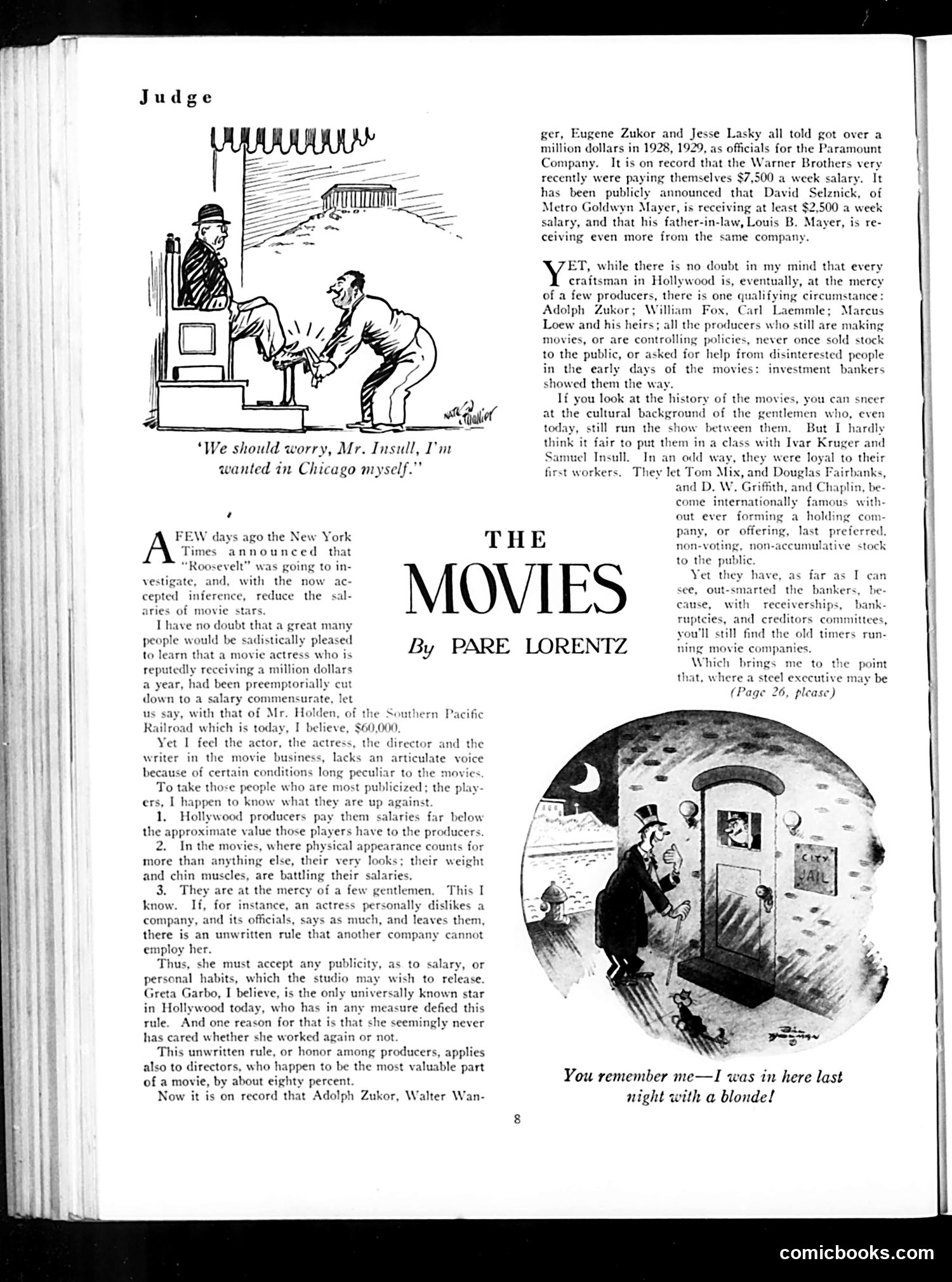
# Explanation for Modern Readers The top cartoon satirizes Samuel Insull, a prominent utilities magnate who faced legal troubles in Chicago (he was indicted in 1932 for fraud). The judge warns a defendant about his salary, and the defendant replies he's also "wanted in Chicago"—equating the defendant's minor legal problem with Insull's major scandal. The main article by Pare Lorentz criticizes Hollywood's power structure. It argues that studio moguls like Adolph Zukor, Louis B. Mayer, and the Warner Brothers pay actors far below their market value, enforce blacklists against difficult employees, and extract enormous personal salaries (millions yearly) while controlling everything. Lorentz defends these moguls slightly—unlike financial swindlers like Insull and Ivar Kruger, they at least didn't defraud the public and helped early stars become famous. Still, the piece exposes the exploitative system where a few executives hold absolute power over performers' careers.
📄 Transcribed text from this page (OCR, searchable)
Machine-transcribed from the original scan — historical spelling and the odd misread are preserved.
‘We should worry, Mr. Insull, I’m wanted in Chicago myself.” ‘ FEW days ago the New York A Times announced that sevelt” was going to in- ate, and, with the now ac- cepted inference, reduce the sal- aries of movie stars. I have no doubt that a great many people would be sadistically plez vesti to learn that a movie actress who ‘a By PARE LORENTZ reputed! ay y receiving a million dollars ar, had been preemptorially c down to a salary commensurate. us say, with that of Mr. Holden, of vuthern Pacific Railroad which is today, I believe, $60,000. Yet I feel the actor, the actre writ the director and the in the movie business, lacks an articulate voice because of certain conditions long peculiar to the movies To take those people who are most publiciz ers, I happen to know what they 2 1, Hollywood producers pay the the approximate value those players h 2. In the movies, where ph the play- e€ up against. 1) salaries far below e to the producers. sical appearance counts for more than anything else, their very Ic ; their weight and chin muscles, are battling their salaries. 3. They are at the mercy of a few gentlemen. This I know. If, for instance, an actress personally dislikes company, and its officials, sas much, and leaves them, there is an unwritten rule that another company cannot employ her. Thus, she must accept any put y, as to salary, or personal habits, which the studio may wish to release. a Garbo, I believe, is the only universally known star in Hollywood today, who has in any measure defied this rule. And one reason for that is that she seemingly never has cared whether she worked again or not This unwritten rule, or honor among producers, applies also to directors, who happen to be the most able part of a movie, by about eighty percent. Now it is on record that Adolph Zukor, Walter Wan- pany, or offering, last pref THE non-voting, 1 : to the pub Yet they have, as far as I can see, out-smarted the bankers, be- cause, with eiverships, bank- ger, Eugene Zukor and Jesse Lasky all told got over a million dollars in 1928, 1929, as officials for the Paramount Company. It is on record that the Warner Brothers very recently were paying themselves $7,500 a week salary. It has been publicly announced that David Selznick, of Metro Goldwyn Mayer, is receiving at least $2,500 a week salary, and that his father-in-law, Louis B. Mayer, is re- ceiving even more from the same company ET, while there is no doubt in my mind that every craftsman in Hollywood is, eventually, at the merc: of a few producers, there is one qualifying circumstance: Adolph Zukor; William Fox, Carl Laemmle; Marcus. Loew and his heirs; all the producers who still are making movies, or are controlling policies, never once sold stock to the public, or asked for help from disinterested people in the early days of the movies: investment bankers showed them the way. If you look at the history of the movies, you can sneer at the cultural background of the gentlemen who, even today, still run the show between them. But I hardly think it fair to put them in a class with Ivar Kruger and Samuel Insull. In an odd way, they were loyal to their first workers. They let Tom Mix, and Douglas Fa and D. W. Griffith, and Chapli come internationally famous wii out ever forming a holding com- non-accumulative ste ic. ruptcies, and creditors committees, you'll still find the old timers run- ning movie companies. Which brings me to t point y be at, where a steel executive m (Page 26, please) You remember me—I was in here last night with a blonde! comicbooks.com