
Judge, 1933-09 · page 3 of 36
Judge — September 1933 — page 3: what you’re looking at
What you’re looking at
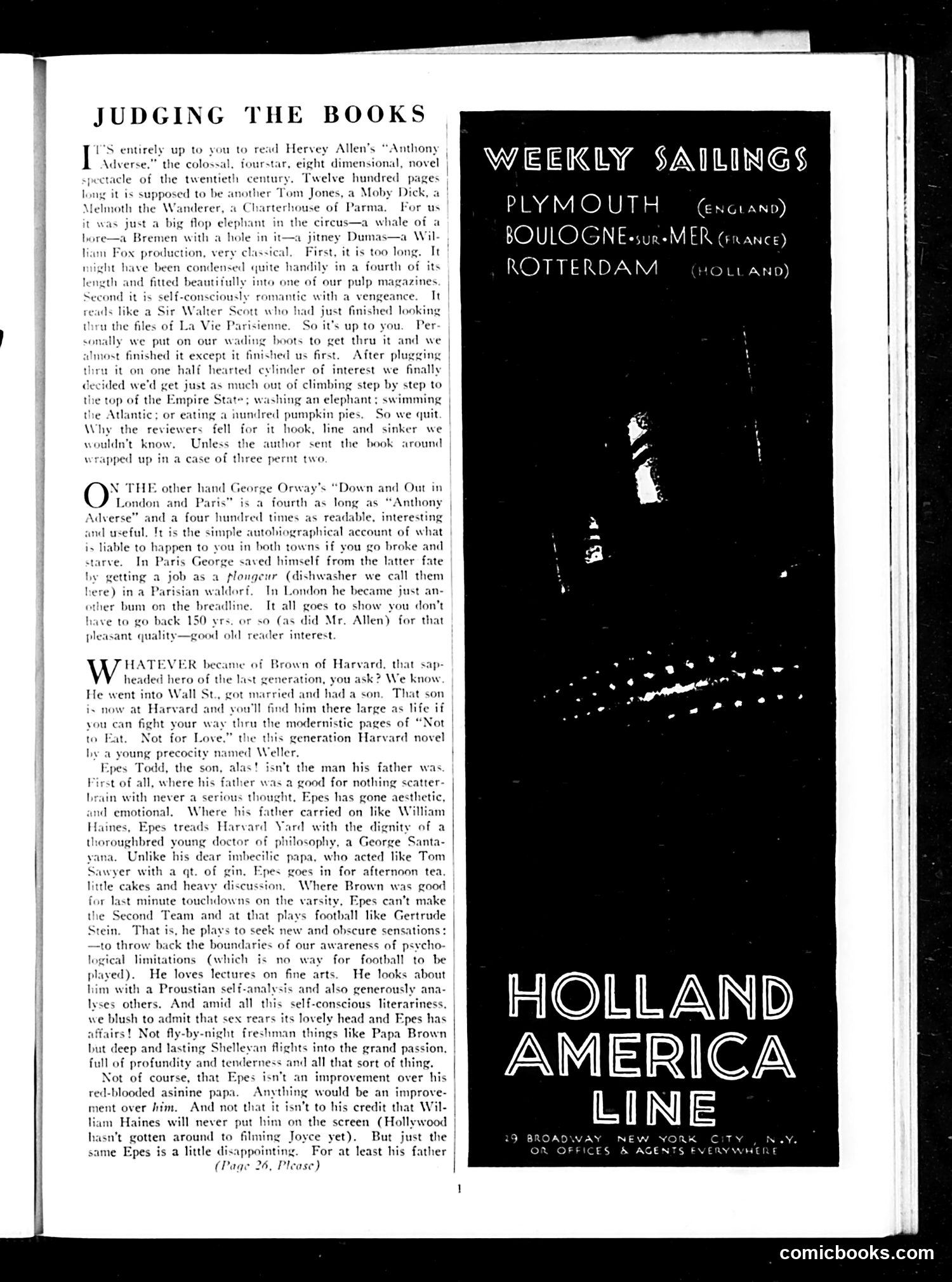
# Analysis This page combines book reviews with maritime advertising. The left column critiques three novels: Hervey Allen's "Anthony Adverse" (criticized as too long and overly romantic), George Orway's "Down and Out in London and Paris" (praised as readable autobiography), and a Harvard novel by Weller featuring protagonist Epes Todd (satirized as an affected, aesthete character embodying 1920s intellectual pretension—contrasted unfavorably with his father's practical values). The right side displays two advertisements: "Weekly Sailings" announcing passenger routes to European ports, and the "Holland America Line" shipping company logo, targeting affluent travelers. The Epes Todd satire appears to mock contemporary Harvard students as emotionally indulgent, overly introspective pseudo-intellectuals interested in obscure sensations rather than practical achievement—a common Judge theme criticizing generational cultural shifts.
📄 Transcribed text from this page (OCR, searchable)
Machine-transcribed from the original scan — historical spelling and the odd misread are preserved.
THE BOOK 1 Hervey Allen’s “Anthony ar, eight dimensional, novel ctacle of the twentieth century. Twelve hundred ges it is supposed to be another Tom Jones, a Moby Dick, a oth the Wanderer, a Charterho of Parma. For us flop elephant in the circus—a whale of JUDGING S entirely up to you to re: 1, four Adverse.” the colos: s just a big bore—a Bremen with a hole in it—a jitney Dumas—a Wil liam Fox production, very classical, First, it is too long. It might have been condensed quite handily in a fourth of its length and fitted be f our pulp magazines. Second it is self-conse ¢ with a veng reads like a Sir Walter $ ad just finished looking thru the files of La Vie Parisienne. So it’s up to you. Per sonally we put on our wading boots to utifully into one ance. It yusly roma ‘ott who almost finished it except it finished us first. After plugging thru it on one half hearted evlinder of interest we finally ach out of climbing step by step to top of the Empire State; washing an elephant; swimming Atlantic; or eatir we quit Why the reviewers fell for it hook, line and sinker we wouldn't know. Unless the author sent the book around et just as r a iundred pumpkin pies wrapped up ina case of three pernt two N THE other hand George Orway's “Down and Out in London Anthony Adverse” and a four hundred times as readable, interesting and useful, Tt is the simple autobiographical account of what is liable to happen to you in both towns if you go broke and starve. In Paris George saved himself from the latter fate y getting a job flongeur (dishwasher we call them ere) ina Parisian waldorf, In London he became just her bum on the breadline. It all goes to show you don’t d Mr. Allen) for that vod old reader interest nd Paris” is a fourth as long as have to go back 150 yrs. or so (as pl asant quality— HATEVER became hero of the last own of Harvard, that sap- headec neration, you ask? We know He went into Wall St., got married and had a son. That son is now at Harvard and you'll find him there large as life if you can fight your way thru the modernistic pages of “Not it. Not for Love, this generation Harvard novel by a young precocity named Weller, Epes Todd, the son, alas! isn’t the man his father was First of all, where his father was a good for nothing scat brain with never a serious thought, Epes has gone a and emotional. Where his father carried on like William Haines, Epes treads Harvard Yard with the dignity of a thoroughbred young doctor of philosophy, a George Santa- yana. Unlike his dear imbecilic papa, who acted like Tom Sawyer with a qt. of gin. Epes goes in for afternoon tea. little cakes and heavy discussion. Where Brown was good t minute touchdowns on the varsity, E an’t make nd am and at that plays football like Gertrude hat is, he plays to seek new and obscure sensations: -to throw back the boundaries of our awareness of psycho- gical limitations (which no way for football to be played). He loves lectures on fine arts. He looks about him with a Proustian self-analysis and also generously ana- Iyses others. And amid all self-conscious literariness, we blush to admit that sex ‘ion, nd all that sort of thing. but deep and lasting Shelleyvan flights into the grand p: full of profundity and tendern Not of course, red-blooded asinine papa. Anything would be an improve- ment over him. And not that it isn’t to his credit that Wil- mn Haines will never put him on the screen (Hollywood asn’t gotten around to filming Joyce yet). But just the ame Epes is a little disap) (Page 26, Please) et thru it and we | rears its lovely head and Epes has | affairs! Not fly-by-night freshman things like Papa Brown | that Epes isn’t an improvement over his | pinting. For at least his father | WEEKLY SAILINGS PLYMOUTH BOULOGNE-sure-MER (FRANCE) ROTTERDAM HOLLAND i AMERICA LINE 29 BROADWAY NEW YORK CITY | N or OFFICES & AGENTS EVERYWHERE (enact AND) HOLLAND) comicbooks.com