
Judge, 1933-09 · page 18 of 36
Judge — September 1933 — page 18: what you’re looking at
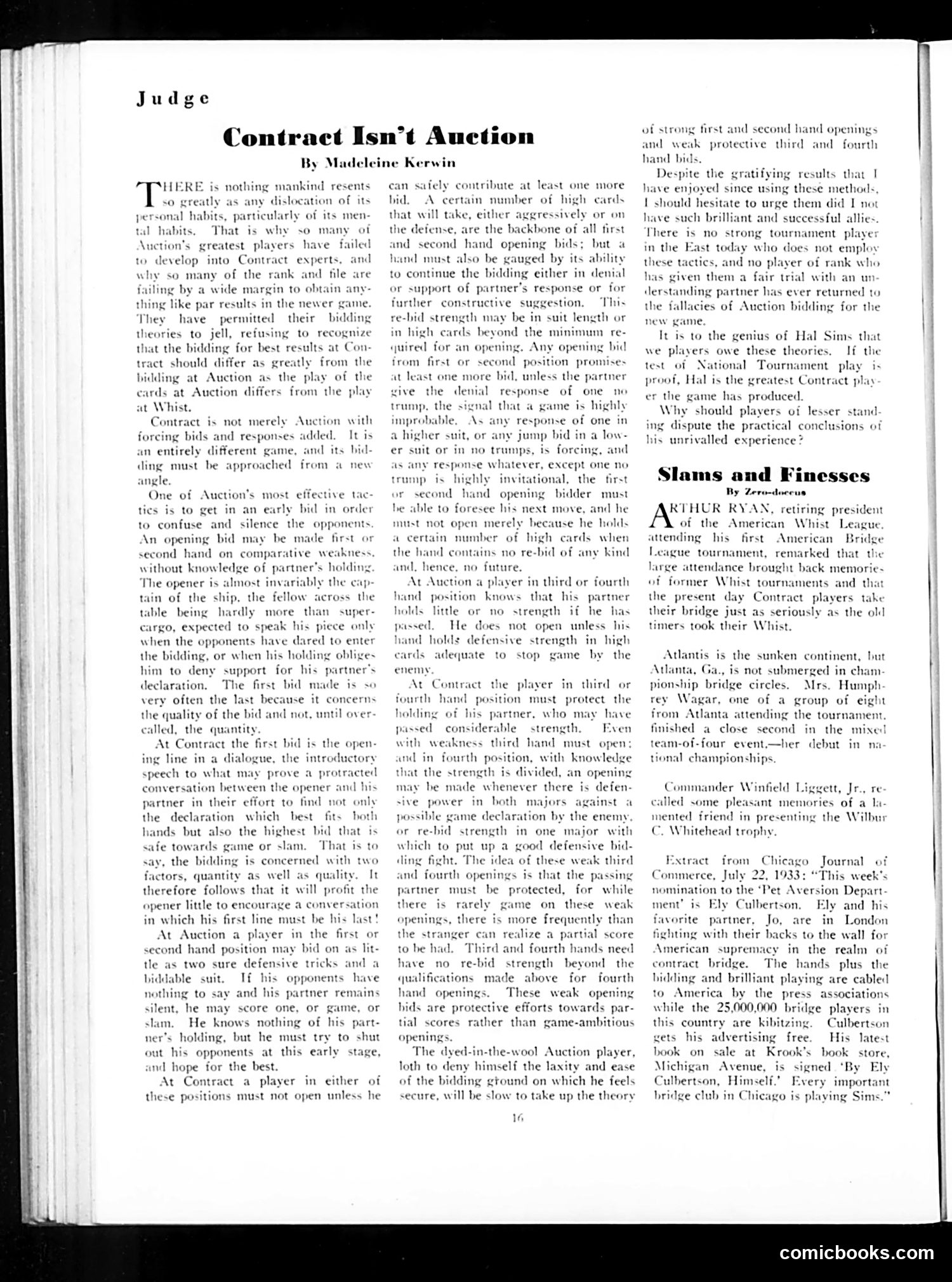
A restored page from Judge, 1933-09. Page through the whole issue in the reader above.
📄 Transcribed text from this page (OCR, searchable)
Machine-transcribed from the original scan — historical spelling and the odd misread are preserved.
~ ames amen A Judge Contract Isn’t Auction By Madele HERE is nothing ankind resents » greatly as any dislocation of its nal habits, particularly of its men- habits, That so many of *s greatest players have failed \uct to develop into Contract experts, and why so many of the rank and file are jailing by a wide margin to obtain any thing like par results in the newer game. They have permitted their bidd theories to jell, refusing to rece that the bidding for best results tract should diff bidding at Auction as the play of tl cards at Auction differs from the play at Whist. Contract is not merely Auction with ras greatly from tl forcing bids and responses adde an entirely different game, and ding must be approached from a new angle. One of Auction’s most effective tac tics is to get in an early bid in order to confuse and silence the oppone An opening bid m: second hand on arative weakn without knowledge of partner's hol The opener is almost invariably the eap- tain of th table being hardly more than sup be made first 0} ‘om| ship, the fellow across the cargo, expected to speak his piece only when the opponents have dared to enter the bidding, or when his holding oblig him to deny support for his partner declaration. The first bid made is so very often the last because it ¢ the quality of the bid and not, until over called, the quantity At Contract the first 1 ing line in a dialogu 1 is the open- . the introductory speech to what may prove a protracted conversation between the opener ¢ partner in their effort to find not only the declaration whi best fits both hands but also the highest bid that is ame or slam. That i say, the bidding is concerned with two factors, quantity as well as quality, It therefore follows that it will profit the opener little to encourage a conversation in which his first line must be his last! At Auction a player in the first or second hand position may bid on as lit- tle as two sure defensive tricks and a biddable suit. Tf his opy nothin safe towards ents have ig to say and his partner remains silent, he may score one, or game, or slam. He knows nothing of his part- ner’s holding, but he must try to shut out his opponents at this early stage, and hope for the best. At Contract a player in either of these pc ions must not open unless he ve Kerwin can safel ribute at least one more hid. \ certain number of high cards that will take, either aggressively or on ckbone of all first and second hand opening bids; but a I must also be gauged by its ability to continue the bidding either in denial or support of partner’s response or for gestion, “This id strength may be in suit length or the deiense, are the b further constructive sug: in I v cards beyond the minimum re- ing bid ui irom first or second position promises «| for an opening. Any oper at least one more bid, unless the partner ive the denial respons of one no trump, the signal that a game is highly improbable, As any response of one in a higher suit, or any jump bid in a low- er suit or in no trumps, is forcir ¥ response whatever, except ¢ rump is | ghly invitational, the bidder must ible to foresee his next move, and he if second hand openin nust not open merely because he hi a certain number o igh cards when the hand contains no re-bid of any kind ind, henee, no future. At Auction a player in third or fourth sition knows that his partner holds little or no strength if he He does not open unless his vind holds defensive strength in hig cards adequate to stop game by the enemy \t Contract the player in third or fourth hand position must protect. the ! ner, who may passed considerable strength. — Even with weakness third hand must open: Lin fourth position, with knowledge the strength is divided, oldin: of his pa ve n opening may be made whenever there is defe sive power in both majors against a or re-bid strength in one major w h to put up a good defensive bid- ding fight. The idea of these weak third and fourth openings is that the passing partner must be protected, for while there is rarely game on these weak penings, there is more frequently than the stranger can realize a partial score 1, Third and fourth hands need ave no re-bid strength beyond the qualifications made above for fourth hand openings. These weak openin hids are protective efforts towards tial scores rather than game-ambi openings to be h. par ious The dyed-in-the-wool Auction player, loth to deny himself the laxity and ease the bidding gtound on which he feels secure, will be slow to take up the theory of strong first and second hand openings and weak protective third and fourth hand bids. Despite the gratifying results that | have enjoyed since using these methods, I should hesitate to urge them did I not have such brilliant and successful allies. There is no strong tournament playe in the st today who ses not employ these tactics, and no player of rank who has given them a fair trial with an un derstanding partner has ever returned to t for the the fallacies of Auction bidding new game. It is to the genius of Hal Sims that we players owe these theories. If the test National Tournament play i » Hal is the greatest Contract play r the game has produced. Why should players of lesser stand ing dispute the practical conclusions of his unrivalled experience Slams and Finesses By Zere-doce A’ THUR RYAN, retiring. president of the American Whist League attending his first American Bridge League tournament, remarked that the large attendance broug! back memorie~ of former Whist tournaments and that the present day Contract players t their bridge just as seriously as the old timers took their Whist. Atlantis is the sunken continent, but Atlanta, is not submerged in cham pionship bridge circles. Mrs. Humph rey Wagar, one of a group of eig' from Atlanta attending the tourn t ment, finished a close second in the mixed team-of-four event.—her debut in na nal championships Commander Winfield Liggett, Jr., re called some pleasant memories of a ls nted friend in presenting the Wilbur C, Whitehead trophy. Extract’ from Chicago Journal of Commerce, July 22, 1933: This week's tion to the ‘Pet Aversion Depart ment’ is Ely Culbertson. Ely and his worite partner, Jo, are in London fighting with their backs to the wall for American supremacy in the realm of contract bridge. The hands plus the bidding and brilliant playing are cabled to America by the press associatic while the 25,000,000 bridge players in this country are kibitzing. Culbertson gets his advertising free. His late-t book on sale at Krook’s book store, Michigan Avenue, is signed ‘By Ely Culbertson, Himself. nomin Every imports bridge club in Chicago is playing Sims Mw comicbooks.com