
Judge, 1933-09 · page 14 of 36
Judge — September 1933 — page 14: what you’re looking at
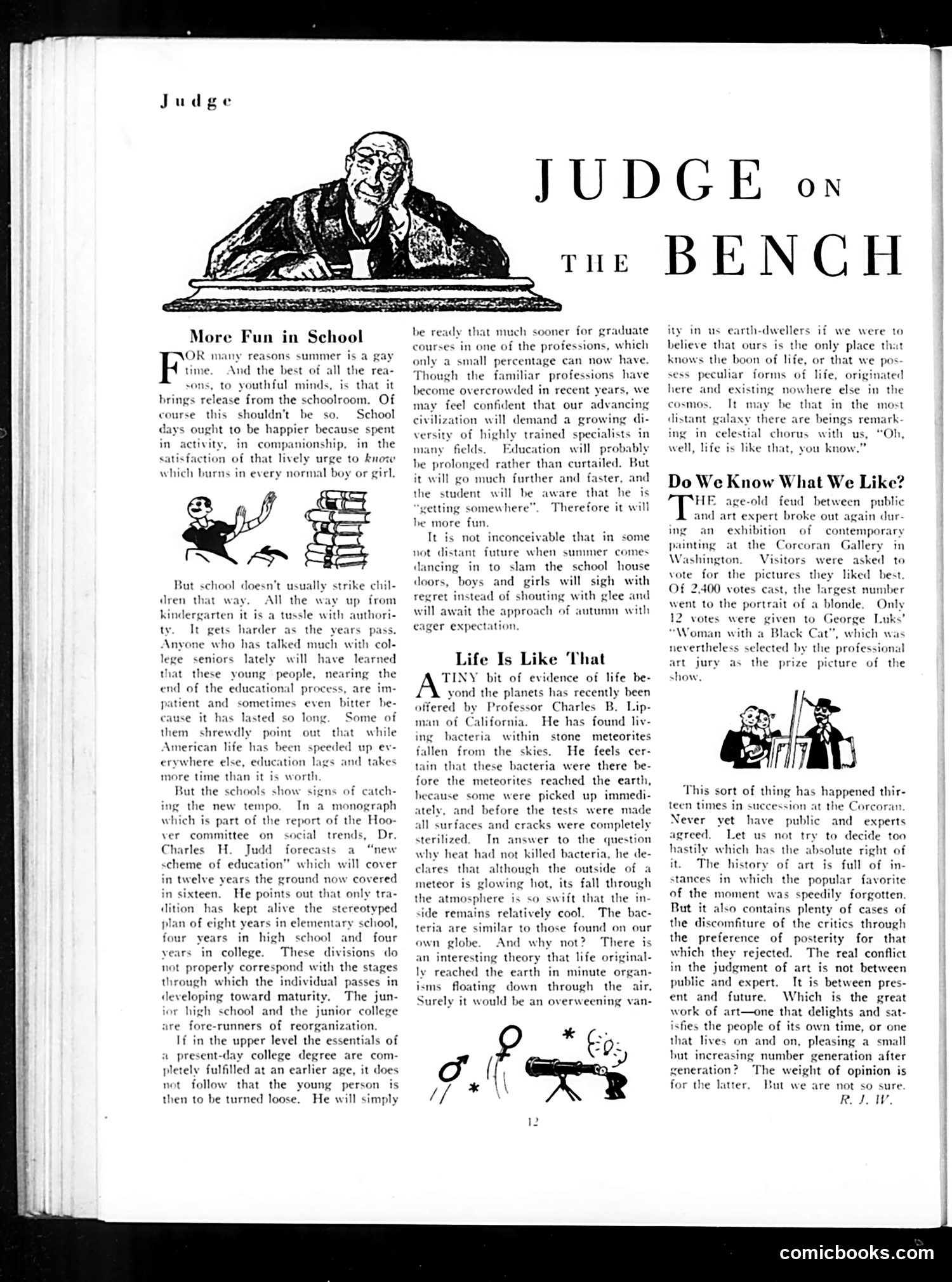
A restored page from Judge, 1933-09. Page through the whole issue in the reader above.
📄 Transcribed text from this page (OCR, searchable)
Machine-transcribed from the original scan — historical spelling and the odd misread are preserved.
More Fun in School OR m, time. ly reasons summer is a gay And the best of all the rea- to youthful minds, is that it ase from the schoolroom. Of this shouldn't be so. School ays ought to be happier because spent in activity, in companionship, in the atisfaction of that lively urge to know which burns in every normal boy or girl. a But school doesn’t usually strike c dren that brings rel course il- All the way up from kindergarten it is a tussle with authori- ty. It gets harder as the years pass. Anyone who has talked much with col- lege seniors lately will have learned that these young people, nearing the way. end of the educational process, are im- tient and sometimes even bitter cause it has lasted so long. ome of them shrewdly point out that while American life has been speeded up ev- erywhere else, education lags and takes more time than it is worth But the schools show signs of catch- the new tempo. In a monograph h is part of the report of the Hoo- ver committee on trends, Dr. Charles H. Judd forecasts a “new scheme of education” which will cover in twelve years the ground now covered in sixteen. He points out that only tra- dition has kept alive the stereotyped plan of eight years in elementary school, four years in high and four years in college. These divisions do not properly correspond with the stages through which the individual passes in developing toward maturity, The jun- ior high school and the junior college are fore-runners of reorganization. If in the upper level the essentials of a present-day college degree are com- pletely fulfilled at an earlier age, it does not follow that the young person is He will simply social school then to be turned loose. be ready that much sooner for graduate courses in one of the professions, which only a small percentage can now have. Though the familiar professions have become overcrowded in recent years, we may feel confident that our advancing civilization will demand a growing di of highly trained specialists in fields. Education will f he prolonged rather than curtailed. it will go much further and faste the student will be aware that he is etting somewhere”. Therefore it will he more fun. It is not inconceivable that in some not distant future when summer come dancing in to slam the school house doors, boys and girls will sigh with regret instead of shouting with glee and will await the approach of autumn with eager expectation versit many Life Is Like That TINY bit of evidence of life be- yond the planets has recently been offered by Professor Charles B. Lip- man of California. He has found liv- ing bacteria within stone meteorites fallen from the skies. He feels cer- tain that these bacteria were there be- fore the meteorites reached the earth, hecause some were picked up immedi- ately, and before the tests were made all surfaces and cracks were completely sterilized In answer to the que why heat had not killed bacteria, he de- clares t although the outside of a meteor is glowing hot, its fall through the atmosphere is so swift that the in side remains relatively cool. The bac- teria are similar to those found on our And why not? There is an interesting theory that life original- ly reached the earth in minute organ- isms floating down through the air. Surely it would be an overweening van- own globe ity in us earth-dwellers if we were t believe that ours is the only place knows the boon of life, or that we pos- s peculiar forms of life, originated here and existing nowhere else in the mos, It that in the most distant galaxy there are beings remark ing in celestial chorus with us, “Oh, well, life is like that, you know.” hat may be Do We Know What We Like? HE -old feud between public and art expert broke out again dur- ing an exhibition of contemporary painting at the Corcoran Gallery in Washington. Visitors were asked to vote for the pictures they liked best. Of 2,400 votes cast, the largest number went to the portrait of a blonde, Only 12 votes were given to George Luks’ “Woman with a Black Cat”, which was nevertheless selected by the professional art jury as the prize picture of the show. This sort of thing has happened thir- teen times in succession at the Corcoran, Never yet have public and experts agreed, Let us not try to deci hastily which cide too the absolute right of it. The history of art is full of in- stances in which the popular favorite of the moment was speedily forgotten. But it also contains plenty of cases of the discomfiture of the critics through the preference of posterity for that which they rejected. The real conflict in the judgment of art is not between public and expert, It is between pres- and future. Which is the great work of art—one that delights and sat- isfies the people of its own time, or one that lives on and on, pleasing a small but increasing number generation after generation? The weight of opinion is for the latter, Mut we are not so sure. RILW. ent comicbooks.com