
Judge, 1933-08 · page 14 of 36
Judge — August 1933 — page 14: what you’re looking at
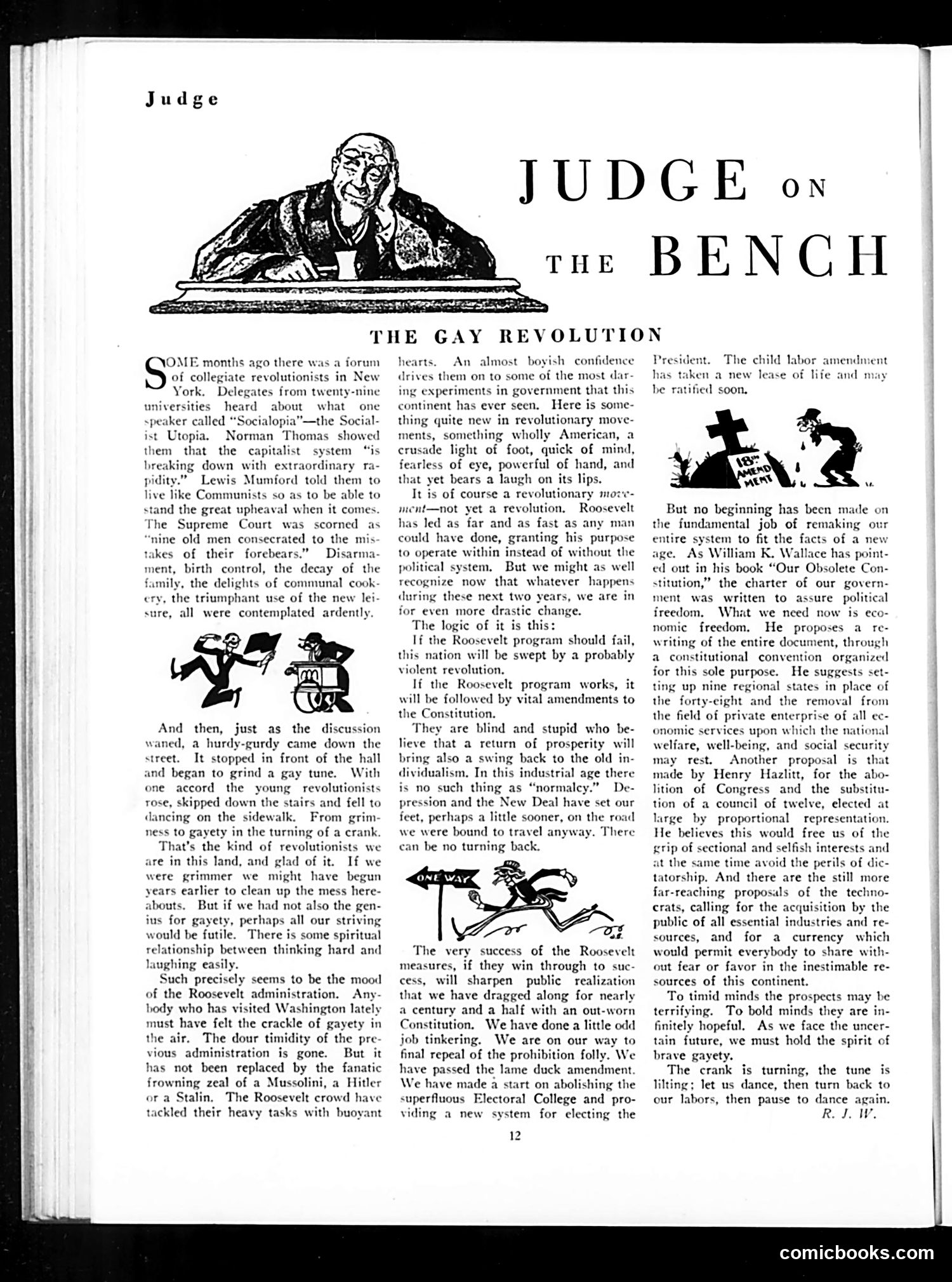
A restored page from Judge, 1933-08. Page through the whole issue in the reader above.
📄 Transcribed text from this page (OCR, searchable)
Machine-transcribed from the original scan — historical spelling and the odd misread are preserved.
Delegates from twenty-nine heard about what one Socialopia”—the Social- a. Norman Thomas showed m that the capitalist system “is breaking down with extraordinary ra- pidity.” Lewis Mumford told them to live like Communists so as to be able to stand the great upheaval when it comes. The Supreme Court was scorned as “nine old men consecrated to the mis takes of their forebears.” Disarma- ment, birth control, the decay of the family, the delights of communal cook- ery, the triumphant use of the new lei- sure, all were contemplated ardently. And then, just as the discussion waned, a hurdy-gurdy came down the street. It stopped in front of the hall and began to grind a gay tune. With one accord the young revolutionists rose, skipped down the stairs and fell to dancing on the sidewalk. From grim- ness to gayety in the turning of a crank. That's the kind of revolutionists we are in this land, and glad of it. If we were grimmer we might have begun years earlier to clean up the mess here- abouts. But if we had not also the gen- ius for gayety, perhaps all our striving would be futile. There is some spiritual relationship between thinking hard and laughing easily Such precisely seems to be the mood of the Roosevelt administ body who has visited W. ashington lately must have felt the crackle of gayety in the air. The dour timidity of the pre vious administration is gone. But it has not been replaced by the fanatic frowning zeal of a Mussolini, a Hitler ora Stalin, The Roosevelt crowd ha tackled their heavy tasks with buoyant c HE GAY REVOLUTION rts. An almost boyish confidence ives them on to some of the most dar- ing experiments in government that this continent has ever seen. Here is some- thing quite new in revolutionary move- ments, something wholly American, a crusade light of foot, quick of mind, fearless of eye, powerful of hand, and that yet bears a laugh on its lips It is of course a revolutionary moze- wient—not yet a revolution. Roosevelt has led as far and as fast as any man could have done, granting his purpose to operate within instead of without the pe system. But we might as well recognize now that whatever happens during these next two years, we are in for even more drastic change. The logic of it is this: If the Roosevelt program should fail, this nation will be swept by a probably violent revolution. If the Roosevelt program works, it will be followed by vital amendments to the Constitution. They are blind and stupid who be- lieve that a return of prosperity will bring also a swing back to the old in- vidualism. In this industrial age there is no such thing as “norn ” De- pression and the New Deal have set our feet, perhaps a little sooner, on the road we were bound to travel anyway. There can be no turning back. TR. The very success of the Roosevelt measures, if they win through to suc- cess, will sharpen public realization that we have dragged along for nearly a century and a half with an out-worn Constitution, We have done a little odd job tinkering. We are on our way to final repeal of the prohibition folly. We have passed the lame duck amendment. We have made a start on abolishing the superfluous Electoral College and pro- viding a new system for electing the 12 The child labor amendment a new lease of life and may soon, But no beginning has been made on the fundamental job of remaking our entire system to fit the facts of a ni age. As William K, Wallace has point- ed out in his book “Our Obsolete Con- stitution,” the charter of our govern- ment was written to assure political freedom. What we need now is eco- nomic freedom, He proposes a_re- writing of the entire document, through a constitutional convention organized for this sole purpose. He suggests set- ting up nine regional states in place of the forty-eight and the remo from the field of private enterprise of all ec- onomic services upon which the national welfare, well-being, and social security may rest. Another proposal is that made by Henry Hazlitt, for the al lition of Congress and the substitu- tion of a council of twelve, elected large by proportional representation. He believes this would free us of th grip of sectional and selfish interests and at the same time avoid the perils of dic tatorship. And there are the still more far-reaching proposals of the techno- crats, calling for the acquisition by the public of all essential industries and re- sources, and for a currency which would permit everybody to share with- out fear or favor in the inestimable re- sources of this continent. To timid minds the prospects may be terrifying. To bold minds they are in- finitely hopeful. As we face the uncer- tain future, we must hold the spirit of brave gayety. The crank is turning, the tune is lilting; let us dance, then turn back to our labors, then pause to dance again. JW. comicbooks.com