
Judge, 1933-08 · page 12 of 36
Judge — August 1933 — page 12: what you’re looking at
What you’re looking at
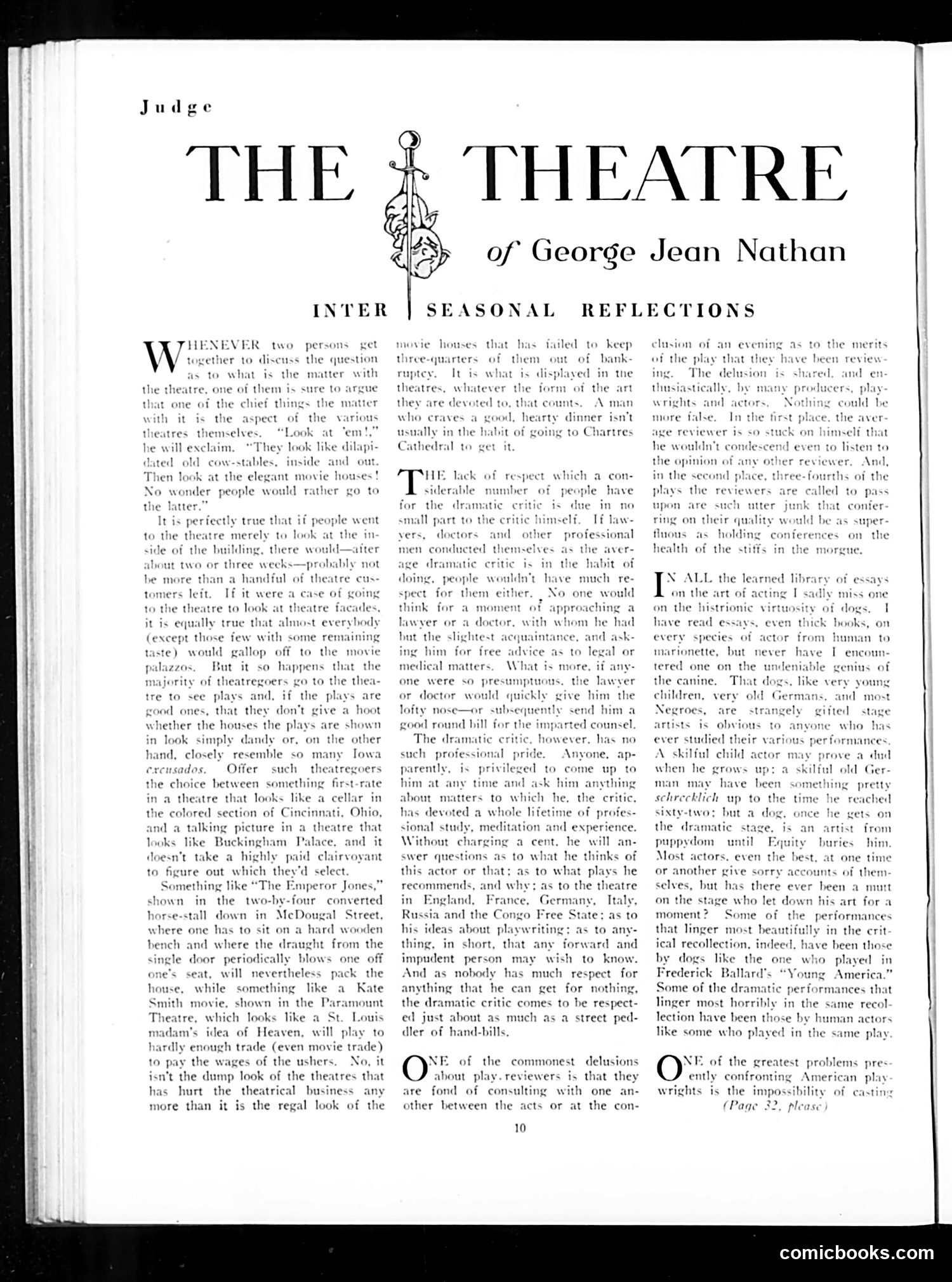
# Analysis of Judge Magazine Page This is an editorial essay by George Jean Nathan titled "The Theatre: Inter-Seasonal Reflections"—not a cartoon, but rather critical commentary on American theater and drama critics. Nathan argues that theatre audiences and critics lack proper respect for their craft. He contrasts shabby but authentic theaters with elegant movie houses, noting people prefer movies despite superior theatrical performances. His main complaint concerns dramatic critics who, despite lifelong dedication to theater, receive less professional deference than lawyers or doctors. The public treats critics dismissively, yet feels entitled to ask their free opinions on plays and performances. Nathan also criticizes actors and reviewers who consult with one another casually between acts, suggesting unprofessional conduct. He laments that young, talented actors like those trained in Germany are rarely properly recognized in American theater. The piece reflects early 20th-century anxieties about theater's decline amid rising film popularity and the low cultural status of drama criticism as a profession.
📄 Transcribed text from this page (OCR, searchable)
Machine-transcribed from the original scan — historical spelling and the odd misread are preserved.
Judge HE INTER ASONAL REFLECTIONS JHENEVER two persons get movie houses that has failed to keep clusion of an evening as to / rogether to discuss the question — three-quarters of them ot bank- of the play that they have is to what is the matter with ruptey, It is what is displayed in the ing. The delu s shared, and et e theatre, one of them is sure to argue — thes atever the for es, W oft eoart thusiastically, producers, play y of the chief tl s the mat they are devoted to, th th it is the aspect eatres themselves. “Look at ‘er ts and ac ner isn’t more false. In th ily in the habit of going to Chartres utc Amani wr rag could be the various who craves good, hearty di ace, the aver Ti tt ven to listen te reviewer, And, tuck on him Y reviewer he will exclaim, “They look like dilapi- it he wouldn't cor ] dated old cow-stables, inside and out the opinion of any ot Then look at the elegant movie houses! lack of respect in the secor three-fc ths of the tee, No wonder people would rather go to rable 1 ro have plays the ure called to pass | the latter.” for the dramatic critic no upon are s utter junk at_ confer It is perfectly true that if peop! small part to the critic himself. If law- ring on their quality would aS SUT ing conferences on re merely to lov tot side of the buile the: g, there would—aiter ond as the aver- health of the stiffs in the morgue. about two or three weeks—probably not dramatic critic is habit of | more than a handful of theatre cus- doing, people wouldn't nich re- N ALL the learned library / tomers leit. If it were a case of going spect for them either. _No one would on the art of acting T sad ] to the theatre to look at theatre facac think for a moment of approaching a on the histrionic ¥ sity of it is equally true that almost everybody — lawyer or a doctor, with whom he had have read ¢ thick (except those few with some remaining — but the slightest acquaintance, and ask- every species of actor from » but never have I the under taste) would g at it so happens that the — me najority of theatre; »p off to the movie for free advice ¢ I matters. What thea- one were so presumy see plays and, if the plays are or doctor would quickly ud ones, that they don’t give a hoot — lofty nose—or subseqt hether the houses the plays him s to legal or — marionett ly: tered one riable genius of ers go to th the lawyer — the anine. That dc give him the children, very old Germans. Neg varted counsel. artists i like very young ud palazzos. I 1 ntly ‘0€s, re strangely gif nown — good round bill for the vious to anyone who has k simply dandy or, on the other The dramatic crit iowever, has no ever studied pride. Anyone, ap- A skilful child actor privileged toc rate him at any time and ask him anythi matters to which he, the c up t s devoted a whole lifetime of pre sixty-two: but onal study, meditation and experience. the dramatic looks like Bucking and it Without charging a cent, he will an- — puppydom doesn't take a highly paid clairvoyant — swer questions as t t he thinks of | Most actors, even to figure out which they'd select this actor or that plays he or another give s« Something like “The Emperor Jones,” recommends, and why; as to the theatre selves, but has th shown in the two-by-four converted in’ England, horse-stall down in McDougal Street, Russia a where one has to sit on a hard wooden _ his ide Ger- hand, closely resemble so many ywa such profession prove excusados Offer such theatreg fir ne up to when he grows up: a skilful ol choice between somethir man may have be: schrecklic heatre that looks like a cellar in) abo: m somethi g pretty the time he reached the colored section of ( nnati, Ohio, — bh and a talking picture in a theatre thats zg, once he gets on is an ty bu rtist from alace, um es him ie best, at one time ry accounts of them rre ever been a m e wh rance, Germany, Italy, on the s nd the Congo Free State; as to moment? let down his art for the performances s about playwriting: as to any-— that linger most beautifully in the crit bench and where the draught from the thing, in short, that any forward and ical recollection, indec single door periodically blows one off impudent person may wi he ave been the who played in « America.” house, while something like a Kate anything that he can get for nothing, Some of the dramatic performances that h to know. by dogs like < seat, will nevertheless pack the And as nobody has much respect for Frederick Ballard’s “Young { Sm movie, shown in the Paramount the dramatic critic comes to be respect- linger most horribly in the same recol | Theatre, which looks like a St. Louis ed just about as much as a strect ped- lection have been those by human actors fs am’s idea of Heaven, will play to dler of hand-1 Is, like some who played in the same play ly enough trade (even movie trade) to pay the wages of the ushers. No, it OX of the commonest delusions NE. of the greatest pr isn’t the dump look of the theatres that about play. reviewers is that they ently confront American play has hurt the theatrical business any are fond of nsulting with one an- wrights is the impossibility of casting more than it is the regal look of the other between the acts or at the con- (Page 32, plea blems pres 10 comicbooks.com