
Judge, 1933-07 · page 8 of 36
Judge — July 1933 — page 8: what you’re looking at
What you’re looking at
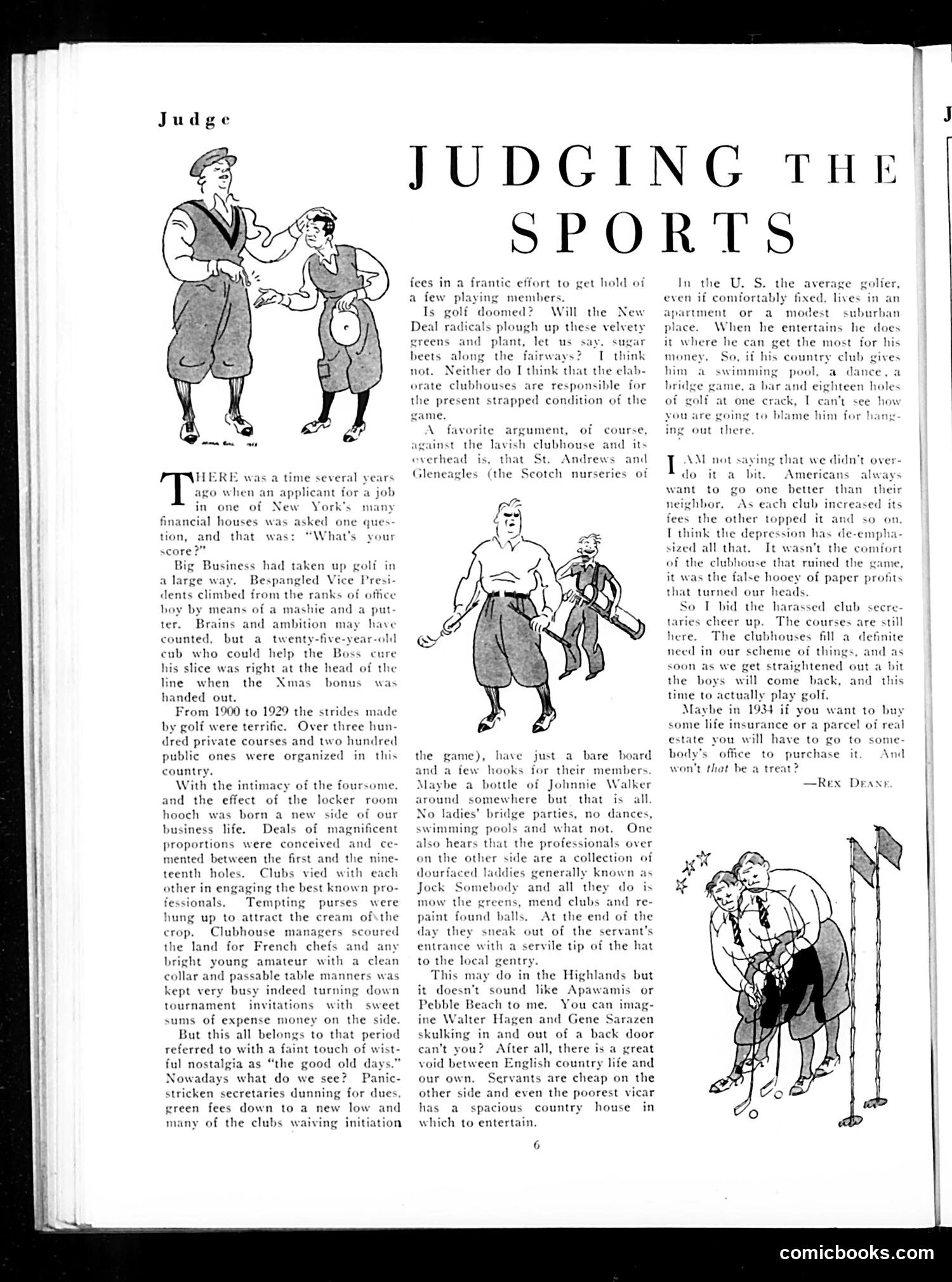
# "Judging the Sports": Golf's 1920s Decline This satirical piece critiques the dramatic collapse of American golf's popularity between 1900-1929. The text explains that golf clubs—which had proliferated with "magnificent proportions" and clubhouse extravagance—suddenly faced crisis as the sport fell from fashion. The cartoons illustrate the problem: overeager club managers had chased memberships and revenue so aggressively that the sport lost its appeal. Wealthy amateurs abandoned golf for other entertainments. The author (Rex Deane) argues the crisis stems not from course conditions but from excessive commercialization—the "false hooey of paper profits" that corrupted the game. The illustrations show a judge-like authority figure explaining this collapse to a younger golfer, suggesting satirical commentary on how poor management destroyed what was once an elite pastime.
📄 Transcribed text from this page (OCR, searchable)
Machine-transcribed from the original scan — historical spelling and the odd misread are preserved.
Judge ] HERE was a time several years ago when an applicant for : in one of New York's man financial houses was aske and that tion, wa score? Sig Business had taken up golf in alarge way. Bespan led Vice Pre dents climbed from the ranks of office b by means of a mashie and a put- ter. Brains and ambition may have | counted, but a_ twenty-five-year-old | cub who could help the Boss cure his slice was right at the head of the line when the Xmas bonus was handed out. From 1900 to 1929 the strides made by golf were terrific. Over three hun- dred private courses and two hundred public ones were organized in this country. With the intimacy of th and the effect of the hooch born a new side business Deals of magnificent vere conceived and mented between the first and the ni teenth holes. Clubs vied with each other in engaging the best known pro- fessionals. Tempting purses were hung up to attract the cream of\the crop. Clubhouse managers i the land for French chefs and bright young amateur with a clean collar and passable table manners was kept very busy indeed turning down e foursome. m locker re was of our life. proportions ce sco) any tournament invitations with sweet 1 sums of expense money on the side. 4 3ut this all belongs to that period | referred to with a faint touch of wist- ful nostalgia as “the good old days. Nowadays what do we see? Panic- stricken secretaries dunning for dues. | green fees down to a new low and many of the clubs waiving initiation Deal radi the present st game. against the lavish clubhouse everhead is, th Gl JUDGING THE SPORTS fees in a frantic effort to get hold of a few playing members. Will the New cals plough up these velvety Is golf doomec plant, let us say. sugar ong the fairways? I think ither do I think that the elab- orate clubhouses are responsible for ndition of the apped ¢ \ favorite ument, of course, and its Andrews and nur at St les (the Scotch cries of the game), have just a bare board and a few hooks for their members Maybe a bottle of Johnnie Walker around re but that is all No ladies’ bridge parties, no dances, swimming pools and what not. One also hears that the professionals over on the otl surfaced laddies generally known as xck Somebody and all they do is mend clubs and re- paint found balls, At the end of the day they of the servant's entrance with a servile tip of the to the local gentry. This may do in the Highlands but it doesn’t sound like Apawamis or Pebble Beach to me. You can imag- ine Walter Hagen and Gene Sarazen skulking in and out of a back door can’t you? After all, there is a great void between English country life and our own. Servants are cheap on the other s' and even the poorest v has a spacious country house which to entertain. somewlh r side are a collection of mow the greer sneak o} 6 In the U. the average golier, even if comfortably fixed, lives in an apartment or a modest urban place. When he entertains he does it where he can get the most for his money. So, if his country club gives him a ming pool, bar and e at one cr bridg of ¢ ck, I can’t see me him for | you are going to ing out there. \M not saying that we didn't over- do it bit, Americans always want to go one better than their hbor, As each club increased its fees the other topped it and so on I think the depression has de-empha- sized all that. It wasn’t the comfort of the clubhouse that ruined the it was the false hooey of paper profits that turned our heads. So IT bid the haras taries cheer up. ume, club secre- The courses are still The clubhouses fill i need in our scheme of thing soon as we get straightened out the boys will come back, ar time to actually play golf. Maybe in 1934 if you want to buy some life insurance or a parcel of real estate you will have to go to some- body's office to purchase it won't that he a treat? —Rex Deane here. And comicbooks.com