
Judge, 1933-07 · page 23 of 36
Judge — July 1933 — page 23: what you’re looking at
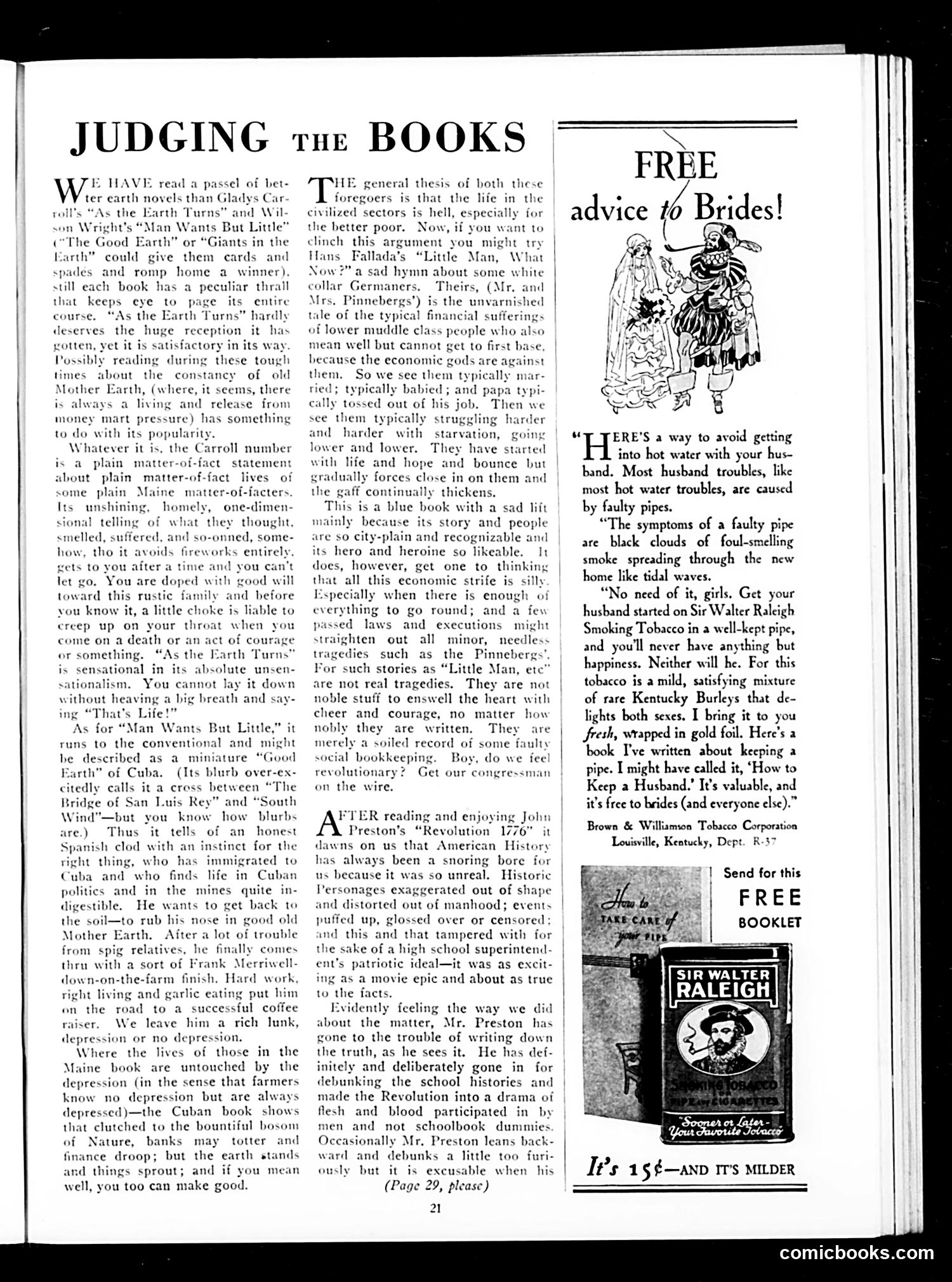
A restored page from Judge, 1933-07. Page through the whole issue in the reader above.
📄 Transcribed text from this page (OCR, searchable)
Machine-transcribed from the original scan — historical spelling and the odd misread are preserved.
JUDGING rue BOOKS 2 HAVE read a passel of bet- r earth novels than Gladys Car carth Turns” and Wil- n Wants But Little” «The Good Earth” or “Giants in the Earth” could give them cards and spades and romp home a winner). still each book has a peculiar thrall that keeps eye to page its entire course, s the Earth Turns” hardly deserves the huge reception it has gotten, yet it is satisfactory in its way. Possibly reading during these tough constancy of old rth, (where, it seems, there ) living and release from mart pressure) has something to do with its p 5 Whatever it i ‘arroll number a plain matter-of-fact statement pout plain matter-of-fact s of some plain Maine matter-of-facters. Its unshining, homely, one-dimen- sional telling what they thought, smelled, suffer ined, some- how, tho it ave rks entirely, you can’t gets to you after a time and let go. You are doped with good will toward this rustic family and before you know it, a little choke is liable to creep up on your throat when you come on a death or an act of courage or something. “As the Earth Turns” is sensational in its absolute unsen- sationalism. You cannot lay it down without heaving a big breath and say- ing “That's Life!” As for “Man Wants But Little,” it runs to the conventional and might be described as a miniature “Good Earth” of Cuba. (Its blurb over- citedly calls it a cross between “The Bridge of San Luis Rey” and “South Wind"—but you know how blurbs are.) Thus it tells of an honest Spanish clod with an instinct for the right thing, who has immigrated to Cuba and who finds life in Cuban politics and in the mines quite in- digestible. He wants to get back to the soil—to rub his nose in good old Mother Earth. After a lot of trouble from spig relatives, he finally comes thru with a sort of Frank Merriwell- down-on-the-farm finish. Hz work, right living and garlic eating put him on the road to a successful coffee raiser. We leave him a rich lunk, depression or no depression. Where the lives of those in the Maine book are untouched by the depression (in the sense that farmers know no depression but are always depressed)—the Cuban book shows that clutched to the bountiful bosom of Nature, banks may totter and finance droop; but the earth stands and things sprout; and if you mean well, you too can make good. times, about the mone > fire HE general thesis of both these oregoers is that the life in the civilized sectors is hell, especially for the better poor. Now, if you want to clinch this argument you might try Hans Fallada’s “Little Man, What Now ?"a sad hymn about some white collar Germaners. heirs, (Mr. and Mrs. Pinnebergs’) is the unvarnished tale of the typical financial sufferings of lower muddle class people who also mean well but cannot get to first base, because the economic gods are against them. So we see them typically mar- 1; typically babied ; and papa typi- tossed out of his job. Then we see them typically struggling harder and harder with starvation, goi lower and lower. hey have start with life and hope and bounce but adually forces close in on them and » gaff continually thickens, is is a blue book with a sad liit its story and people are so city-plain and recognizable and its hero and heroine so likeable. It does, however, get one to thinking that all this economic strife is silly Especially when there is enough of everything to go round; and a few passed laws and executions m straighten out all minor, needl tragedies such as the Pinnebergs’. r such stories as “Little Man, etc are not real tragedi They are not noble stuff to enswell the heart with cheer and courage, no matter how nobly they are written. They are merely a soiled record of some faulty social bookkeeping. Boy, revolutionary ? on the wire. Ape reading and enjoyir Preston's “Revolution 1776’ dawns on us that American History has always been a snoring bore for us because it was so unreal, Historic Personages exaggerated out of shape and distorted out of manhood; events puffed up, glossed over or censored: ind this and that tampered with for the sake of a high school superintend- 's patriotic ideal—it was as excit- ing as a movie epic and about as true to the facts. Evidently feeling the way we did about the matter, Mr. Preston has gone to the trouble of writing down the truth, as he sees it. He has def- initely and deliberately gone in for debunking the school histories and made the Revolution into a drama of flesh and blood participated in by men and not schoolbook dummies Occasionally Mr. Preston leans back- ward and debunks a little too furi- ously but it is excusable when his (Page 29, please) 21 rie do we feel Get our congressman SS FREE advice ce Brides! “HS a way to avoid getting into hot water with your hus- band. Most husband troubles, like most hot water troubles, are caused by faulty pipes. “The symptoms of a faulty pipe are black clouds of foul-smelling smoke spreading through the new home like tidal waves. “No need of it, girls. Get your husband started on Sir Walter Raleigh Smoking Tobacco in a well-kept pipe, and you'll never have anything but happiness. Neither will he. For this tobacco is a mild, satisfying mixture of rare Kentucky Burleys that de- lights both sexes. I bring it to you fresh, wrapped in gold foil. Here's a book I've written about keeping a pipe. I might have called it, ‘How to Keep a Husband.’ It’s valuable, and it’s free to brides (and everyone else).” Brown & Williamson Tobacco Corporation Louisville, Keatuchy, Dept. R-37 | Send for this | FREE | BOOKLET It’s 1 5#—AND IT’S MILDER comicbooks.com