
Judge, 1933-07 · page 19 of 36
Judge — July 1933 — page 19: what you’re looking at
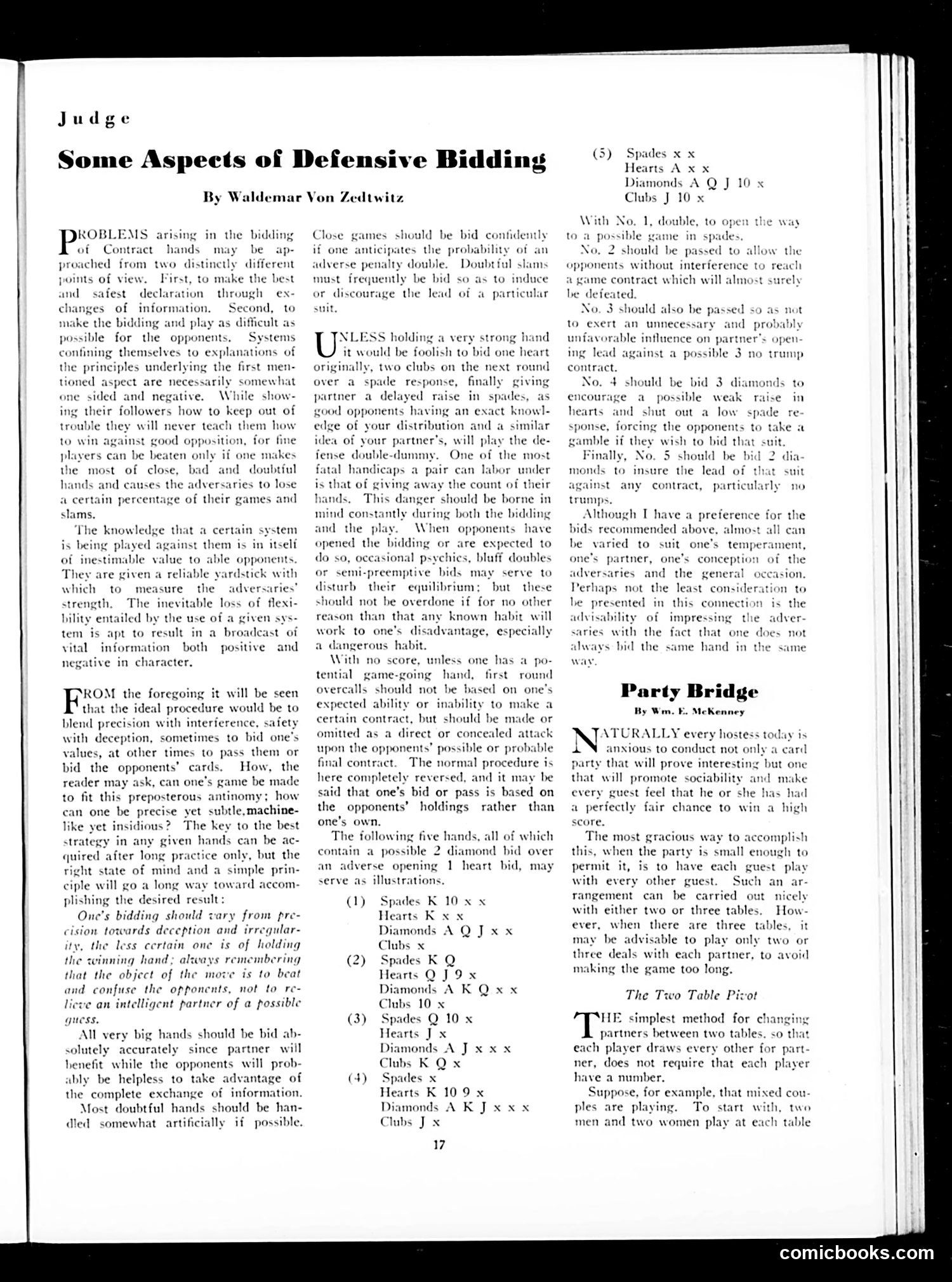
A restored page from Judge, 1933-07. Page through the whole issue in the reader above.
📄 Transcribed text from this page (OCR, searchable)
Machine-transcribed from the original scan — historical spelling and the odd misread are preserved.
Judge Some Aspects of Defensive Bidding By Wald ROBLEMS arising in the biddir ot Contract hands may be ap proached from two distinetly different points of view. First, to make the be: and safest) declaration through changes of information. Second, to make the bidding and play as difficult as possible for the opponents. ystems confining themselves to explanations of the principl ex- s underlying the first men- tioned aspect are necessarily somewhat one sided and negative. W ing their followers how to keep out of trouble they will never teach them how to win against good opposition, for fine ile show- players can be beaten only if one makes the most of close, bad and doubtful hands and causes the adversaries to lose a certain percentage of their games and slams, The knowledge that a certain system is being played against them is in itseli of inestimable value to able opponents. re given a reliable yardstick with which to measure adversari strength, The inevitable loss of flexi- bility entailed by the use of a given sys- tem is apt to result in a broadcast of vital information both positive and negative in character, the ROM the foregoing it will be seen that the ideal procedure would be to blend precision with interference, safety with deception, sometimes to bid one’s values, at other times to pass them or bid the opponents’ cards. How, the reader may ask, can one’s game be made to fit this preposterous antinomy; how an one be precise yet subtle,machine- ike yet insidious? The key to the best strategy in any given hands can be « quired after long practice only, but the right state of mind and a simple prin- ciple will go a long w: y toward accom- plishing the desired result: One’s bidding should vary from pre- cision towards deception and irreqular- ity, the less certain one is of holding the winning hand; always remembering that the object of the ° is to beat and confuse the opponents, not to re- ieve an intelligent partner of a possible g All very big hands should be bid ab- solutely accurately since partner will benefit while the opponents will prob- ably be helpless to take advantage of the complete exchange of informati Most doubtful hands should be h: dled somewhat artificially if possible. r Von Zedtwitz Close games should be bid confidently if one anticipates the probability of an adverse penalty double. Doubtful slams must frequently be bid so a or di to induce ourage the Jead of a particular suit, ‘LESS holding a very strong hand U it would be foolish to bid one heart originally, two clubs on the next round over a spade response, finally giving partner a delayed raise in spades, as 1 opponents having an exact knowl- edge of your distribution and a similar idea of your partner's, will play the de- fense double-dummy, One of the most fatal handicaps a pair can labor under is that of giving away the count of their hands. This danger should be borne in mind constantly during both the biddin and the play. When opponents 1 opened the bidding or are expected to do so, occasional psychics, bluf mptive may serve to their equilibrium: but these should not be overdone if for no other doubles or semi-pre bids disturb reason than that any known habit will work to one’s disadvantage, especially a dangerous habit. With no score, unless one has a po- tential game-going hand, first’ round overcalls should not be based on one’s expected ability or inability to make a certain contract, but should be made or omitted as a direct or concealed attack upon the opponents’ possible or probable final contract. The normal procedure is here completely reversed, and it may be said that one’s bid or pass is based on the opponents’ holdings rather than one’s own. The following five hands, all of which contain a possible 2 diamond bid over an adverse opening 1 heart bid, may serve as illustrs (1) Spades K Hearts K Diamonds Clubs x Spades K Q Hearts Q J 9 x Diamonds A K Q x x Clubs 10 x Spades Q 10 x Hearts J x Diamonds A J x x x Clubs K Q x Spades x Hearts K 109 x Diamonds A K J x x x Clubs J x 17 ions. 10x x xX AQIJxx (2) (3) (4) (5) Spades x x Hearts A x x Diamonds A Q J 10 x Clubs J 10 x With No. 1, double, to open t ible 2 should be passed to allow the without interference & game contract which will almost be defeated. should also be passed so as not to exert anun ry and probat unfavorable influence on partner's oper ing lead against a possible 3 no trump contract. No. 4 1cour possible hearts 1 shut out a low ponse, forcing the oppone: mble if they wish to bid th: Finally, No. 5 should be nonds to insure the lead of tinst any contract, particula trumps. should be bid Ke 3 dian weak rais spade to take a Although T have a preference for the mmended ried to suit one’s te one’s partner, one’s conception of above, almc adversaries and the general « casion. Perhaps not the least consideration to be presented in this connection is the advisability of impressing the adver- aries with the fact that one does not always bid the same hand in way same Party Bridge By Wm. FE. McKenney \TURALLY every hostess today is N anxious to conduct not only a card one mike as had r chance to win a high rty that will prove interesting but that will promote sociability and every guest feel that he or she a perfectly f score. The most gracious way to accomplis this, when the party is small enough to permit it, is to have each guest play with every other guest. Such an ar- rangement can be carried out . with either two or three tables. How- ever, when there are three tables, it may be advisable to play only two or three deals with each partner, to avoid making the game too long. The wo Table Pivot HE simplest method for changir partners between two tables th; each player draws every other for part- ner, does not require that each player have a number. Suppose, for example, that mixed cou- ples are playing. To start wi two men and two women play at each table comicbooks.com