
Judge, 1933-07 · page 17 of 36
Judge — July 1933 — page 17: what you’re looking at
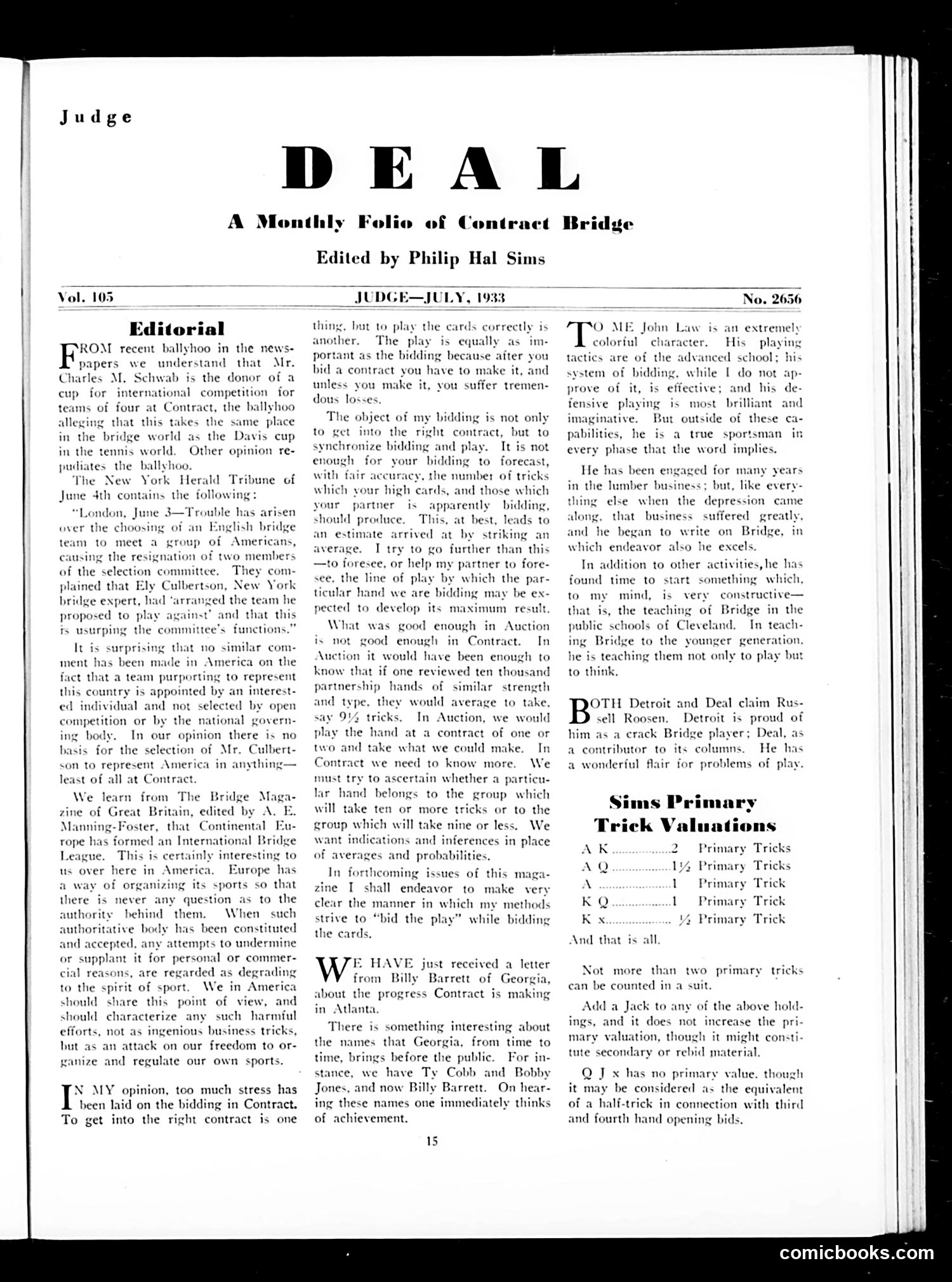
A restored page from Judge, 1933-07. Page through the whole issue in the reader above.
📄 Transcribed text from this page (OCR, searchable)
Machine-transcribed from the original scan — historical spelling and the odd misread are preserved.
Judge Vol fditorial ROM recent ballyhoo in the news- papers we understand that: Mr. Charles M, Schwab is the donor of a cup for international teams of four at Contract, the ballyhoo alleging that this takes the same place world as the Davis cup in the tennis world. Other opinion re- pudiates the ballyhoo. The New York Herald Tribune of June 4th contains the following: competition for in the bridg “London, June 3—Trouble has arisen over the sh bri team to meet a group of Americans, causing the resignation of two members of the selection committee. They com- plained that Ely Culbertson, New York bridge expert, had ‘arranged the team he proposed to 7 and that t fs usurping the committee's funct hoosing of an E y against similar com- ment has been made in America on the fact that a team purporting to represent this country is appointed by an interest- ed individual and not selected by open competition or by the national govern- It is surprisi ing body, In our opinion there is no basis for the selection of Mr. Culbert- son to represent America in anythir least of all at Contract. We learn from The Bridge Maga- zine of Great Britain, edited by A. E. Manning-Foster, that Continental Eu- rope has formed an International Bridge This is certainly interesting to League. us over here in America. Europe has a way of organizing its sports so that there is never any question as to the authority behind them. When such authoritative body has been constituted and accepted, any attempts to undermine or supplant it for personal or commer- cial reasons, are regarded degrading to the spirit of sport. We in America should share this point of view, and should characterize any such harmful efforts, not as ingenious business tricks, but as an attack on our freedom to or- ganize and regulate our own sports. N MY opinion, too much stress has been laid on the bidding in Contract. To get into the right contract is one No. 2656 ling, but to play the cards correctly is The play is equally as im- portant as the bidding because after you bid a contract you have to make it, and unless you make it, you suffer tremen- dous los another, The object of my bidding is not only to get into the right contract, but to synchronize bidding and play. It is not enough for your bidding to f with fair accuracy, which your hi your partner is apparently bidding, should produce. This, at best, leads to an estimate arrived at by striking an average. I try to go further than this —to foresee, or help my partner to fore: ¢. the line of play by which the par- ticular hand we are bidding may be ex- recast, ne number of tricks ards, and those which he se pected to develop its maximum resul What was good enough in is not good enough in Contract. In Auction it would have been enough to know tha reviewed ten thousand partnership hands of similar and type. they would ave say 91% tricks, play ty Auction t if on strength to take, In Auction, we would hand at a contract of one or take what we could make. In Contract we need to know more. We > and must try to ascertain whether a particu- lar hand belongs to the group which will take ten or more tricks or to the group which will take nine or less. We want indications and inferences in place vbilities. of averages and pr In forthcoming issues of this mag zine I shall endeavor to make very clear the manner in which my methods strive to “bid the play” while bidding the cards. HAVE just received a letter from Billy Barrett of Georgia, about the progress Contract is making in Atlanta. There is something interesting about the names that Georgia, from time to time, brings before the public. For in- stance, we have Ty Cobb and Bobby Jones, and now Billy Barrett. On hear- ing these names one immediately thinks of achievement. "Te ME John Law is an extremely coloriul character. His playing tactics are of the advanced scl 901; his system of bidding, while I do not ap- prove of it, is effective; and his de- nsive playing is most brilliant and imaginative. t outside of these ca- pabilities, he is a true sportsman. in every phase that the word implie He has been engaged for many years in the lumber business; but, like every- depression came suffered greatly, n to write on Bridge, in thing else when along, that business and he be which endeavor also he excels. In addition to other activities, he hs found time to start something wh to my mind, very constructive— that is, the ted of Bridge in the public schools of Cleveland. In teach- Bridge to the younger gene he is teaching them not only to play but to think, ich, ation in OTH Detroit and Deal claim Rus- B sell Roosen, Detroit is proud of im as a crack Bridge player; Deal, as a contributor to its columns. He has a wonderful flair for problems of play. Ss Primary Trick Valuations AK 2 Primary Tricks AQ 1% Primary Tricks \ 1 Primary Trick KQ 1 Primary Trick K x 1% Primary Trick And that is all Not more than two primary tricks can be counted in a suit. Add a Jack to any of the above hold- . and it does not increase the pri- mary valuation, thot tute secondar QI]x no primary value. though it may be considered rit might consti- or rebid material. as the equivalent of a half-trick in connection with third and fourth hand opening bids. comicbooks.com