
Judge, 1933-07 · page 14 of 36
Judge — July 1933 — page 14: what you’re looking at
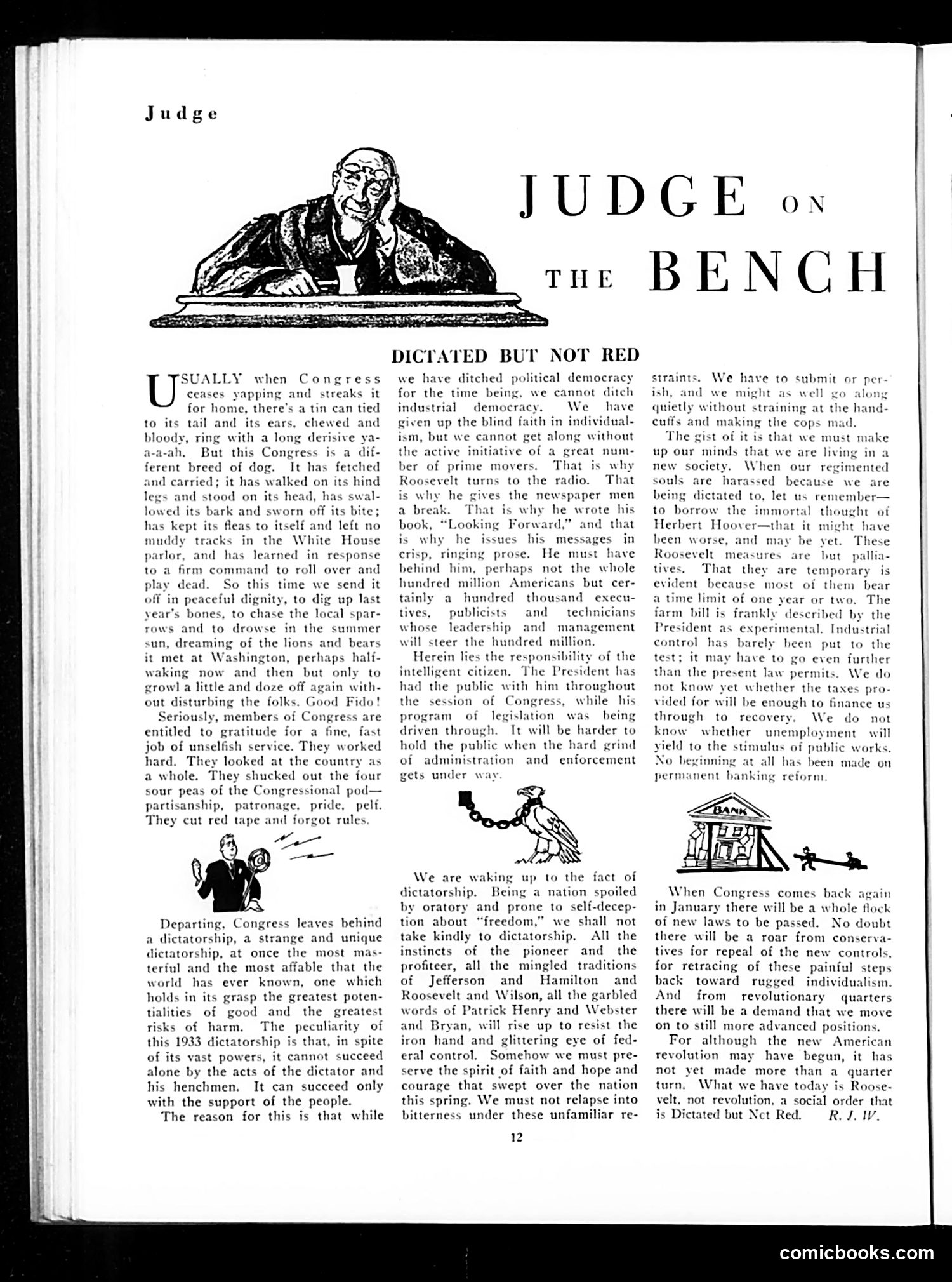
A restored page from Judge, 1933-07. Page through the whole issue in the reader above.
📄 Transcribed text from this page (OCR, searchable)
Machine-transcribed from the original scan — historical spelling and the odd misread are preserved.
UALLY when Congress ceases yapping and aks it for home, there's a tin can tied to its tail and its ears, chewed and bloody, ring with a long derisive y a-a-ah. But this Congress is a dif ferent breed of dog. It has fetched and carried; it has walked on its hind and stood on its head, has sw lowed its bark and sworn off its bite; has kept its fleas to itself and left no muddy tracks in the White House parlor, and has learned in response to a firm command to roll over and play dead. So this time we send it off in peaceful dignity, to dig up last year’s bones, to ¢ leg ¢ the local spar- in the summer sun, dreaming of the lions and bears it met at Washington, perhaps half- waking now and then but only to growl a little and doze off again with- out disturbing the folks. ( Fido! Seriously, members of Congress are entitled to gratitude for a fine, fast job of unselfish service. They worked hard. They looked at the country as a whole. They shucked out the four sour peas of the Congressional pod— partisanship, patronage, pride, pelt. They cut red tape and forgot rules. Departing, Congress leaves behind a dictatorship, a strange and unique dictatorship, at once the most mas- terful and the most able that the world has ever known, one which holds in its grasp the greatest poten- tialities of good and the greatest risks of harm. The peculiarity of this 1933 dictatorship is that, in spite of its vast powers, it cannot succeed alone by the acts of the dictator and his henchmen. It can succeed only with the support of the people. The reason for this is that while to drowse rows and DICFATED BUT NOT RED we have ditched political democracy for the time being, we cannot ditch industrial democracy. We have given up the blind faith in individual- ism, but we cannot get along without the active initiative of reat num- ber of prime movers. That is why Roosevelt turns to the radio, That is why he gives the newspaper men a break. That is why he wrote his book, “Looking Forward,” and that is why he issues his messages in crisp, ringing prose. He must have behind him, perhaps not the whole hundred million Americans but cer- tainly a hundred thousand execu- tives, publi and techni whose leadership and management will steer the hundred million. Herein lies the responsibility of the intelligent citizen, The President has had the public with him throughout the Congress, while his program of was being driven through. It will be harder to hold the public when the hard grind of administration and enforcement gets under way session of legislation wl We are waking up to the fact of dictatorship. Being a nation spoiled by oratory and prone to self-decep- tion about “freedom,” we shall not take kindly to dictatorship. All the instincts of the pioneer and the profiteer, all the mingled traditions of Jefferson and Hamilton and Roosevelt and Wilson, all the garbled words of Patrick Henry and Webster and Bryan, will rise up to resist the iron hand and glittering eye of fed- eral control. Somehow we must pre- serve the spirit of faith and hope and courage that swept over the nation this spring. We must not relapse into bitterness under these unfamiliar re- 12 straints, We have to submit or per- ish. H and we might as well go alc etly without straining at the he cuffs and making the cops mad. The gist of it is that we must make up our minds that we are living in a new society. When our regimente souls harassed we are ictated to, let us remember— to borrow the immortal thought of Herbert Hoover—that it might been worse, and may be Roosevelt measures tives. That they are temporary is evident because a time limit of one year or two. The farm bill is frankly described by the President as experimental. Industrial control has barely been put to the test; it may have to go even further than the present law permits. We do not know yet whether the taxes pro- vided for will be enough to finance us through to recovery. We do not know whether unemployment will yield to the stimulus of public works. No be: because have vet. hese are but pallia- nost of them bear nning at all has been made on When Congress comes back again in January there will be a whole flock of new laws to be passed. No doubt there will be a roar from conserva- tives for repeal of the new controls, for retracing of these painful steps back toward rugged individualism. And from revolutionary quarters there will be a demand that we move on to still more advanced positions. For although the new American revolution may have begun, it has not yet made more than a quarter turn. What we have today is Roose- velt, not revolution, a social order that is Dictated but Net Red. R.JW, comicbooks.com