
Judge, 1933-05 · page 25 of 36
Judge — May 1933 — page 25: what you’re looking at
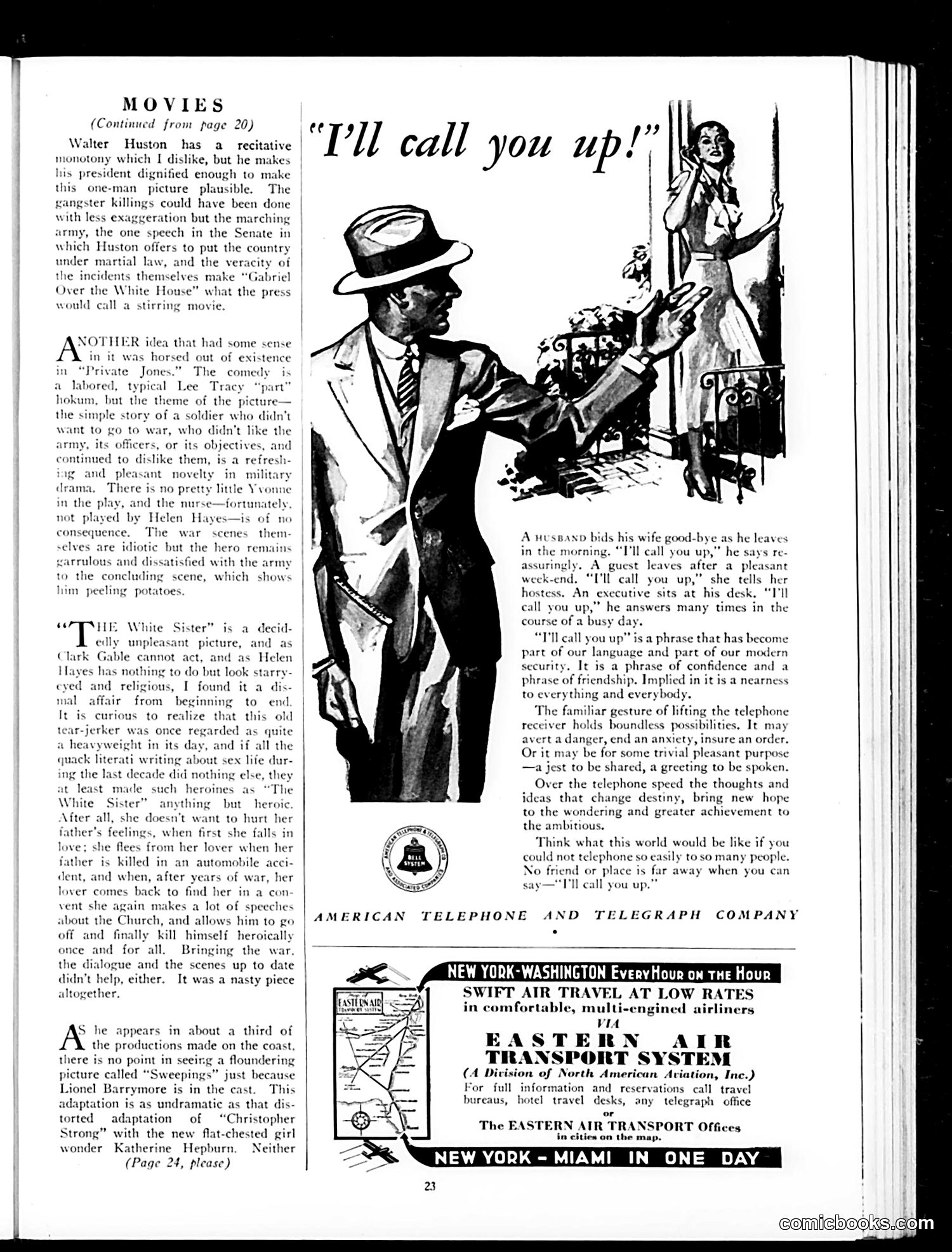
A restored page from Judge, 1933-05. Page through the whole issue in the reader above.
📄 Transcribed text from this page (OCR, searchable)
Machine-transcribed from the original scan — historical spelling and the odd misread are preserved.
MOVIES (Continued from page 20) Walter Huston has a_ recitativ monotony which I dislike, but he makes his president dignified enough to make this one-man picture plausible. The gangster killings could have been done with less exaggeration but the marching army, the one speech in the Senate in which Huston offers to put the country under martial law, and the veracity of the incidents themselves make “Gabriel Over the White House” what the press would call a stirring movie. A YTHER idea that had some sense in it was horsed out of existence “Private Jones.” The comedy is labored, typical Lee Tracy “part” hokum, but the theme of the picture— the simple story of a soldier who didn’t want to go to war, who didn’t like the army, its officers, or its objective continued to dislike them, is a refresh- ing and pleasant novel drama. 1 in military litle Yv lere is no prett ind the nur The war scenes iotic but the hero r garrulous and dissatisfied with t to the concluding scene, which shows him peeling potatoes, ves are A HE White Sister” is a decid- edly unpleasant picture, and as Clark Gable cannot act, and as Helen Hayes has nothing to do but look starry- eyed and religious, I found it a dis- mal air from beginning to end It is curious to realize that this ol erker was once re; rded as qu and if all the J gut sex life dur- ing the last decade did nothing else, they at least made such heroines as “The White Sister” anything but heroic \fter all, she doc iather’s feelings t want to hurt her when first she falls in her lover when her father is killed in an aut dent, and when, after years of war, her back to find her in a con vent she again makes a lot of speeches about the Church, and allows him to go off and finally kill himself heroically once and for all. Bringing the war. the dialogue and the scenes up to date didn’t help, either. It was a nasty piece altogether. A he appears in about a third of the productions made on the coast, there is no point in seeing a floundering picture called “Sweepings” just because Lionel Barrymore is in the cast. This adaptation is as undramatic as that dis- torted adaptation of “Christopher Strong” with the new flat-chested girl wonder Katherine Hepburn. Neither (Page 24, please) love; she flees f rbile acci- lover come AMERICAN TELEPHONE AND TELEGRAPH COMPANY A nussanp bids his wife good-bye as he leaves in the morning. “T'll call you up,” he sa assuringly. guest leaves after a pl week-end. “I'll call you up,” she tells her hostess. An utive sits at his desk. “I'll call you up,” he answers many times in the course of a busy day. “T'll call you up phrase that has become part of our language and part of our modern security. It is a phrase of confidence and a phrase of friendship. Implied in it i: to everything and everybody. The familiar gesture of lifting the telephone receiver holds boundless possibilities. It may avert a danger, end an anxiety, insure an order. Or it may be for some trivial pleasant purpose a jest to be shared, a greeting to be spoken. nearness Over the telephone speed the thoughts and ideas that change destiny, bring new hope to the wondering and greater achievement to the ambitious. Think what this world would be like if you could not telephone so easily to so many people. No friend or place is far away when you can say—"T'll call you up.” ya NEW YORK-WASHINGTON EvervHour on THe Hour = SWIFT AIR TRAVEL AT LOW RATES 23 in comfortable, multi-en VIA EASTERN AIR TRANSPORT SYSTEM (A Division of North American Aviation, Inc.) For full information and reservations call travel bureaus, hotel travel desks, any telegraph office ned airliners or The EASTERN AIR TRANSPORT Offices comichbooks.ceyy)