
Judge, 1933-05 · page 17 of 36
Judge — May 1933 — page 17: what you’re looking at
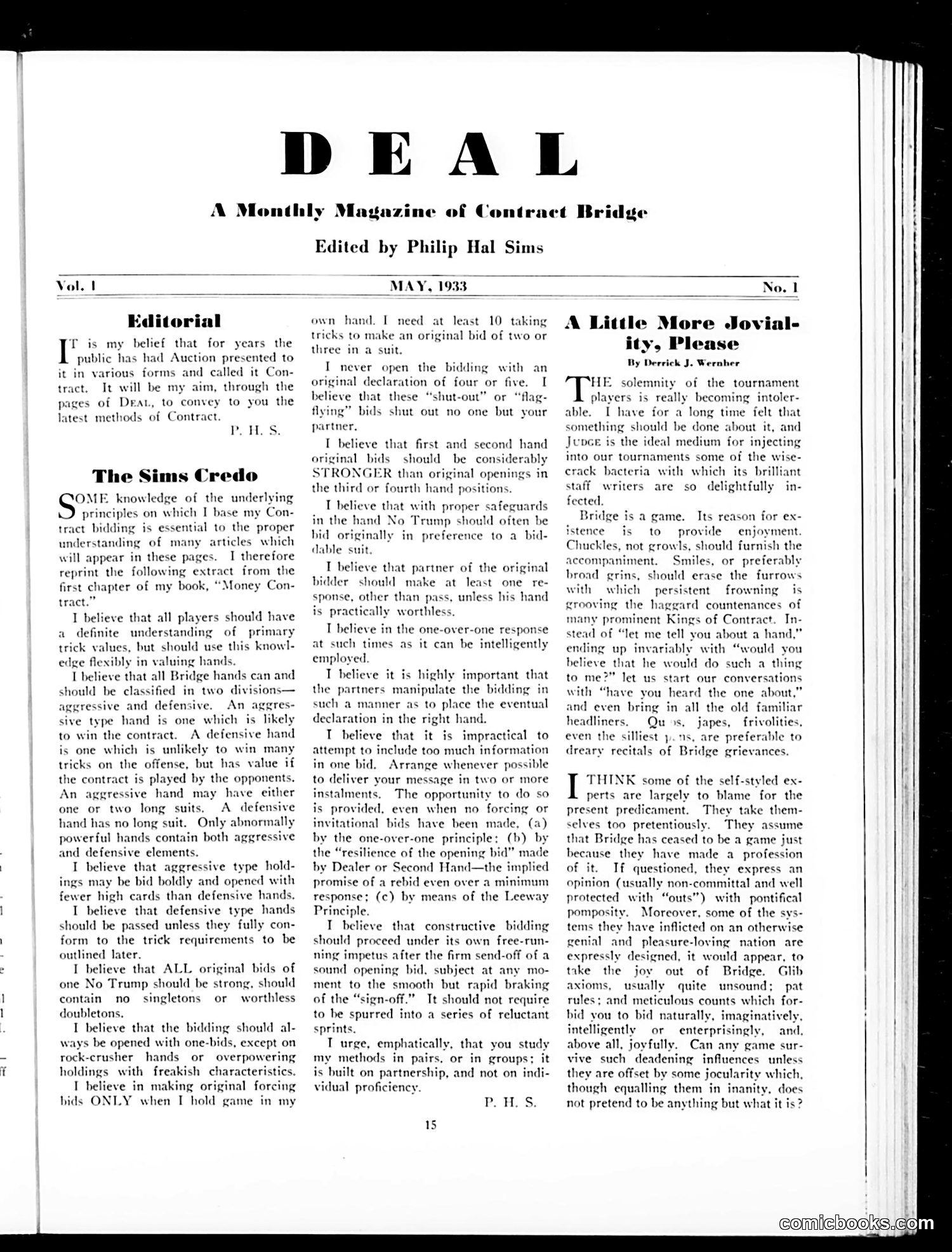
A restored page from Judge, 1933-05. Page through the whole issue in the reader above.
📄 Transcribed text from this page (OCR, searchable)
Machine-transcribed from the original scan — historical spelling and the odd misread are preserved.
DEAL A Monthly Maga Vol. of Contri Edited by Philip Hal Sims t Brid MAY, 1 No. 1 Editorial f is my belief that for years the I public has had Auction presented to it in various forms and called it Con- tract. It will be my aim, through the pages of Dean, to convey to you the latest methods of Contract. The Sims Credo OME knowledge of the underlying principles on which I base my Con- tract bidding is essential to the proper understanding of many articles which will appear in these pages. I therefore reprint the following extract from the first chapter of my book, “Money Con- tract.” I believe that all players should have a definite understanding of primary trick values, but should use this knowl- edge flexibly in valuing hands. I believe that all Bridge hands can and should be classified in two divisions— aggressive and defensive. An aggres- sive type hand is one which is likely to win the contract. A defensive hand is one which is unlikely to win many tricks on the offense, but has value if the contract is played by the opponents. An aggressive hand may have either one or two long suits. A defensive hand has no long suit. Only y powerful hands contain both aggressive and defensive elements. I believe that aggressive type hold- ings may be bid boldly and opened with fewer high cards than defensive hands, I believe that defensive type hands should be passed unless they fully con- form to the trick requirements to be outlined later. I believe that ALL original bids of one No Trump should be strong, should contain no singletons or worthless doubletons. I believe that the bidding should al- ways be opened with one-bids, except on rock-crusher hands or overpowering holdings with freakish characteristics. I believe in making original forcing bids ONLY when T hold game in my own hand. IT need at least 10. taking tricks to make an original bid of two or three in a suit. I never open the bidding with an original declaration of four or five. I believe that these “shut-out” or “flag- flying” bids shut out no one but your partner, I believe that first and second hand original bids should be considerably STRONGER than original openings in the third or fourth hand positions. T believe that with proper safeguards in the hand No Trump should often be hid originally in preference to a bid- dable suit I believe that partner of the original bidder should make at least one sponse, other than pass, unless his hand is practically worthless T believe in the one-over-one response at such times as it can be intelligently employed. T believe it is highly important that the partners manipulate the bidding in such a manner as to place the eventual declaration in the right hand. T believe that it is impractical to attempt to include too much information in one bid. Arrange whenever possible to deliver your message in two or more instalments. The opportunity to do so is provided, even when no forcing or invitational bids have been made, (a) by the one-over-one principle; (b) by the “resilience of the opening bid” made by Dealer or Second Hand—the implied promise of a rebid even over a minimum response; (c) by means of the Leeway Principle. I believe that constructive bidding should proceed under its own free-run- ning impetus after the firm send-off of a sound opening bid, subject at any mo- ment to the smooth but rapid braking of the “sign-off.” Tt should not require to be spurred into a series of reluctant sprints. T urge, emphatically, that you study my methods in pairs, or in groups; it is built on partnership, and not on indi- vidual proficiency. P. H. S. 15 A Little More Jovial- By Derrick J. Wernher solemnit HE of the tournament players is really becoming intoler- able. I have for a long time felt that something should be done about it, and Jupce is the ideal medium for injecting into our tournaments some of the wise- crack bacteria with which its brilliai i writers are so delightfully in- feeted. 3ridge is a game. istence is to Chuckle: accomp Its reason for ex- provide enjoyment not growls, should furnish the iment. Smiles, or preferably broad ¢ should erase the furrows with which persistent frowning is grooving the haggard countenances of many prominent Kings of Contract. In- stead of “let me tell you about a hand,” ending up invariably with “would you believe that he would do such a thing to me?” let us start our conversations with “have you heard the one about,” and even bring in all the old familiar headliners. Qu os, japes, frivolities, even the silliest p. ns, are preferable to dreary recitals of Bridge grievances. I THINK some of the self-styled ex- perts are largely to blame for the present predicament. They take them- selves too pretentiously. They assume that Bridge has ceased to be a game just because they have made a_ profession of it. If questioned, they express an opinion (usually non-committal and well protected with “outs”) with pontifical pomposity. Moreover, some of the sys- tems they have inflicted on an otherwise genial and pleasure-loving nation are expressly designed, it would appear, to take the joy out of Bridge. Glib axioms, usually quite unsound; pat rules; and meticulous counts which for- bid you to bid naturally, imaginatively, intelligently or enterprisingly, and, above all, joyfully. Can any game sur- vive such deadening influences unless they are offset by some jocularity which, though equalling them in inanity, does not pretend to be anything but what it is? comichooks.coly)