
Judge, 1933-05 · page 14 of 36
Judge — May 1933 — page 14: what you’re looking at
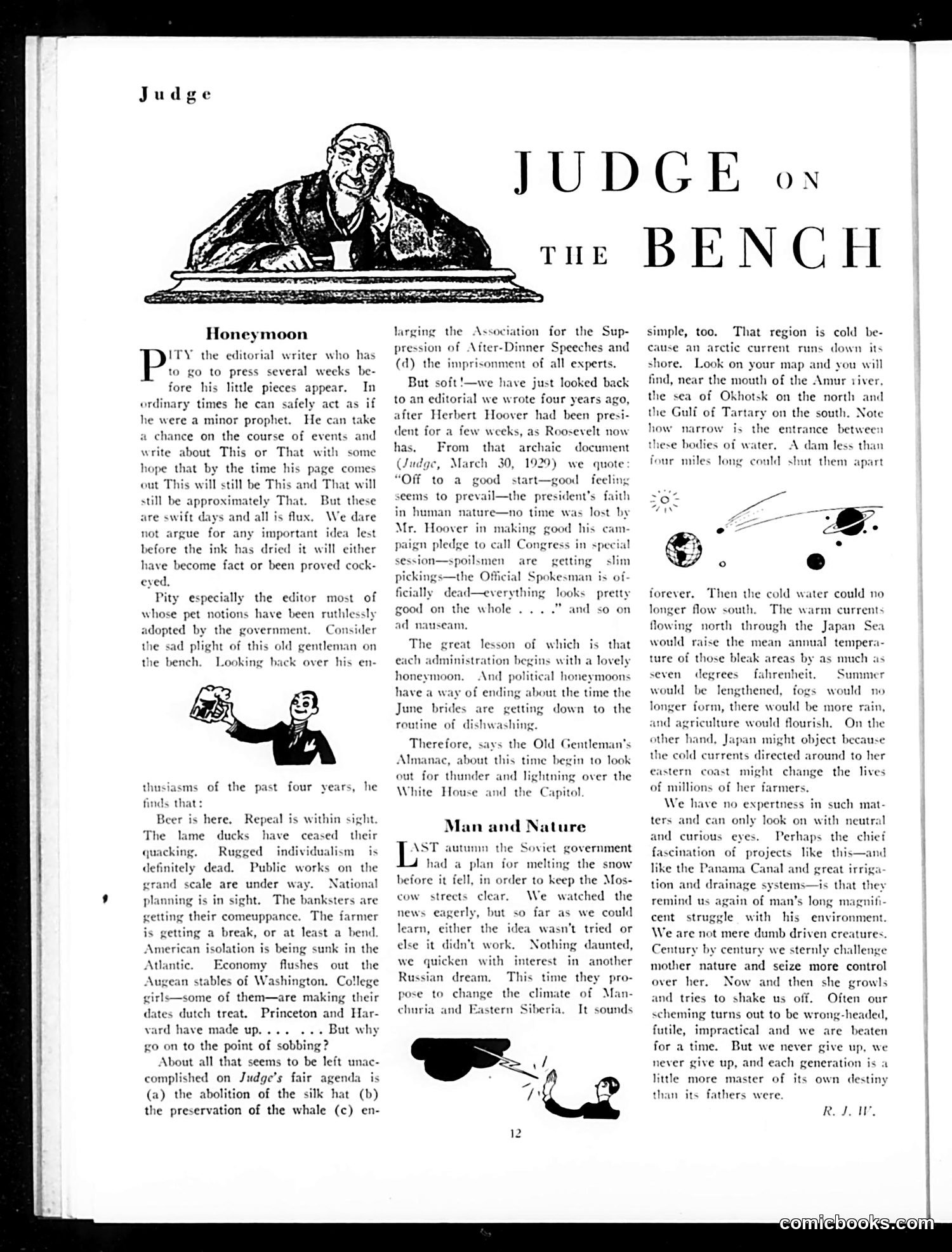
A restored page from Judge, 1933-05. Page through the whole issue in the reader above.
📄 Transcribed text from this page (OCR, searchable)
Machine-transcribed from the original scan — historical spelling and the odd misread are preserved.
Judge Honeymoon ITY the editorial writer who has P: go to press several weeks be- ore his little pieces appear. In ordinary times he can safely act as if he were a minor prophet. He can take a chance on the course of events and write about This or That with some hope that by the time his page comes out This will still be This and That will still be approximately That. But these € swift days and all is flux, We dare ot argue for any important idea lest before the ink has dried it will either have become fact or been proved cock- eyed, Pity especially the editor most of whose pet adopted by the governm tions have been ruthle: ent. Consider the sad plight of this old gentleman on the bench. Looking back over his en- thusiasms of the past four years, he i that: 3cer is here, Repeal is within sight t. sed their The lame ducks have cea quacking. Rugged individualism is definitely dead. Public works on the grand scale are under way. planning is in sight. The banksters are getting their comeuppance. The tional armer is getting a break, or at least a bend. American isolation is being sunk in the Atlantic. Zconomy flushes out the Augean stables of Washington. College girls—some of them—are making their dates dutch treat. Princeton and Hz vard have made up.... ... But why go on to the point of sobbing? About all that seems to be left unac- complished on Judge’s fair agenda is (a) the abolition of the silk hat (b) the preservation of the whale (c) en- larging the Association for the Sup- pression of After-Dinner Speeches and (d) the imprisonment of all experts. But soft!—we have just looked back to an editorial we wrote four years ago, after Herbert Hoover had been presi- dent for a few weeks, as Roosevelt now From that archaic document (Judge, March 30, 1929) we quote “Off to a good start—good feel seems to prevail— has. lent’s faith he pres: in human nature—no time was lost by Mr. Hoover in making good his cam- ign pledge to call Co ess in special ion—spoilsmen are getting slim —the Official Spokesman is of ficially dead—everything loc pretty and so on good on the whole... .” ad nauseam, The great lesson of which is that each administration begins with a lovely honeymoon. And political honeymoons have a way of ending about the time the June brides are gettir i down to the routine of dishwashing. Therefore, says the Old Gentleman's Almanac, about this time begin to look out for thunder and lightning over the White House and the Capitol Man and Nature AST autumn had a plan for melting the snow before it fell, in order to keep the Mos- cow strects clear. We watched the news eagerly, but so far as we could her the idea wasn’t tried or else it didn’t work. Nothing daunted, we quicken with interest in another Russian dream. This time they pro- pose to change the climate of Man- churia and ¢ Soviet government learn, e tern Siberia. It sounds simple, too, That region is cold be- cause an arctic current runs down its shore. Look on your map and you will find, near the mouth of the Amur river, the sea of Okhotsk on the north and the Guli of Tartary on the south. Note how narrow is the entrance between these bod: A dam less than four miles long could shut them apart es of water, forever. Then the cold water could no longer flow south. The warm currents flowing north through the Japan Sea would raise the mean annual tempera- ture of those bleak areas by as much as Summer seven degrees fahrenheit. would be lengthened, fogs would longer form, there would be more rain, and agriculture would flourish. On the other hand, Japan might object because the cold currents directed around to her eastern coast might change the lives of mil ions of her farmers. We have no expertness in such mat- ters and can only look on with neutral and curious eyes. Perhaps the chief fascination of projects like this—and like the Panama Canal and great irriga tion and d: that they remind us again of man’s long magnifi- cent struggle with his environment. We are not mere dumb driven creature Century by century we sternly challenge mother nature and seize more control over her. Now and then she growls and tries to shake us off. Often our scheming turns out to be wrong-headed, futile, impractical and we are beaten for a time. But we never give up, we never give up, and each generation is « little more master of its own destiny ze systems than its fathers were. Rude We