
Judge, 1933-05 · page 10 of 36
Judge — May 1933 — page 10: what you’re looking at
What you’re looking at
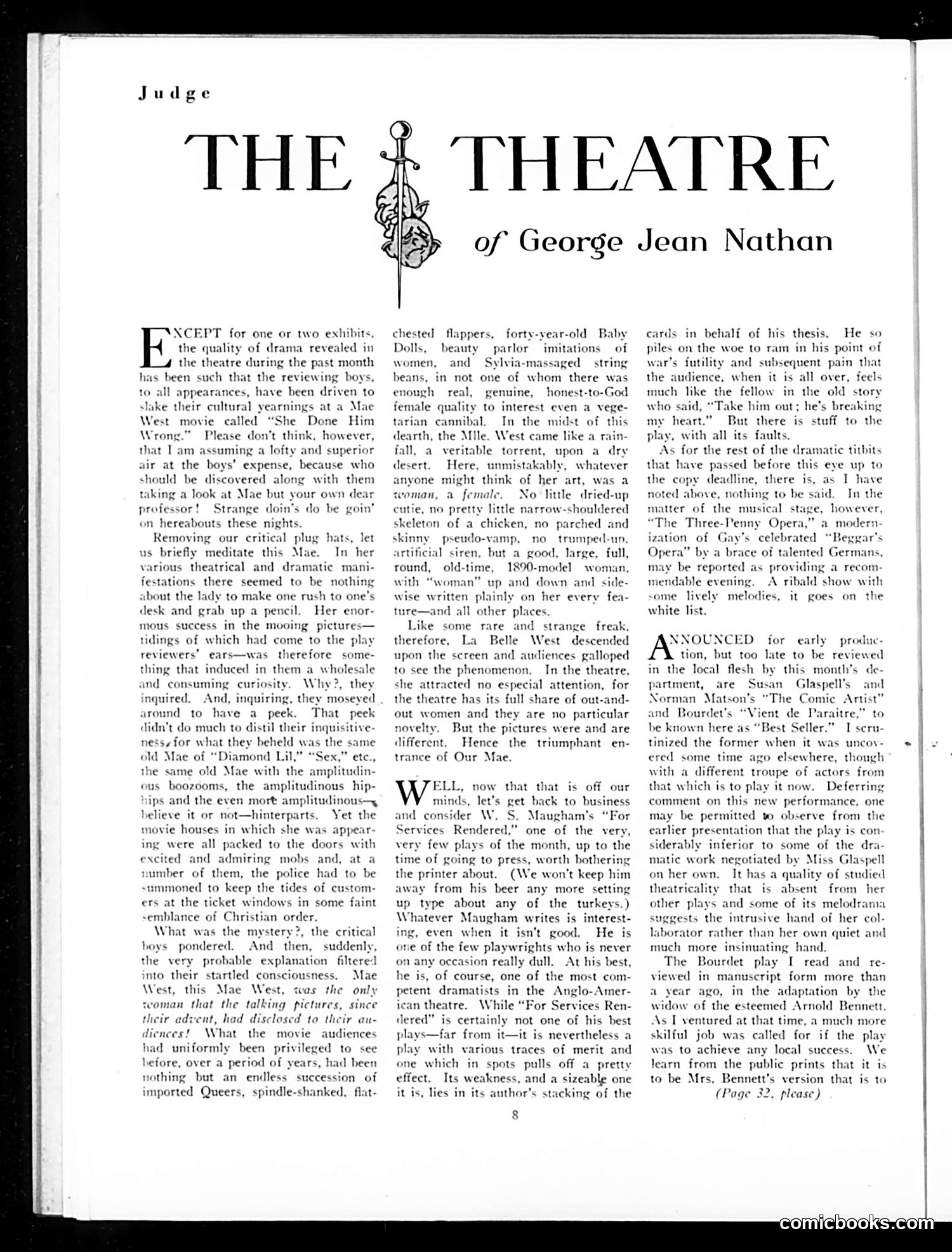
# Analysis of Judge Magazine Page This page is primarily a theater review essay, not a political cartoon. The critic discusses Mae West's surprising success in movies versus theater, attributing it to her representing authentic femininity—a "woman, a female"—in contrast to the "imported Queers, spindle-shanked, flat-chested flappers" and artificial actresses dominating cinema. The satire targets 1930s film industry aesthetics: the critic argues audiences flocked to West's films precisely *because* she embodied conventional womanly curves and presence, unlike the prevailing trend of androgynous or overly stylized female performers. The tone is tongue-in-cheek but suggests genuine puzzlement at this popularity gap between her theatrical and film appearances. The second half reviews W.S. Maugham's play "For Services Rendered," praising his consistent quality as a playwright. The ornamental column divider and period typography are typical Judge magazine design elements.
📄 Transcribed text from this page (OCR, searchable)
Machine-transcribed from the original scan — historical spelling and the odd misread are preserved.
XCEPT for one or two exhibits, the quality of drama revealed in the theatre during the past month has been such that the reviewing boys, all appearances, have been driven to slake their cultural yearnings at a Mae West movie called “She Done Him Wrong.” Please don’t think, however, that Lam assuming a lofty and superior air at the boys’ expense, because who should be discovered along with them taking a look at Mae but your own de professor! Strange doin’s do be on hereabouts these nights. Removing our critical plug hats, let us briefly meditate this Mae. In her various theatrical and dramatic mani- stations there seemed to be nothing about the lady to make one rush to one’s desk and grab up a pencil. Her enor- mous success in the mooing pictures— tidings of which had come to the play reviewers’ ears—was therefore some- thing that induced in them a wholesale and consuming curiosity. Why?, they inquired. And, inquiring, they moseyed around to have a peek. That peek didn’t do much to distil their inquisitive- ness, for what they beheld was the same old Mae of “Diamond Lil,” “Sex,” ete., the same old Mae with the amplitudin- ous boozooms, the amplitudinous hip- ips and the.even mort amplitudinous—_ believe it or not—hinterparts. Yet the movie houses in which she was appear- ing were all packed to the doors with excited and admiring mobs and, at a number of m, the police had to be summoned to keep the tides of custom- ers at the ticket windows in some faint semblance of Christian order. What was the mystery ?, the critical boys pondered. And then, suddenly, the very probable explanation filtered into their startled consciousness, Mae West, this ™ West, was the only jan that the talking pictures, since their advent, had disclosed to their au- diences!’ What the movie audiences had uniformly been privileged to see hefore, over a period of years, had been nothing but an endless succession of imported Queers, spindle-shanked, flat- of George chested flappers, forty-year-old Baby Dolls, beauty parlor imitations of women, and Sylvi massaged — string beans, in not one of whom there was to-God female quality to interest even a vege- tarian cannibal. In the midst of this dearth, the Mlle. West came like a rain- fall, a veritable torrent, upon a dry desert. Here, unmistakably, whatever anyone might think of her art, was a woman, a female, No little dried-up cutie, no pretty little narrow-shouldered skeleton of a chicken, no parct skinny artificial siren, but a good, large, full, round, old-time, 1890-model woman, with “w up and down and side- wise written plainly on her every fea- ture—and all other places. Like some rare and strange freak, therefore, La Belle West descended upon the screen and audiences galloped to see the phenomenon. In the theatre, she attracted no especial attention, for the theatre has its full share of out-and- out women and they are no particular novelty. But the pictures were and are different. Hence the triumphant en- trance of Our Mae. enough real, genuine, hon ed and eudo-vamp, no trumped-un. an ELL, now that that is off our minds, let’s get back to business. and consider W. S. Maugham's “For Services Rendered,” one of the very, very few plays of the month, up to the time of going to press, worth bothering the printer about. (We won't keep him away from beer any more setting up type about any of the turkeys.) Whatever Maugham writes is interest- ing, even when it isn’t good. He is one of the few playwrights who is never on any occasion really dull. At his best, he is, of course, one of the most com- petent dramatists in the Anglo-Amer- ican theatre. While “For Services Ren- dered” is certainly not one of his best plays—far from it—it is nevertheless a y with various traces of merit and one which in spots pulls off a pretty effect. Its weakness, and a sizeable one it is, lies in its author’s stacking of tl 8 THEATRE Jean Nathan cards in behalf of his the He so piles on the woe to ram in his point of war’s futility and subsequent pain that the audience, when it is all over, feels much like the fellow in the old story who said, “Take him out; he’s breaking my heart But there is stuff to the pl with all its faults. As for the rest of the dramatic tithits that have passed before this eye up to the copy deadline, there is, as I have noted above, nothing to be said. In the matter of the musical st he Three-Penny Ope ion of Gay's celebrated Opera” by a brace of talented Germans, may be reported as providing a recom- mendable evening. A ribald show with some lively melodies, it goes on the white list. e, however, NNOUNCED for early produc- tion, but too late to be reviewed in the local flesh by this month’s de- partment, are Susan Glaspell’s and Norman Matson’s “The Comic Artist” and Bourdet’s “Vient de Paraitre,” to be known here as “Best Seller.” I seru- tinized the former when it was uncov- ered some time ago elsewhere, though with a different troupe of actors fre that which is to play it now. Deferri comment on this new performance, one may be permitted wo observe from the earlier presentation that the play is con siderably inferior to some of the dra- matic work negotiated by Miss Glaspell on her own. It a quality of studied theatricality that is absent from her other plays and some of its melodrama suggests the intrusive hand of her col- laborator rather than her own quiet and much more insinuating hand. The Bourdet pl: I read and re- viewed in manuscript form more than a year ago, in the adaptation by the widow of the esteemed Arnold Bennett. As I ventured at that time, a much more skilful job was called for if the p! was to achieve any local success. We learn from the public prints that it to be Mrs. Bennett’s version that is to (Page 32, please)