
Judge, 1933-04 · page 16 of 36
Judge — April 1933 — page 16: what you’re looking at
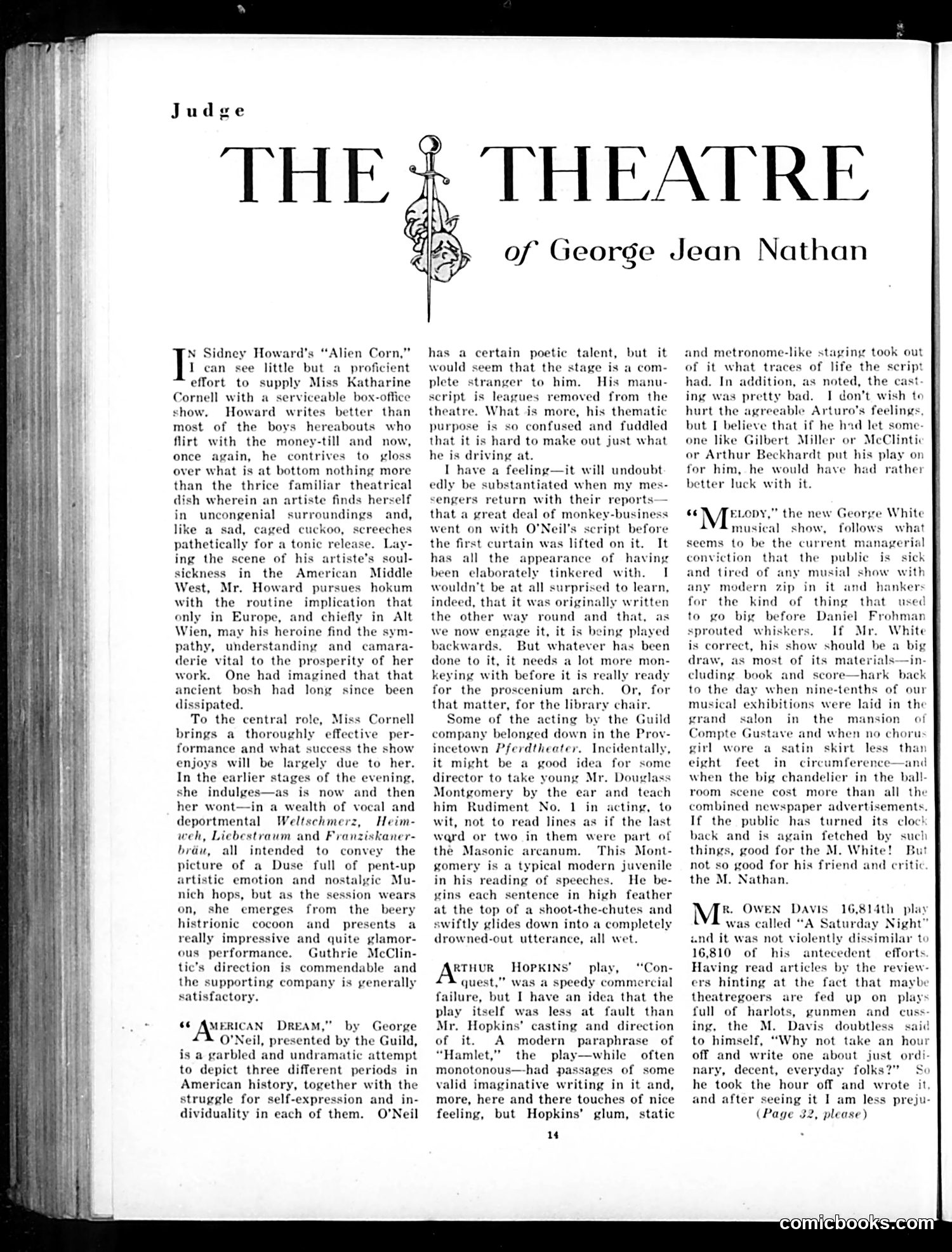
A restored page from Judge, 1933-04. Page through the whole issue in the reader above.
📄 Transcribed text from this page (OCR, searchable)
Machine-transcribed from the original scan — historical spelling and the odd misread are preserved.
THE I can see little but a proficient effort to supply Miss Katharine Cornell with a se able box-office show. Howard writes better than most of the boys hereabouts who flirt with the money-till and now, once in, he contrives to gloss over what is at bottom nothing more than the thrice familiar theatrical dish wherein an artiste finds herself in uncongenial surroundings and, like a sad, caged cuckoo, screeches pathetically for a tonic rel Lay- ng the scene of his a 's_soul- sickness in the Ame Middle West, Mr. Howard pursues hokum with the routine implication that only in Europe, and chiefly in Alt Wien, may his heroine find the sym- pathy, understanding and camara- derie vital to the prosperity of her work. One had imagined that that ancient bosh had long since been dissipated. To the central role, Miss Cornell brings a thoroughly effective per- formance and what success the show enjoys will be largely due to her. In the earlier stages of the evening, she indulges—as is now and then her wont—in a wealth of vocal and deportmental Welftschmerz, Heim- weh, Liebestraum and Franziskaner- braéu, all intended to convey the picture of a Duse full of pent-up artistic emotion and nostalgic Mu- nich hops, but as the session wears on, she emerges from the beery h ionic cocoon and presents a really impressive and quite glamor- ous performance. Guthrie McClin- tic’s direction is commendable and the supporting company is yenerally satisfactory. ji Sidney Howard's “Alien Corn. 66 AMERICAN DREAM,” by George O'Neil, presented by the Guild, is a garbled and undramatic attempt epict three different periods in can history, together with the struggle for self-expression and i dividuality in each of them. O'Neil THEATRE of George Jean Nathan has a certain poetic talent, but it would seem that the stage is a com- plete stranger to him. His manu- script is leagues removed from the theatre. What is more, his thematic purpos so confused and fuddled that it is hard to make out just what he is driving at. I have a feeling—it will undoubt edly be substantiated when my mes- sengers return with their reports— that a great deal of monkey-business went on with O’Neil’s script before the first curtain was lifted on it. It has all the ance of having been elabor: <ered with. I wouldn't be at all surprised to learn, indeed, that it was originally written the other way round and that, as we now engage it, it is being played backwards. But whatever has been done to it, it needs a lot more mon- keying with before it is really ready for the proscenium arch. Or, for that matter, for the library chair. Some of the acting by the Guild company belonged down in the Prov- incetown Pferdtheater. Incidentally, it might be a good idea for some director to take young Mr. Douglass Montgomery by the ear and teach him Rudiment No. 1 in acting, to wit, not to ad lines as if the last ward or two in them we part of the Masonic arcanum. This Mont- gomery is a typical modern juvenile in his reading of speeches. He be- wins each sentence in high feather the top of a shoot-the-chutes and swiftly glides down into a completely drowned-out utterance, all wet. RTHUR HOPKINS’ play, ‘“Con- quest,” was a speedy commercial failure, but I have an 2 that the less at fault than Hopkins’ casting and direction it. A modern raphrase of “Hamlet,” the often monotonous—h valid imaginative writing in it and, more, here and there touches of nice feeling, but Hopkins’ glum, static 14 and metronome-like staging took out of it what traces of life the script had. In addition, as noted, the cast ing was pretty bad. I don’t wish to hurt the ag ble Arturo’s feelings, but I believe that if he had let some- one like Gilbert Miller or MeClintic or Arthur Beckhardt put his play on for him, he would have had rather better luck with it. “N ELopY,” the new George White musical show, seems to be the curr conviction that the public i and tired of any musial show any modern zip in it and hanke: for the kind of thing that used to go big before Daniel Frohman sprouted whiskers. If Mr. White is correct, his show should be a big draw, as most of its material n- cluding book and score—hark back to the day when nine-tenths of our musical exhibitions were laid in the grand salon in the mansion of Compte Gustave and when no chorus girl wore a satin skirt than eight feet in’ circumference—and when the big chandelier in the ball- room scene cost more than all the combined newspaper advertisements. If the public has turned its cloc back and is again fetched by such things, good for the M. White! But not so good for his friend and critic. the M. Nathan. less Davis 16,814th play led “A Saturday Night” s not violently dissimilar to 16,810 of his antecedent efforts Having read articles by the review- ers hinting at the fact that maybe theatregoers are fed up on pl full of harlots, gunmen and_ cuss- ing, the M. Davis doubtless to himself, “Why not take an hour off and w one about just ordi- nary, decent, everyday folks?” So he took the hour off and wrote it and after seeing it I am less preju- (Page 32, please)