
Judge, 1932-07 · page 16 of 36
Judge — July 1932 — page 16: what you’re looking at
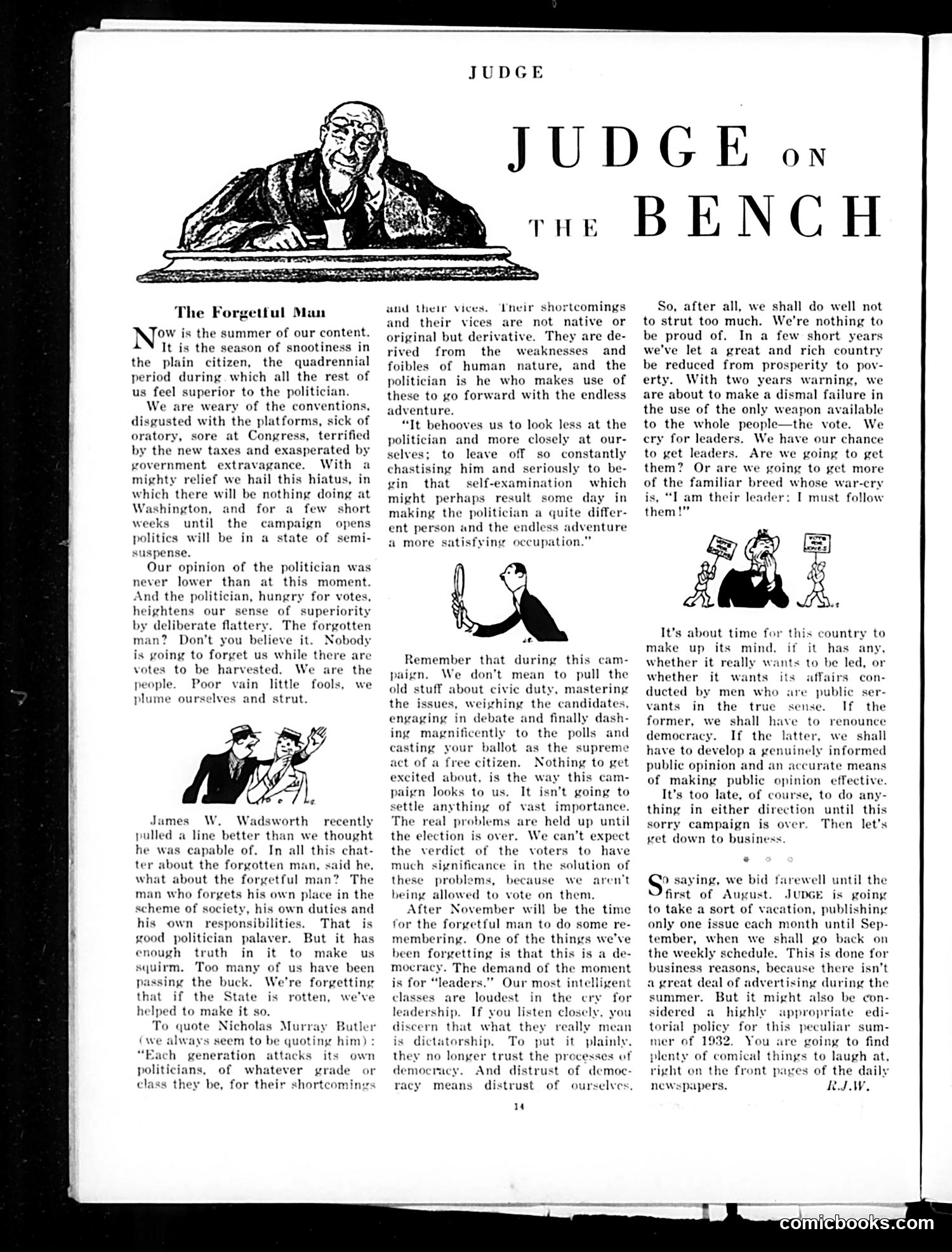
A restored page from Judge, 1932-07. Page through the whole issue in the reader above.
📄 Transcribed text from this page (OCR, searchable)
Machine-transcribed from the original scan — historical spelling and the odd misread are preserved.
The Forgettul Man ‘ow is the summer of our content. It is the season of snootiness in the plain citizen, the quadrennial period during which all the rest of us feel superior to the politician. We weary of the conventions, disgusted with the platforms, sick of oratory at Congress, terrified by the new taxes and exasperated by yovernment extravagance With a mighty relief we hail this hiatus, in which there will be nothing doing at Washington, and for a few short weeks until the campaign opens politics will be in a state of semi- suspense. Our opinion of the politician was never lower than at this moment. And the politician, hungry for votes, heightens our sense of superiority by deliberate flattery. The forgotten man? Don’t you believe it. Nobody is going to forget us while there are votes to be harvested. We are the people. Poor vain little fools, we plume ourselves and strut. James W. Wadsworth — recently pulled a line better than we thought he was capable of. In all this chat- ter about the forgotten man, said he, what about the forgetful man? The man who forgets his own place in the scheme of society, his own duties and his own responsibilities. That is sood politician palaver. But it has enough truth in it to make us squirm. Too many of us have been passing the buck. We're forgetting that if the State is rotten, we've helped to ma it so. cholas Murray Butler Iways seem to be quoting: him): ch generati attacks its own politicians, of w ver grade or cla y be, for their shortcomi UDGE on re BENCH and their Mneir shortcomings and their vices are not native or original but derivative. They are de- rived from the weaknesses and foibles of human natur nd the politician is he who m s use of these to go forward with the endless adventure. “It behooves us to look less at the politician and more closely at our- selve to leave off so constantly chastising him and seriously to be- gin that self-examination which might perhaps result some day in making the politician a quite differ- ent person and the endless adventure a more satisfying occupation.” “ Remember that during this cam- paign. We don’t mean to pull the old stuff ¢ duty, mastering the iss hing the candidates, and finally da: ing magnificently to the polls and casting your ballot as the supreme act of a free citizen. Nothing to get excited about, is the way this cam- paiyn looks to us. It isn’t going to settle anything of vast importance. The r problems are held up until the election is over. We can’t expect the verdict of the voters to have much significance in the solution of these problems, because we aren't being allowed to vote on them, After November will be the time for the forgetful man to do some re- membering. One of the things we've been forgetting is that this is a de- mocracy. The demand of the m is for ders.” Our most inte classes are loudest in the cry for leadership. If you listen closely, you discern that what they really mean is dictatorship. To put it plainly, they no lonver trust the processes of democracy. And distrust of democ- racy means distrust of ourselves. 4 So, after all, we shall do well not to strut too much. We're nothing to be proud of. In a few short years we've let a great and rich country be reduced from prosperity to pov- erty. With two years ming, we are about to make a dismal failure in the use of the only weapon available to the whole people—the vote. We cry for leaders. We have our chance to get leade Are we going to get them? Or are we going to get more of the familiar breed whose war-cry is, “I am their leader: I must follow them! It’s about time for this country to make up its mind. if it has any, whether it really wants to be led, or whether it wants its affairs con- ducted by men who are public se vants in the true sense. If the former, we shall have to renounce If the latter, we shall have to develop a yenuinely informed public opinion and an accurate means of making public opinion effective. , of course, to do any- thing in either direction until this sorry campaign is over. Then let’s set down to business. * S saying, we bid farewell until the st of August. JUDGE is going to take a sort of vacation, publishing only one issue each month until Sep- tember, when we shall go back on the weekly schedule. This is done for business reasons, because there isn’t a great deal of advertising during the summer. But it might also be con- sidered a highly appropriate edi- torial policy for this peculiar sum- mer of 198 You are going to find plenty of cor things to laugh at right on the front pages of the d; newspapers. RAW.